
 The Specialty News
Google's TPU 8i Max Packs Twice the Compute Into the Same Rack
Its sibling, TPU 8tx, keeps data and model weights protected even mid-calculation, making 2026 the first year Google has introduced four TPU systems.
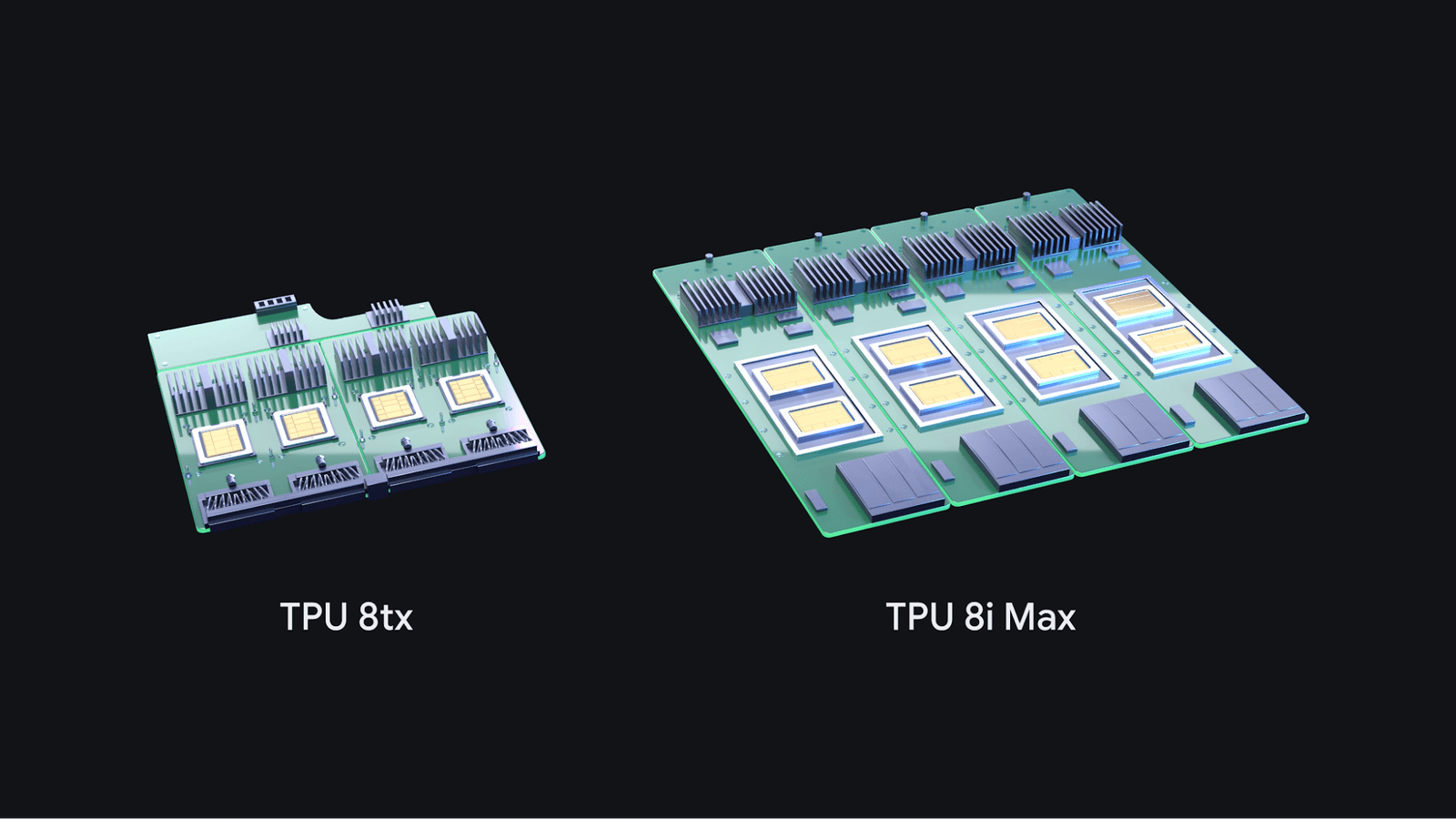
Google took two of its newest AI chips, mounted them on a single package and slid the result into a rack the same size as before. The system, TPU 8i Max, announced on Monday, delivers twice the compute, on-chip memory and memory bandwidth of the TPU 8i it is built from. It arrives alongside TPU 8tx, built for regulated companies and governments, which keeps data protected even while the chip is working on it. Together they make 2026 the first year Google has introduced four TPU systems, in more than a decade of building its own AI chips.
Two Chips, One Package, the Same Rack
The 8i Max targets what engineers call the memory wall. When dozens of AI agents work through an entire software codebase, or a model takes in hours of video at once, processors spend more time waiting for data than doing math. Google's fix was to fuse two low-latency TPU 8i chips onto one package so that compute and memory grow together, “in lockstep” as Google puts it, and large jobs do not stall.
The 8i was already built around memory. When Google introduced it at its Cloud Next conference in April, each chip carried 288 GB of high-bandwidth memory and 384 MB of SRAM, the small, very fast memory that sits on the chip itself, three times the SRAM of the previous generation. The 8i Max builds on that by pairing the chips inside each package.
Density is the part data center operators will notice first. Because the 8i Max fits more silicon into the existing rack footprint, Google says customers can deploy significantly more computing power per square foot and per watt. New data centers take years to build and connect to the grid, so squeezing more work out of the same space is a little like adding a second floor to a house without buying more land.
The second system answers a different question: what happens to secret data at the exact moment an AI model reads it?
TPU 8tx Keeps Secrets Even Mid-Calculation
Data is usually encrypted when it is stored or sent across a network, yet it has to be unlocked in memory while it is being processed. Some highly regulated customers, Google says, asked for specialized encryption for exactly that moment. TPU 8tx builds the protection into the hardware, keeping sensitive data and model weights protected and isolated even while in active use.
Under the hood it uses the same silicon as TPU 8t, Google's training chip, paired with 5th Generation AMD EPYC processors as hosts. It also borrows Boardfly, the low-latency network Google designed for the 8i, which gives the 8tx up to 2x lower latency than the TPU 8t with what Google calls a near-zero performance penalty. That matters for agents that take many small steps in a row.
The benefit is practical. A bank, a hospital group or a government agency could fine-tune a model on its private records, distill a large model into a smaller one and train its agents through reinforcement learning on a single system, without migrating sensitive data between separate clusters. Every copy of the data that never gets made is one less place that needs guarding.
How does a company ship two new systems seven months after the last two? The answer is a distinction most people never think about.
Why Google Can Ship Four TPU Systems in Seven Months
A new chip and a new system are different things. Designing a chip means laying out billions of transistors on a silicon wafer, a process that takes years. A system is everything around the chip: packaging, high-speed memory, optical networking, security. When Google built its first TPU more than a decade ago, it bet that AI software would change faster than silicon manufacturing, so it made its TPUs modular building blocks. That bet now lets it deliver specialized supercomputers in months rather than years.
“This is the first time we have introduced four TPU systems in a single year.”— Amin Vahdat, Google
The customers are there to use them. Google says TPUs are now a rapidly growing business with nearly 100 customers, including frontier labs, trading firms, retailers and universities. Anthropic, the maker of Claude, announced in October 2025 that it would expand to as many as one million TPUs, a deal it said was worth tens of billions of dollars.
The software is opening up as well. Last month Google open-sourced TorchTPU, so PyTorch code and Hugging Face models run natively on TPUs, and a new open-source TPU agent suite, now in preview, plugs into coding tools such as Claude Code, Cursor and Google Antigravity to tune code in plain language. Google says its new TPU Sync layer cuts the wait before a model starts answering, the time to first token, by more than 90%.
Google has not yet said when the 8tx and 8i Max will be available or what they will cost, the next thing customers will ask. The pattern is already clear, though. Chips still take years to design. At Google, the machines built around them now arrive in months.
Four TPU Systems, Seven Months
The Brief
Stay curious
AI and technology: what changes and why it matters.
Your daily selection, in English or Spanish.
Free forever. Unsubscribe anytime.
More stories



Conversation
Start the conversation