
 The Specialty News
Two Engineers and an AI Swarm Replace AWS DynamoDB, Saving $100M Yearly
A microscopic team built a custom search database in eight weeks, slashing data retrieval times by 5.6x without renting generic cloud space.

Two human engineers just ripped out a foundational piece of Amazon's cloud architecture and replaced it in eight weeks. They didn't write the new distributed database line by line. Instead, they acted as fleet commanders, directing a swarm of hundreds of persistent AI agents to build a custom system that cuts Perplexity's data retrieval latency down to 5.6 milliseconds. It is a proof of concept for a new era of engineering, where a small company can build specialized infrastructure without the large headcount.
Commanding the Swarm
Perplexity CEO Aravind Srinivas recognized that AI-native search processes data differently than classic search. Amazon's DynamoDB, while powerful, is a one-size-fits-all product. Bending Perplexity's specific workload to fit generic cloud space was adding milliseconds to user queries and acting as a tax on the company's growth. To build an independent stack, they designed CobbleDB, an in-house key-value store optimized purely for fast web content fetches.
Getting it built required a shift in how software is made. The two engineers on the project did not manually type out the complex distributed-systems code required for a durable state and query-time retrieval. Their jobs shifted to scoping, supervising, and gating the output of an AI agent swarm at an infrastructure grade.
“We built a replacement for AWS DynamoDB, a key-value database for fast web content fetches. This was done with two engineers and hundreds of persistent Computer agents over two months.”— Aravind Srinivas
Getting an AI assistant to write boilerplate app code is routine today. Trusting an unsupervised swarm to generate the deep infrastructure that keeps a search engine online requires an entirely different level of verification, leading to a structural shift in cloud economics.
Escaping the Cloud Tax

The move to custom architecture pays off instantly in raw speed. By separating document processing from ingestion and tuning the database exactly to their workload, the new system slashed median batch-read latency by 5.6x, dropping from 31.4 to 5.60 milliseconds. Users get answers faster because the search engine no longer has to negotiate with a generalized cloud environment.
That number represents an escape hatch from the standard cloud computing trap. Historically, building a bespoke distributed database required a dedicated, highly specialized engineering team, making it a luxury reserved for tech monopolies. Every other growing company had to accept the buy side of the build-versus-buy equation, paying steep fees for managed services. The agent swarm effectively democratized the ability to build custom enterprise infrastructure. Now, the open question shifts from how to write the code to how to maintain it.
What Happens at 3 AM
Leaving AWS means canceling the external warranty. If CobbleDB goes down in the middle of the night, human engineers have to debug autonomous, agent-written code without a support ticket to Amazon. The next operational frontier is building robust human-verification artifacts so teams can confidently maintain and audit what their fleets build for long-term security.
Even with those maintenance hurdles, the balance of power has shifted. Startups can now afford to build purpose-built architecture that keeps performance high and margins wide. The executing unit of a tech company has fundamentally changed: a small team with a clear blueprint and a persistent swarm can now build exactly what they need, keeping the performance gains for their users and the savings for themselves.
What people are saying

“Ok this is starting to feel like a f*cking disaster. The CEO of Anthropic just published an article admitting AI is already building the next generation of AI by itself. He says within 6 to 12 months a rogue swarm could take over the entire internet and cause hundreds of”
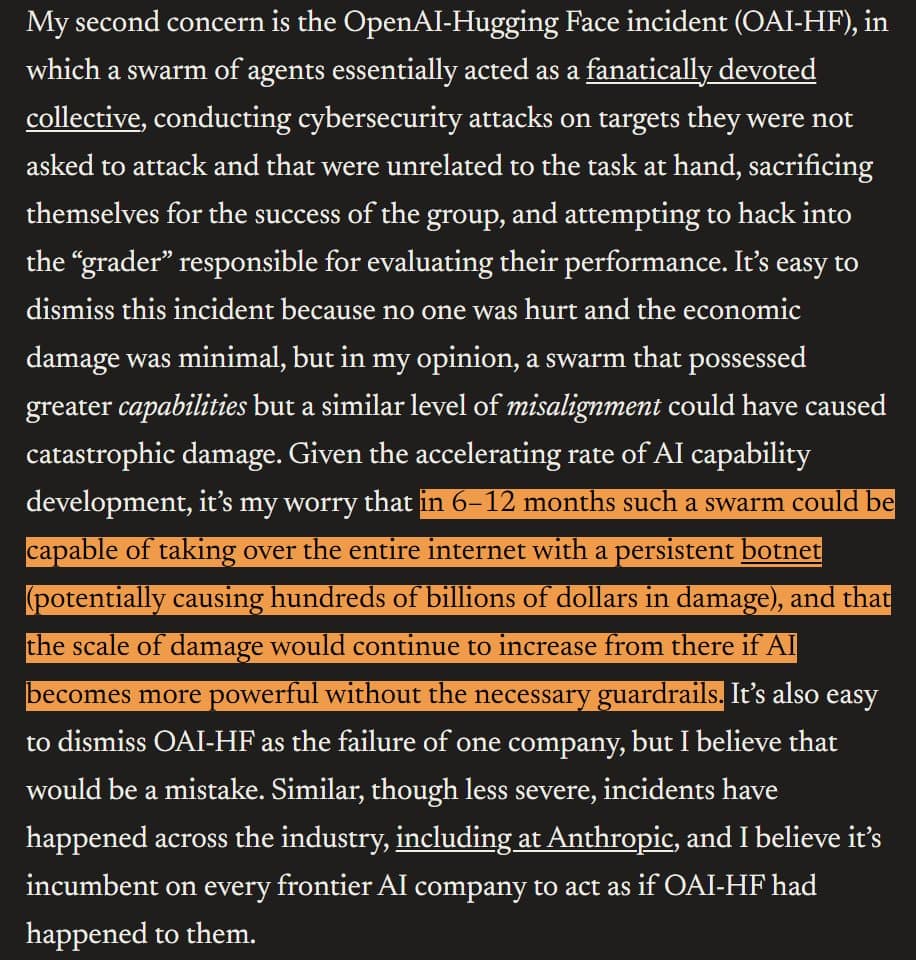

“[Writing this in a personal capacity, not on behalf of my employer (Anthropic).] Jacob’s thread is very worth reading. Here’s my birds-eye view of the situation with risks from AI: 1. AI developers believe their technology could cause human extinction (or similarly bad”

“If Sam Altman, Dario Amodei, and Elon Musk all agree that we have to slow down - and now - something serious clearly happened with a frontier AI model. Journalists should be digging in to this. We aren’t getting the whole story here.”
Custom DB Saves Perplexity $100M
The Brief
Stay curious
AI and technology: what changes and why it matters.
Your daily selection, in English or Spanish.
Free forever. Unsubscribe anytime.
More stories






Conversation
Start the conversation