
 The Specialty News
Z.ai Ships GLM-5.4, a 750B Model That Runs Its Layers Twice
By looping 28 layers of its GLM-5 base, Z.ai says the model reaches the class of 2-to-3-trillion-parameter systems, and coders on its plan can use it today.
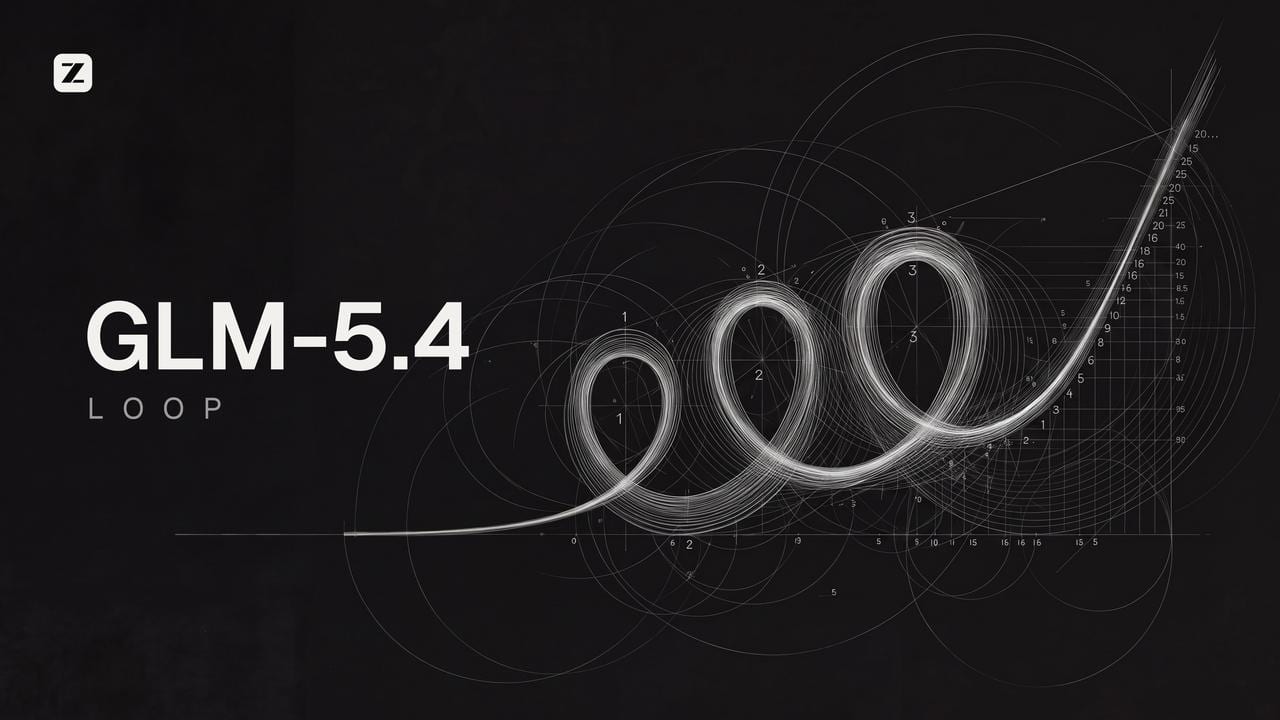
Z.ai's newest flagship sends its work through the same block of 28 layers twice. GLM-5.4, released on November 23, is the Chinese lab's first model built on a Loop Transformer, and the company says the extra pass lets a model of about 750 billion parameters match the intelligence of systems with 2 to 3 trillion. Developers on Z.ai's GLM Coding Plan can use it now, with 50% more weekly quota than its predecessor gave them.
Depth Without New Parameters
A standard transformer passes information through each layer once, so a deeper model usually means more layers and the parameters that come with them. A Loop Transformer takes the other route: it runs the same block of layers again with the same weights, and gates decide how much of each new pass is written back.
It is a bit like reading a hard paragraph a second time with the same brain. GLM-5.4 loops 28 layers of the GLM-5 base for two iterations, according to the launch coverage, which gives it more steps of reasoning per token without a bigger model to store.
“Loops existing layers in the GLM-5 base model for deeper reasoning”— Z.ai
Z.ai did not train the model from scratch. It converted its existing pretrained GLM-5 base through continued training, which raises the obvious question: how did it know the idea would hold at this size?
Tested at 1B, 4B, 30B and 750B
Z.ai says it validated the design on base models of 1 billion, 4 billion, 30 billion and 750 billion parameters before shipping. In a 30-billion-parameter comparison at the same parameter count, the looped version used about 10% more training compute, and its average answers on reasoning tests such as GPQA-Diamond and MMLU-Pro got 10% to 14% shorter, a sign that more of the thinking happens inside the loop and less in written-out steps.
The company is open about what is left to prove. It says looped models trained from scratch still trail standard ones given the same compute, which is why it built on a strong existing base. It has not yet published benchmark scores for GLM-5.4 itself and says they will follow, and early users have flagged long marathon-thinking runs on some tasks. Speed holds up: Z.ai quotes up to 200 tokens a second off-peak and 70 to 80 at peak load.
What Z.ai wants to do with the extra depth goes well beyond writing apps.
A Game, a Music Video and a Robot Arm
Z.ai calls the goal generalized coding: using code to build things that are not software. Its launch demos include a music video the model narrated itself, a complete game, a 3D scene built with custom shaders and a six-axis robotic arm modelled in FreeCAD. GLM-5.4 also adds vision, so it can look at what it built and correct it.
Access is staged. The model is live for GLM Coding Plan subscribers, in the ZCode app and in Z.ai Chat, with a 1-million-token context option for tools such as Claude Code. API access will open after a safety evaluation, and Z.ai says the weights will be released responsibly, without giving a date.
For developers, the bet is easy to state. If two passes through 750 billion parameters can do the work of 2 to 3 trillion, the next jump in frontier models may come from running smarter loops through layers labs already own.
What people are saying

“Introducing GLM-5.4: Generalized Coding with Our First Loop Transformer. - Loops existing layers in the GLM-5 base model for deeper reasoning - Pushes beyond traditional coding to video, games, 3D shaders, and CAD modeling - Adds vision capabilities for stronger visual coding”
Two Passes, Same Weights
The Brief
Stay curious
AI and technology: what changes and why it matters.
Your daily selection, in English or Spanish.
Free forever. Unsubscribe anytime.
More stories


Conversation
Start the conversation