
 The Specialty News
Synaptics Seeks $25,000 a Week Over a Hobbyist's Claude-Built Linux Driver
Mike Lothian used his Claude subscription to write an open Rust driver for DisplayLink docks; two UK patents filed in 2010 have sent it back to his own machine.
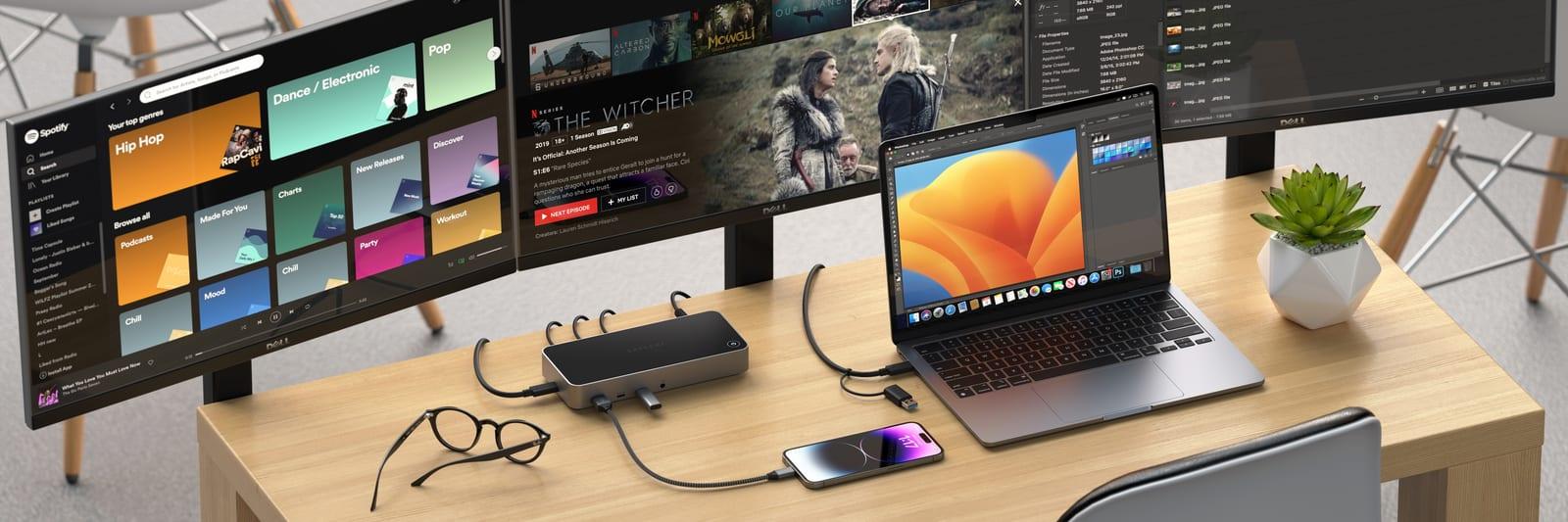
On October 5, a Synaptics lawyer gave a hobbyist in Scotland six days to stop working on a Linux driver, or face a demand for $25,000 that would grow by at least $25,000 every week. Mike Lothian had written the driver, called Vino, with help from his Claude subscription, to make his DisplayLink dock work properly on Linux. He has since taken the code offline, and his case shows where AI-assisted open source meets patents, a limit that better code does not move.
A Dock, a Claude Subscription and a Packet Capture
DisplayLink chips sit inside many USB docks, the boxes that let one laptop drive several monitors. Synaptics, which owns DisplayLink, supports Linux with DisplayLink Manager, a closed, x86-only program that works alongside EVDI, an open-source kernel module kept outside the main Linux tree.
Lothian, who owns a Dell USB 3 dock with a DisplayLink chipset, wanted something better. He decided to use his Claude subscription to build a new driver and its support software. Vino is a Rust driver for DisplayLink's DL3 docks meant to live inside the Linux kernel itself, and he worked out the protocol from captured USB traffic and the vendor's own programs.
He posted the first version for review on the kernel's graphics mailing list on June 17 and a third version on August 26. It was still unfinished: the dock had not yet switched on its content-protection channel for Vino, so no pixels reached a screen. A companion piece, a Rust rewrite of the EVDI module, already drove real monitors. Synaptics' first reply came in July.
From a 'Clean Room' to Claim 11
On July 20, Michal Lukaszek of Synaptics wrote that DisplayLink's protocol and codec are proprietary, and that "an independently written or clean-room implementation does not necessarily avoid patent infringement." On August 17 a cease-and-desist letter followed from Andrew J. Bateman, Synaptics' assistant general counsel for intellectual property, with eight demands and an appendix of 125 patents.
Lothian asked which claims he was supposed to infringe. The answer came on October 5: two claim charts mapping claim 11 of UK patent GB 2484736 and claim 11 of GB 2485613 to Vino's source code. The letter set an October 11 deadline, later moved to October 18, and said Synaptics would seek US$25,000 to recoup the cost of preparing that documentation, an amount that would increase by at least US$25,000 per week. It also raised a possible interim injunction in the UK and said his work put "tens of millions of dollars of yearly corporate revenue at risk."
He took the GitHub repository down.
“Vino itself has to remain local until this is sorted out, I just can't afford to defend myself against Synaptics.”— Mike Lothian
No court has ruled on anything, no payment is on record and Synaptics has made no public statement. The legal question underneath is older than AI, and it explains why writing the driver from scratch did not settle it.
The Line Better Code Does Not Move
Copyright protects code; patents protect methods. A clean-room rewrite, built from observed behavior instead of copied source, answers the first and does nothing for the second, which is the point Synaptics made in July. Lothian had also hoped for cover from the Open Invention Network, the Linux patent pool: Synaptics is a member and Lothian a licensee, though Bateman wrote that DisplayLink itself is not. OIN's chief executive, Keith Bergelt, concluded that its protection did not reach this work, because codecs are excluded from OIN's definition of the Linux system.
The useful lesson is where the cost now sits. One person with a single dock and an AI assistant got far enough into a proprietary protocol that its owner answered with claim charts. The hard part of a project like Vino is shifting from the engineering to the legal homework: knowing which claims a protocol touches, and what an open-source patent pool does and does not cover, before the first public post.
Time is on the open side too. Both patents were filed in 2010, and a UK patent lasts at most 20 years from filing. By 2030 at the latest, those two claims are free for anyone to implement, and Lothian has already shown the code can be written.
Four Months From Driver to Takedown
The Brief
Stay curious
AI and technology: what changes and why it matters.
Your daily selection, in English or Spanish.
Free forever. Unsubscribe anytime.
More stories

Conversation
Start the conversation