
 The Specialty News
LlamaIndex's OCRia-nano-1 Reads a Page in 426 ms on a Plain CPU
Seven tiny models with 8.1 million parameters in total turn scanned PDFs into Markdown, tables included, with no GPU anywhere in the pipeline.
A scanned page goes in, and 426 milliseconds later it comes out as clean Markdown, tables included, on a single processor core with no graphics card in sight. That is OCRia-nano-1, an open-weight text-recognition model LlamaIndex released on November 23 with 8.1 million parameters in total. For any organization sitting on archives of contracts, invoices and reports, the first pass over every page can now run on the servers it already owns.
Seven Models, 8.1 Million Parameters
Most of today's best document readers are large vision-language models that need a GPU. LlamaIndex's own OCRia-1 has 4 billion parameters. Nano went the other way: it splits the job across seven specialized models and makes each one as small as it can be.
The first trick is to skip work. LiteParse, LlamaIndex's open-source parser, reads the text layer that digital PDFs already carry, so pages with usable text never touch the OCR at all. Only scans and images go to a 3.8-million-parameter stack: an 82,000-parameter line detector, a 38,000-parameter script router that picks each page's main writing system and spots upside-down pages, and four recognizers of roughly 0.7 to 1.3 million parameters each.
A final model, the 4.3-million-parameter LayoutNet, lays the recognized lines and native text on a grid and rebuilds tables and content blocks. The output arrives as Markdown, plain text or JSON with bounding boxes, so an agent can point back to the exact spot on the page.
The natural question is what all that shrinking costs in accuracy.
10.5 Points Ahead of Tesseract
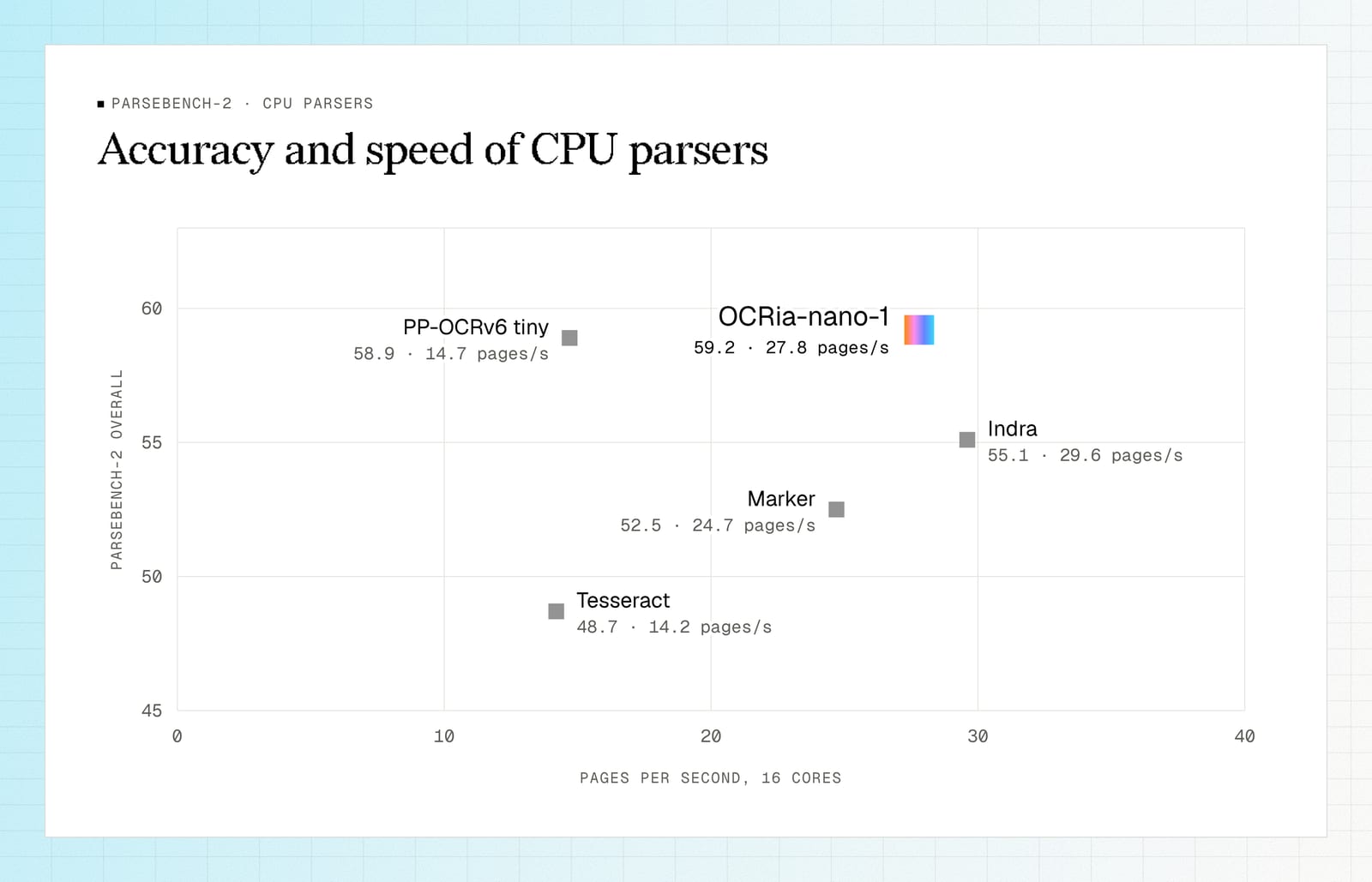
On ParseBench-2, LlamaIndex's document-parsing benchmark, Nano scores 59.2 overall and 59.5 on tables. Tesseract, the long-serving open-source engine LiteParse used by default, scores 48.7. Marker's fast mode reaches 52.5, Indra 55.1 and PP-OCRv6 tiny 58.9, all measured on CPU.
Speed is where the design pays off. Across 300 random ParseBench pages on a 16-vCPU container, Nano ran about twice as fast as Tesseract's 14.2 pages per second and PP-OCRv6 tiny's 14.7. Indra is a little quicker at 29.6 pages per second, about four points behind on accuracy. Nine pages in ten finish within 862 milliseconds.
At that rate a single server gets through about 100,000 pages an hour, a stack of printer paper roughly 10 meters tall. These are LlamaIndex's own figures on its own benchmark, and independent runs on other document mixes will show how well they travel. They also raise a practical question: where should the small model stop and a big one take over?
A Teacher 500 Times Larger
Nano learned from its bigger sibling. LlamaIndex used OCRia-1 to generate the text transcriptions, table annotations and layout labels it trained on, packing a 4-billion-parameter model's judgment into something about 500 times smaller.
The company is clear about the division of labor. Nano has no chart model, so charts stay as images, and handwriting, heavily degraded scans, complex tables and scanned math notation still go to OCRia-1 or the LlamaParse cloud service. The recognizers cover Latin, Chinese, Japanese and Korean, right-to-left scripts and others.
“OCRia-nano-1 is intended to be the first pass parsing for the billions of pages/petabytes of data that are locked up within any organization”— Jerry Liu
That first pass is the point. Installing it takes two commands, pip install liteparse and lit models pull ocria-nano. The code is Apache 2.0, and the weights ship under a modified Open RAIL-M license, with wider commercial terms handled by LlamaIndex directly. A hospital, a bank or a records office can now index every page it holds on the processors in its own building, and save the GPUs for the pages that truly need them.
What people are saying

“In celebration of Jensen Huang's return and his commitment to open-source AI: Today we’re releasing OCRia-nano-1, an extremely lightweight and open-weight OCR model that is just 8.1M parameters in size and can parse pages at 426 ms per page on your CPU ⚡️ - no GPU required!”
Seven Tiny Models, One Parser
The Brief
Stay curious
AI and technology: what changes and why it matters.
Your daily selection, in English or Spanish.
Free forever. Unsubscribe anytime.
More stories

Conversation
Start the conversation