
 The Specialty News
ICEYE's Gen5 Radar Satellite Sees Through Clouds at 11 cm Resolution
Finland's ICEYE unveils its fifth satellite generation in eight years, with twice the imaging time per orbit and an AI processor on board.
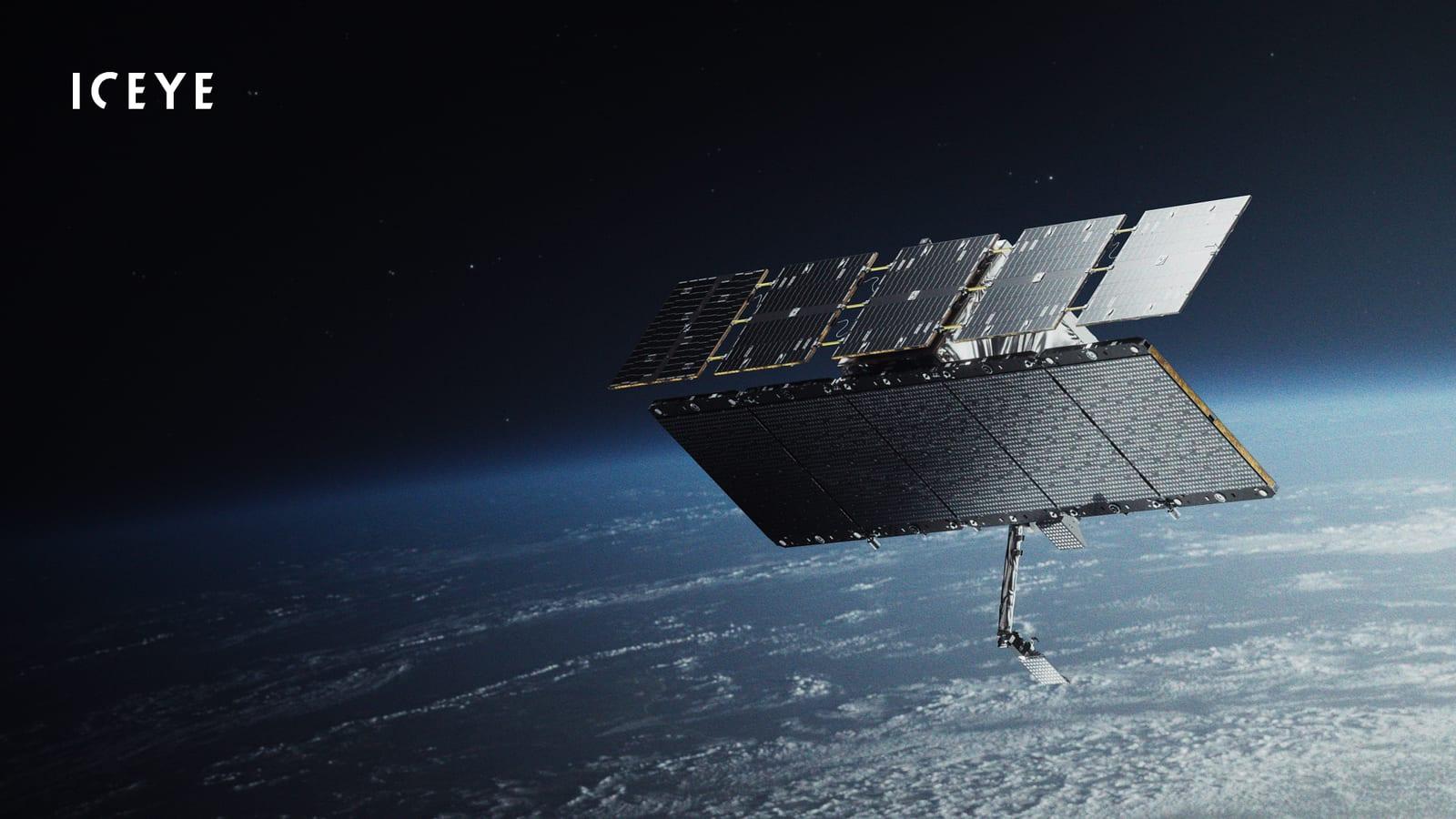
From orbit, through cloud and darkness, ICEYE's newest satellite can pick out details on the ground as fine as 11 centimetres. The Finnish company unveiled Gen5 in Helsinki on Monday and called it the sharpest synthetic aperture radar (SAR) satellite ever built commercially. For the teams who track vessels at sea or map a flood at night, that means sharper images, more of them on every pass, and analysis that can start before the data comes down.
Down to 11 Centimetres, Day or Night
Ordinary cameras in orbit go blind under cloud and after sunset. SAR satellites carry their own light: they fire microwave pulses at the Earth and build a picture from the echoes, so a storm or a polar night changes nothing.
How sharp that picture gets depends largely on bandwidth, the slice of radio spectrum the radar sweeps through. For government customers, Gen5 can image with 1,800 MHz of bandwidth, which takes ground resolution as fine as 11 cm, subject to compliance with ITU rules on spectrum use. Every other customer gets 1,200 MHz and resolution as fine as 16 cm.
Eleven centimetres is smaller than a paperback book. At that scale an analyst can tell apart objects that used to blur into a single bright smudge, and ICEYE says higher transmit power and larger incidence angles lift image quality across every mode.
Sharpness is only half the upgrade. The other half is how many pictures Gen5 can take on a single trip around the planet.
Twice the Imaging Time on Every Orbit
ICEYE calls Gen5 its most agile satellite yet. It cuts the minimum distance between consecutive images, which the company calls Image Window Separation, by more than 30%, so it can line up shots closer together along its path.
Put the two together and every pass over a region yields more potential images. Tighter orbit control adds a quieter benefit: Gen5 satellites can return over the same spot every day from the same angle, so one day's image lines up with the next and small changes on the ground stand out.
Then there is the computer on board. Gen5 carries an AI processor that, over time, will handle screening, pre-processing and tip-and-cue (one sensor flagging a target for another) on the satellite itself, instead of waiting for the data to reach a ground station. New capabilities arrive as over-the-air software updates, so satellites already in orbit keep improving after launch.
“Time to decision is everything in space-based intelligence, whether you're tracking a vessel or responding to a flood. — Rafal Modrzewski, CEO and co-founder of ICEYE”
Who gets to own a fleet of these is the other half of the announcement.
A Sovereign Radar Fleet in 12 Months
ICEYE sells images, and it also sells whole constellations to governments that want their own. New customers can have a fully sovereign Gen5 system, free of US ITAR export restrictions, running within 12 months of signing, with the ground segment, software and operator training included.
Existing customers get an easier path. Every ICEYE generation runs on the same software and ground segment, so an agency can add Gen5 without changing how it tasks its satellites or retraining its operators. Europe is paying attention: in June 2025, European Commission Executive Vice-President Henna Virkkunen visited ICEYE's Helsinki headquarters for a briefing on its SAR constellation.
Gen5 is ICEYE's fifth satellite generation in eight years, and Modrzewski expects a new generation roughly every 18 months, with new software every quarter. The people who benefit reach well beyond defence ministries: ICEYE's constellations already serve environmental monitoring, insurance and emergency management, where a sharper image of a flooded town in the middle of the night can turn into a faster rescue plan.
A radar eye that sees through storms at the scale of a paperback is now something a country can own within a year.
How Gen5 Speeds Up Decisions
The Brief
Stay curious
AI and technology: what changes and why it matters.
Your daily selection, in English or Spanish.
Free forever. Unsubscribe anytime.
More stories



Conversation
Start the conversation