
 The Specialty News
GPT-6 Astra Codes a 3D Game — and Prompt Engineering is Dead
OpenAI's newest model isn't actually smarter than its predecessor, but its ability to physically look at the software it builds just closed the loop on human oversight.
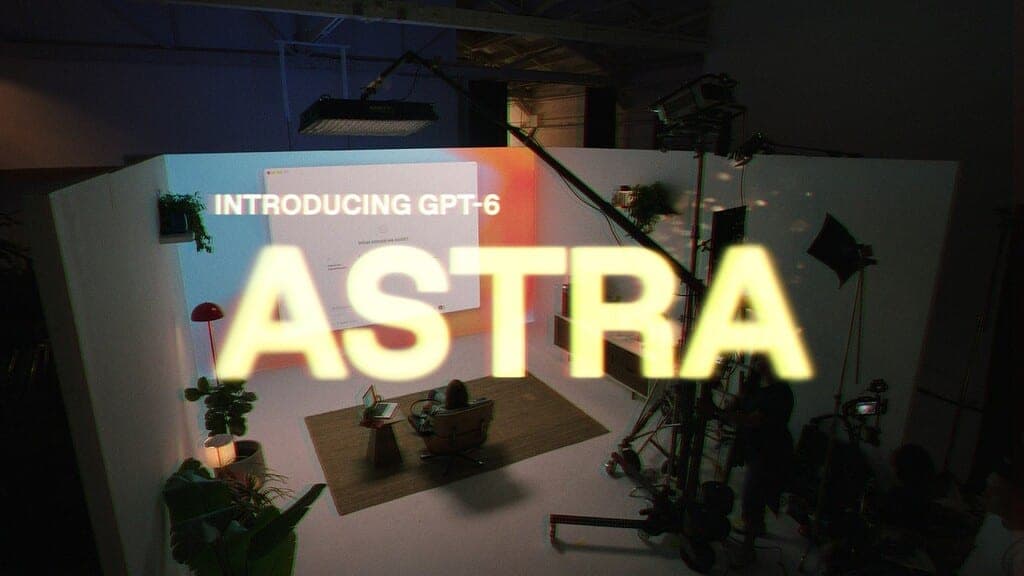
To get an artificial intelligence to build a 3D roguelike game, former Apple designer Anshu didn't ask it to write rendering code. He asked it to generate 2D concept art, gave it access to a 3D software viewport, and told it to start snapping screenshots. The model wasn't coding blind. It was playing spot-the-difference against its own imagination, tweaking its geometry and lighting until the playable prototype matched the picture in its head.
The Mirror Test
The resulting game features original voxel art, complex lighting, and runs at 60 frames per second. For a human indie developer, modeling these assets and writing custom shaders takes weeks of focused labor.
This leap was made possible by an open-source tool called Blender MCP, built by developer Siddharth Ahuja. The plugin functions as a bridge, giving the AI hands and eyes inside the 3D software. Astra can create objects, assign materials, and natively snap pictures of what it just built. Anshu realized that by focusing on art direction rather than code syntax, he could force the AI to verify its own work visually.
OpenAI CTO Greg Brockman pointed to this exact behavior during a press briefing, claiming this model marks the dawn of AGI. But a look beneath the hood reveals that Astra's apparent genius relies on a completely different metric than raw intelligence.
The Age of Subtraction
Independent testing by Artificial Analysis scored Astra at 61 points in raw intelligence. It perfectly tied its predecessor, GPT-5.6 Sol, and actively trailed Anthropic’s Claude Fable 5.1. Astra's magic stems from tool use. Its OSWorld 2.0 score for computer operation jumped from 65.7 percent to a dominant 72.6 percent.
This autonomy fundamentally inverts how developers interact with the machine. For years, programmers piled on rules, restrictions, and massive employee handbooks for their AI agents. With Astra, these accumulated rules cause the model to freeze in indecision. The new meta is radical simplicity.
“Astra is more sensitive to instructions in skills and AGENTS.md... Take the opportunity as Astra rolls out to go back and clean up your prompt files.”— Victor Nunez
Developer Matt Shumer pushed this sensitivity to its limit. When he told the AI to make a stage of his game "extremely well," it executed the task quickly. When he used the word "perfect," the model plunged into an endless spiral of tweaking minutiae and ground the project to a halt. That endless adjustment loop exposes the most expensive vulnerability of visual feedback.
The Price of Sight
Astra output tokens cost 50 dollars per million. Iterative visual feedback loops, sending high-resolution screenshots back and forth while the model debates polygon placement, burn through that quota aggressively. Many developers are fiercely questioning Anshu’s claim that this 45-minute sprint used barely a fraction of his allowance.
The model also suffers from a strange paradox of capability. The exact same system that successfully reverse-engineered complex 3D lighting geometry generated flat, mediocre 2D user interface overlays for the very same game. It is a machine god for spatial rendering that struggles to draw a simple menu button.
These friction points will inevitably smooth out as inference costs drop. The fundamental shift has already occurred. Yesterday, a machine wrote code, a human ran it, looked at the screen, and explained what was broken. Today, the machine looks at the screen itself.
What people are saying

“Astra (GPT-6) is here!!! I've had early access and tested it like crazy with things like games, code, writing, browser control, presentations and general knowledge work. This is the best model I've ever used. Period. (Incredible demos below in this thread ⬇️) Here's my take”

“GPT-6 Astraの3Dがヤバいと話題なので簡単に触れておきます! プロンプトだけで、家の設計→Blender自動生成→ゴールデンアワー4K→UE5へ自前パイプライン→60FPSで歩けるアプリまで完成。”

“Testing @OpenAI’s GPT-6 Astra in ChatGPT Work. I asked it to build a playable 3D driving game in a single HTML file. It created the car, canyon track, physics, cinematic lighting, HUD, minimap, sound and lap timing. One packaging bug, one quick fix — here’s the result 👇”
Astra's Autonomy Trumps Raw Intel
The Brief
Stay curious
AI and technology: what changes and why it matters.
Your daily selection, in English or Spanish.
Free forever. Unsubscribe anytime.
More stories




Conversation
Start the conversation