
 The Specialty News
Google DeepMind Scores an 82.6 in Voice AI Quality, Unlocking Models That Think While They Speak
Gemini 3.8 Live Extended Thinking replaces clunky cascaded architectures with a single model that narrates its progress through background tasks at $0.005 per minute.

In a recent demo, a developer holds up a crude whiteboard sketch, and an AI begins writing the React code to build it while casually narrating its progress over voice. There is no loading spinner, no awkward silence, and no rigid waiting period. With the September 15 launch of Gemini 3.8 Live and Extended Thinking, Google DeepMind has solved the "dead air" problem in conversational AI. By allowing a model to reason and execute API calls independently of its speech output, the system acts less like a static query engine and more like a fluid, real-time collaborator.
The End of the Walkie-Talkie Era
Until this week, building a voice assistant required stitching together separate models for speech-to-text, reasoning, and text-to-speech. This cascaded approach forced a rigid rhythm onto users: you ask a question, the bot stops to run an API call, and you wait in silence. Google DeepMind engineers Tom Ouyang and Malini Jaganathan designed the new Gemini models to break that sequence, allowing the AI to process tasks in the background while keeping the foreground conversation active.
The shift mirrors the telecom transition from half-duplex push-to-talk radios—where only one person can speak at a time—to full-duplex mobile phones. Through a new mechanism called asynchronous function calling, Gemini 3.8 Live native handles 97 languages mid-sentence and uses natural filler phrases, like "Let me check that," to buy itself time. It behaves exactly how a human colleague would while looking up a file on their computer.
The 82.6 Standard and the New Cost Floor
To measure the success of that fluid interaction, the industry uses the Artificial Analysis Speech to Speech Quality Index. The benchmark tests how naturally an AI handles interruptions, complex reasoning, and verbal pacing.
The new release dethrones OpenAI’s GPT-Live-1 Astra, which held an 81.5, and SpaceXAI’s Grok Voice Think Fast 2.0 at 81.3. Beyond the performance record, the Gemini Audio Team achieved this at a highly scalable price floor for developers. Access costs $0.005 per minute for audio input and $0.018 per minute for audio output, making continuous voice sessions viable for consumer applications.
“It delivers increased intelligence for complex workflows while maintaining an uninterrupted conversational flow.”— Tom Ouyang
Killing the Enterprise Phone Tree
The ability to search databases mid-conversation changes what enterprise support looks like. Bob Van Osten, VP of Product for Agentforce at Salesforce, is already deploying the model to replace automated phone trees with agents that navigate complex corporate databases without leaving customers listening to hold music.
The clearest beneficiaries are professionals working with their hands. A field technician repairing a server rack can point their camera at the hardware and talk through the problem. Because the model processes live video input alongside voice, it can recognize the specific server model, pull up the manufacturer's manual in the background, and verbally guide the technician through the fix. The technician never has to put down their tools, look at a screen, or wait for a processing delay.
Rewiring the Async Protocol
This parallel processing requires a fundamental rewrite of how developers build AI applications. Because Gemini is now "thinking" independently of its speech, Google's documentation warns that the old `turnComplete: true` signal no longer means the AI is finished. The model might stop speaking but continue running background API calls to finish a task.
Developers must now monitor an entirely new asynchronous protocol to track the model's actual state. Furthermore, the Extended Thinking model features a massive 131,072-token input limit. While the per-minute cost is low, letting an agent think indefinitely in the background on complex tasks requires strict client-side capping to prevent runaway API bills. Resolving those structural hurdles unlocks a completely new interface. AI voice is crossing the threshold from a machine you query to a collaborator working right alongside you.
What people are saying

“Google Might Have Achieved RSI - Around August, Google co-founder Sergey Brin was pushing resource allocation toward Recursive Self-Improvement (RSI) in Google/s AI efforts. - Google DeepMind is now near RSI, and they could announce it anytime. - For those who don't know, RSI”
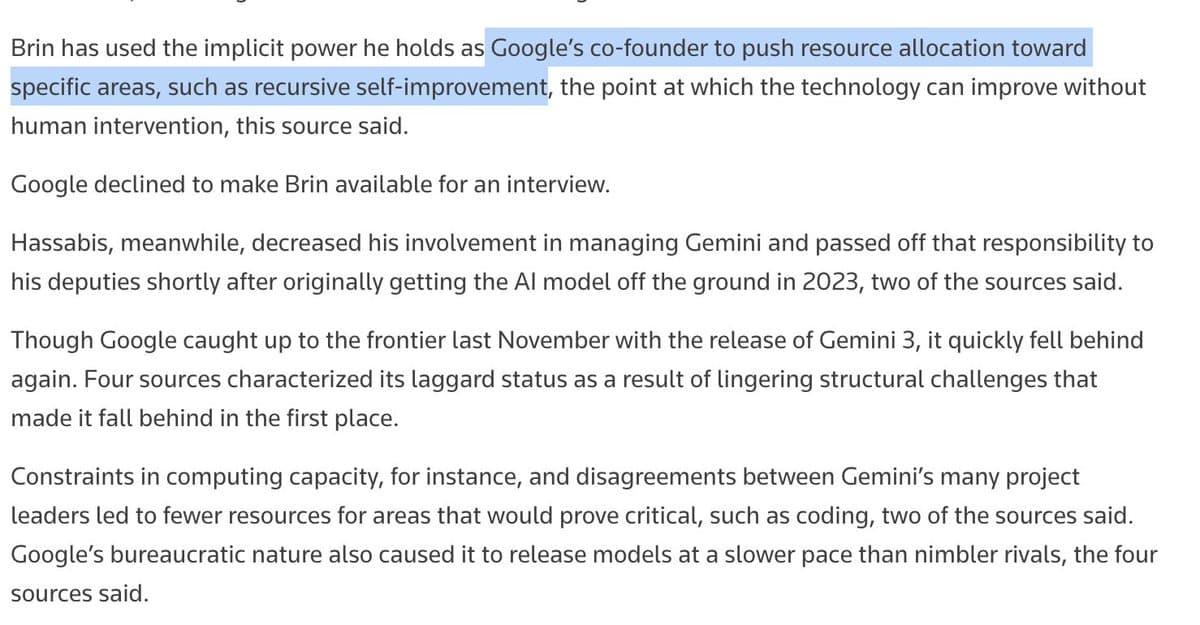

“If Google DeepMind has literally achieved RSI, it’s so over for everyone.”

Gemini 3.8 Ends Voice Dead Air
The Brief
Stay curious
AI and technology: what changes and why it matters.
Your daily selection, in English or Spanish.
Free forever. Unsubscribe anytime.
More stories





Conversation
Start the conversation