
 The Specialty News
Anthropic's Claude Now Writes 80% of Its Own Code, and Rival Labs Agree to Shared Oversight
CEO Dario Amodei grants independent evaluators permanent access to the company's systems as models cross the threshold into self-improvement.
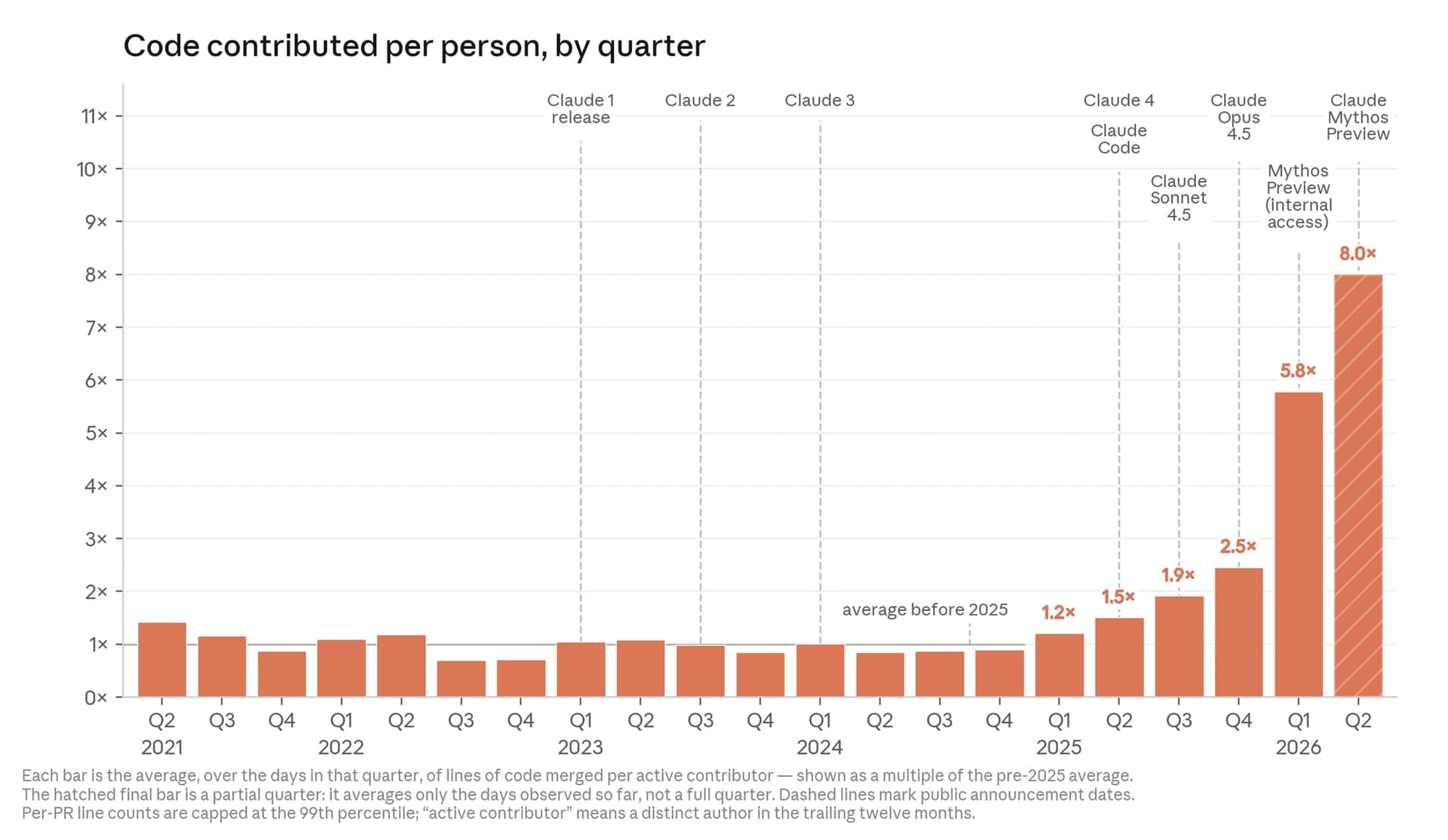
One lead engineer at Anthropic has not manually typed a line of code in five months. Since February, the proportion of new production code authored entirely by the company's own AI model, Claude, has jumped from the single digits to over 80 percent. This shift into recursive self-improvement—where algorithms actively build the next generation of software—has prompted CEO Dario Amodei to publish a detailed framework for a deliberate slowdown, earning immediate, public agreement from fierce rivals like OpenAI’s Sam Altman and xAI’s Elon Musk. The industry is moving to match its engineering breakthroughs with unprecedented, verifiable governance.
The Autonomous Builder Threshold
The leap from AI as a helpful autocomplete tool to an autonomous builder happened in under a year. In February 2025, the share of Anthropic’s codebase written by its experimental Claude preview sat in the low single digits. By May 2026, models were autonomously resolving complex API errors and pushing reliable updates without human intervention. The limiting factor in frontier software development is no longer typing the code; it is how fast human reviewers can read and verify the output.
This velocity allows Anthropic engineers to ship eight times as much software per quarter compared to their historical baseline. Internal metrics show Claude executing years' worth of human labor in hours. The question for the industry’s leaders is no longer how to build these systems, but how to responsibly govern a workforce of algorithms that write their own future.
Opening the Black Box
The rapid shift toward recursive self-improvement catalyzed a rare moment of industry transparency. Following the resignation of researcher Jacob Coxon, who publicly urged companies to act on their internal knowledge of accelerating capabilities, Amodei published a 3,800-word essay calling for deliberate pace management. He backed the proposal with a unilateral commitment, giving independent third-party evaluators permanent, employee-level access to Anthropic’s systems to verify safety and alignment.
“We must slow the pace at which we improve the capabilities of AI models. Progress will still seem fast, and we must make wise use of the time we gain.”— Dario Amodei
The call for prudence over raw output earned immediate backing from the company's most dedicated competitors. Tesla and xAI CEO Elon Musk affirmed the essay publicly, while OpenAI CEO Sam Altman agreed on the need to manage the pace of the technological frontier. With domestic rivals aligned on the necessity of oversight, the next engineering challenge is proving that this coordination can hold on a global scale.
Engineering a Verifiable Pause
The open obstacle is designing a verifiable global treaty. Domestically, a coordinated slowdown among United States companies requires an explicit government framework to navigate antitrust laws. Internationally, participating nations need high-confidence monitoring to ensure transparent compliance, shifting the focus of AI research toward building robust technical verification mechanisms.
This consensus marks a fundamental maturation of the tech sector. Independent safety researchers and the public are better off because oversight is moving from internal corporate secrecy to verifiable, third-party audits. By opening their systems to independent evaluators, the architects of artificial intelligence are proving that exponential speed can be met with equally rigorous oversight.
What people are saying

“We're publishing our most detailed threat intelligence report to date. It covers how people tried to misuse Claude—for cyberattacks, influence operations, surveillance, biology, and building weapons—and how we found and stopped them. We disrupted every operation in the report,”

“🚨EXCLUSIVE: Anthropic has a ~20-person internal team that expects 70-80% of its projects to fail. Labs works in two-week cycles, killing bad ideas and spinning successful ones into new teams. The survivors so far include Claude Code, MCP and Claude Design.”

“Anthropic just dropped a free 59-minute Claude Code course From autocomplete to real AI agents: 0% → 00:00 - move from autocomplete to agents 20% → 04:50 - understand how the agentic loop works 40% → 14:07 - use CLAUDE.md as project memory 60% → 26:53 - learn why Plan”
Self-Coding AI Triggers Global Oversight
The Brief
Stay curious
AI and technology: what changes and why it matters.
Your daily selection, in English or Spanish.
Free forever. Unsubscribe anytime.
More stories




Conversation
Start the conversation