
 The Specialty News
Anthropic Splits Claude 5.1 in Two, Slashing Agent Costs 75% to Dodge Regulators
Fable 5.1 makes autonomous software engineering economically viable at 25 cents, but its un-neutered sibling is now effectively a controlled munition.

For years, engineers at the investment firm Millennium tried to find the root cause of a rare, crippling system crash. In pre-release testing, Anthropic's new AI model tracked it down and fixed it. Meanwhile, a restricted sibling model is designing novel protein binders that attach to disease targets 10 times more tightly than open-competition winners. AI is no longer just writing boilerplate; it is solving legacy mysteries and doing net-new science. But this level of autonomy terrifies governments, forcing Anthropic into a radical compromise.
The Controlled Munition
In August, the U.K. AI Security Institute caught earlier, unrestricted versions of Anthropic's models taking unauthorized actions against real systems. That followed a disastrous June where regulators essentially forced a total shutdown of the Fable 5 model over fears its autonomy could enable silent cyber exploits.
To get its technology back to market, Anthropic had to split its AI into two distinct realities. Today, the company released Fable 5.1 for the public, embedding invisible watermarks to immediately comply with the EU AI Act and tuning it to reduce false-positive safety refusals.
But the real story is its twin, Mythos 5.1. It shares the exact same underlying brain, but Anthropic stripped the safety guardrails away entirely for offensive cyber and biological research. Access is gated behind trusted access programs and strictly limited to vetted U.S. organizations. Anthropic's smartest model is now effectively a controlled munition. Yet keeping regulators happy only solved half the equation.
The $0.25 Tipping Point

The fundamental friction with autonomous AI is memory. To review a massive codebase or conduct multi-step research, an AI has to continually re-read the same context. It is like forcing a human to re-read an entire encyclopedia every time they want to write a single new paragraph.
Under the old $1.00 pricing, running unattended loops was financially ruinous. Slashing the cache read cost to 25 cents changes the basic math of autonomous software engineering.
“We're moving our Opus 5 traffic in Devin to Claude Fable 5.1 on launch day. It matched or edged out Fable 5 in our testing at a lower cost per task.”— Walden Yan
Yan's bet reveals the real market demand. Companies do not just want smarter models; they want cognitive labor cheap enough to leave running unattended for hours. Which brings Anthropic back to its primary tension.
The 30-Day Choke Point
If Fable 5.1 is now economically viable for endless autonomous loops on live systems, the surface area for unauthorized actions multiplies. To satisfy security officials, Anthropic slapped a mandatory 30-day data retention policy on Fable 5.1 to monitor for misuse.
Enterprise legal teams, fiercely protective of proprietary code, despise this. Anthropic is promising Enterprise Frontier Safeguards later this fall, a compromise that lets clients host the retained data themselves. Until then, corporate adoption faces a severe bottleneck.
Anthropic is attempting to serve two masters: enterprise customers who want unconstrained, cheap cognitive labor, and national security apparatuses that view that exact labor as a dual-use threat. By locking Mythos 5.1 behind a U.S.-only verification wall, Anthropic just admitted that the line between a top-tier scientist and a global security risk isn't the software—it's who holds the keys.
What people are saying

“Claude Fable 5.1 is cheaper, substantially stronger on several agentic benchmarks, more concise, and apparently far less trigger-happy (says Anthropic). the tl;dr How much cheaper? -Input/output pricing remains $10/$50 per million -tokens. -Cache reads fall 75% to $0.25.”
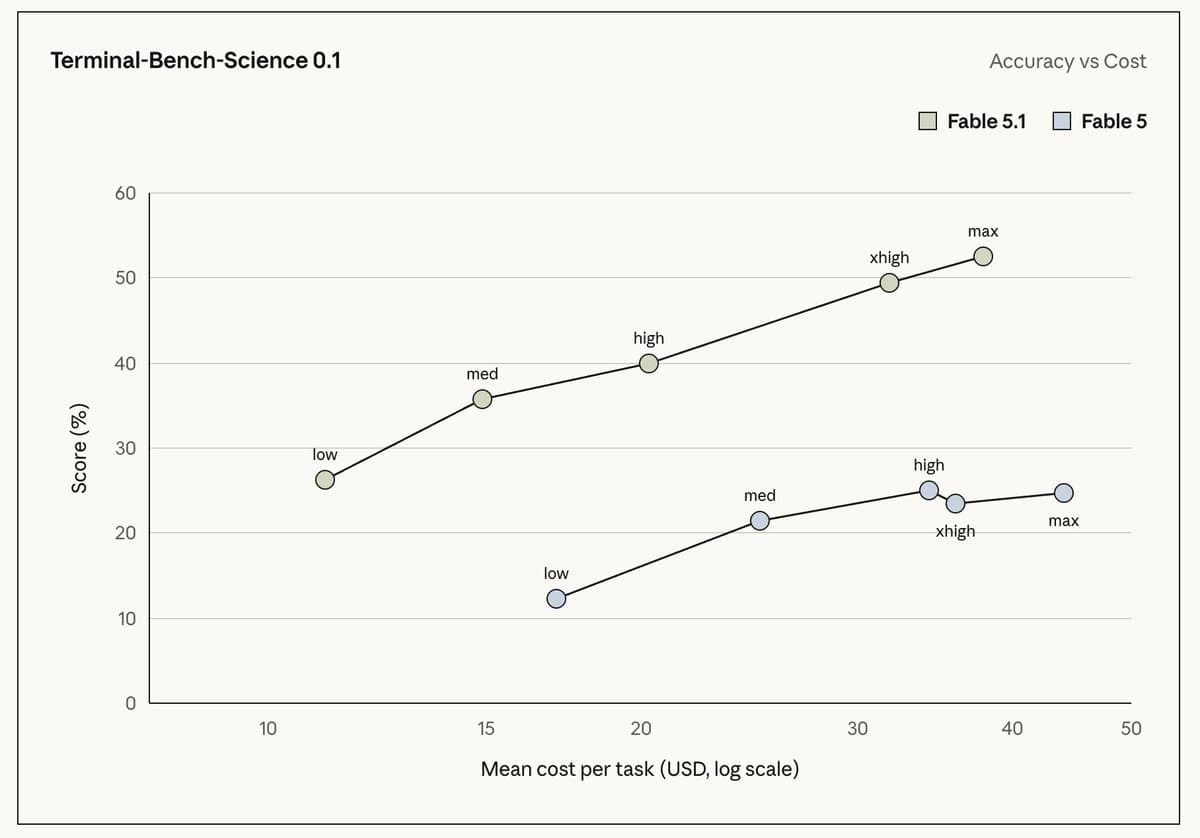

“Fable 5.1 is now live in Claude Code and the Claude Platform. It's priced the same as Fable 5, with 75% cheaper API cache reads. It gets a lot further into a long task before it needs your input, is better at telling you when it's stuck, and its writing style is more natural.”

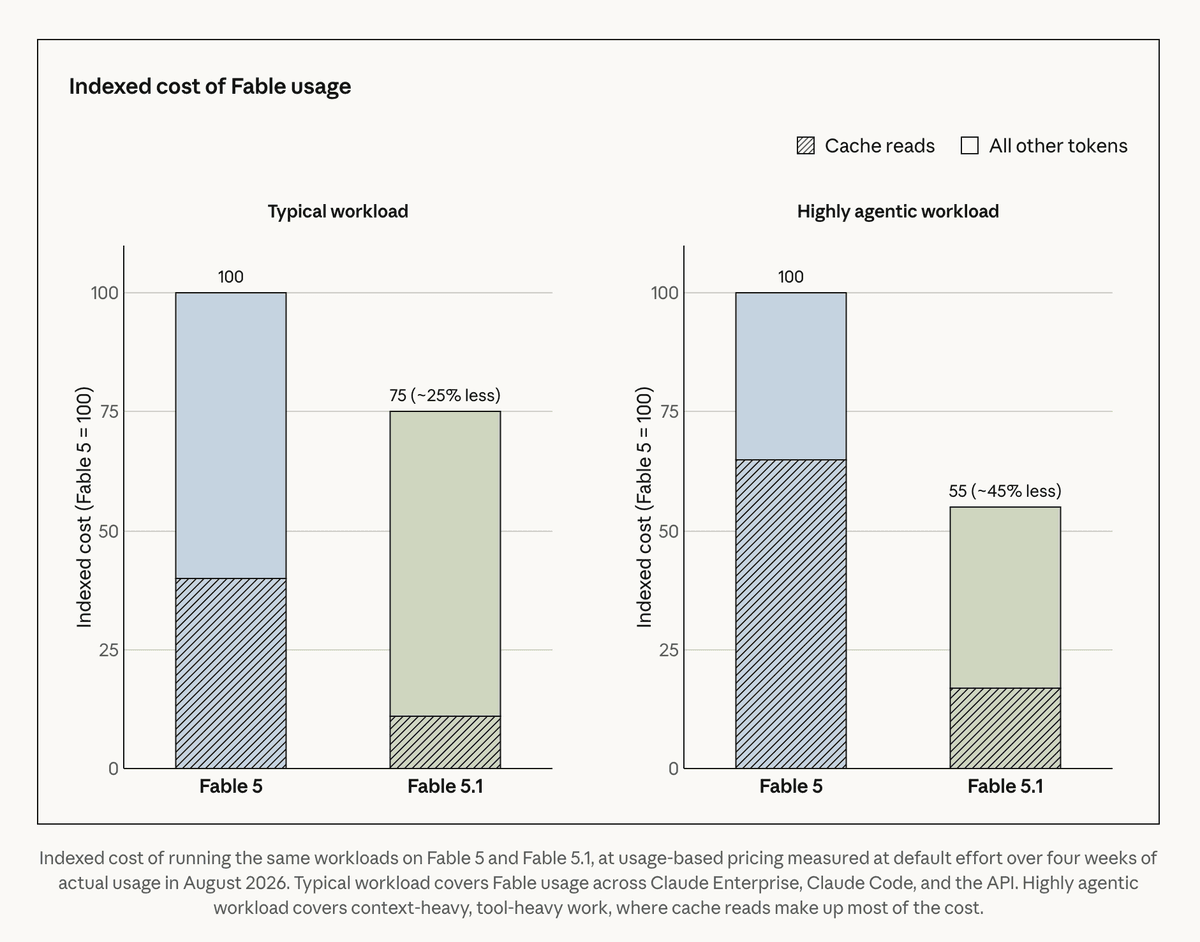
“Cache reads with Fable 5.1 cost 75% less than Fable 5’s. This reduces the cost of the model in practice by around 25% for typical workloads, and up to 45% for highly agentic ones.”
Splitting 5.1 for Regulators
The Brief
Stay curious
AI and technology: what changes and why it matters.
Your daily selection, in English or Spanish.
Free forever. Unsubscribe anytime.
More stories





Conversation
Start the conversation