
 The Specialty News
Tesla's Powercore Folds Three Grid Machines Into One 7.4 MW Box
One solid-state unit takes battery or solar power straight to 34.5 kV, with half the losses of today's two-step setup and first units running in 2027.
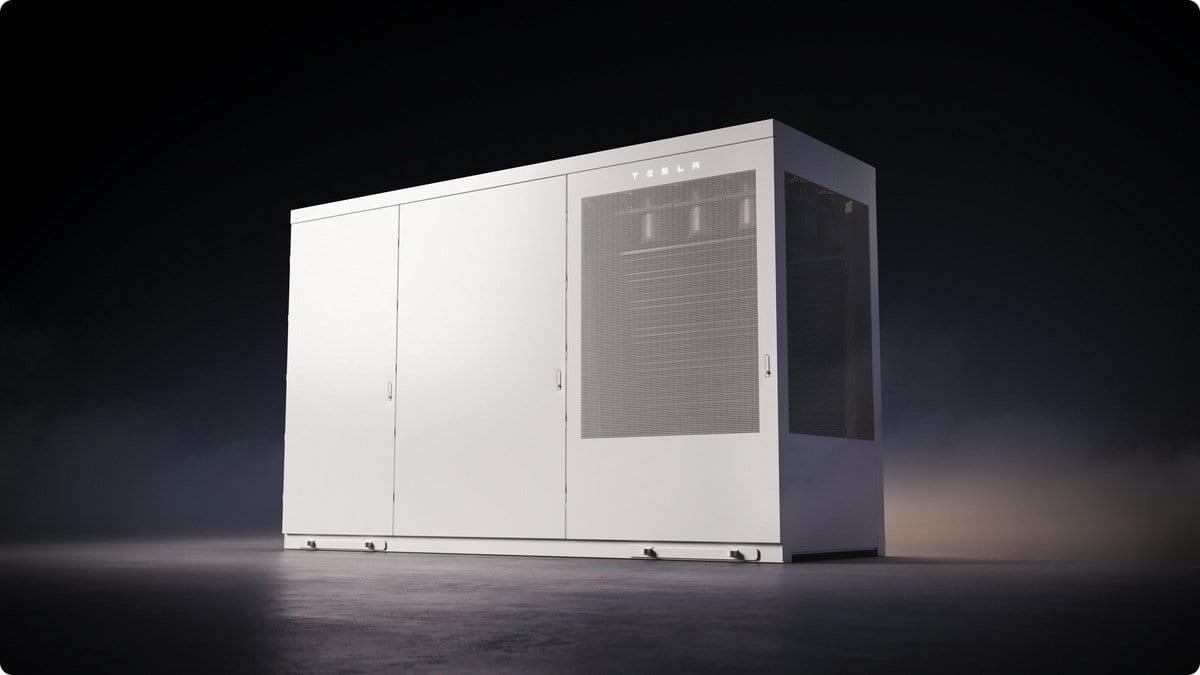
For about a century, the machine that links a power plant to the grid has been a made-to-order transformer, with an inverter and a breaker bolted on beside it. On November 17, Tesla unveiled Powercore, a solid-state unit that does all three jobs in one enclosure, rated at 7.4 megawatts. For the solar farms, battery sites and AI data centers waiting on grid equipment, it promises a part that comes off a factory line, with first units operating in 2027.
Three Machines, One Enclosure
Powercore is what engineers call a solid-state transformer. Instead of copper windings doing the work passively, power electronics switch the current, converting in both directions between medium-voltage AC, up to 34.5 kilovolts, and low-voltage DC, from 800 to 2,000 volts. Tesla rates one unit at 9 MVA, or 7.4 megawatts, continuously, and up to 10 MVA of peak power when it is helping to steady the grid.
That is roughly the average draw of 6,000 American homes, handled by one cabinet. Tesla lists a peak efficiency of 98.86% and an operating range from -40°C to 55°C, and the unit is modular, so a failed component can be swapped in the field without replacing the whole thing.
It also drops the flammable oil that fills a conventional transformer, and its built-in solid-state breaker clears faults up to 1,000 times faster than a conventional one, according to Tesla. Why fold all of that into one box? Because every separate machine between a battery and the grid is a place where energy gets lost.
Half the Losses Between the Battery and the Grid
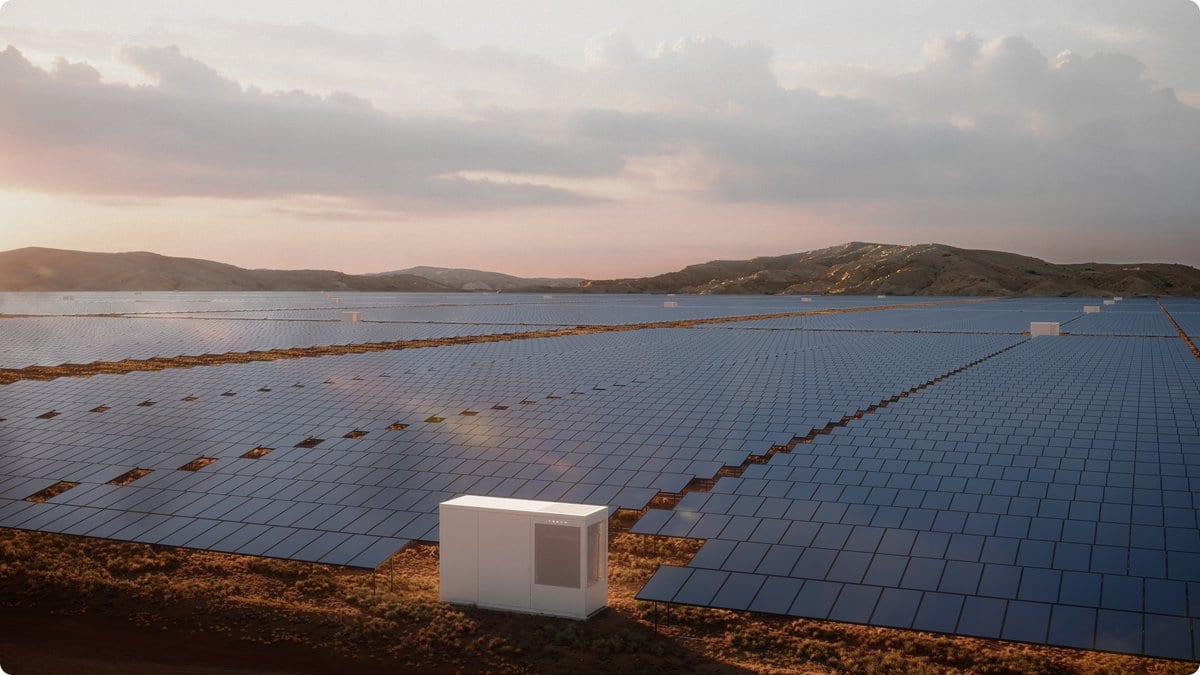
Today a battery site converts its energy twice. Inverters inside each Megapack turn the battery's DC into 480-volt AC, then a separate transformer steps it up to medium voltage. Powercore does it in a single stage, from battery DC to medium-voltage AC, and sits right next to the Megapacks it serves. Both arrive pre-assembled.
Tesla says the old two-step design had twice the losses. Fewer steps means more of the energy stored in the same batteries reaches the grid, which lowers the cost of each megawatt-hour and fits more energy on each site. Tesla has the field record to build on: more than 100 GWh of its storage runs across 2,000 projects in 68 countries, and Megapack 2 XL averaged 99.73% annual availability across more than 50 GWh as of the third quarter.
Data centers get a shortcut too. The industry is moving to racks that run on 800 volts DC, and Powercore goes from the medium-voltage feeder to 800 Vdc in one step, with up to 99.7% availability at the product level. Tesla says it is working with Nvidia on engineering for 800 Vdc data centers, and it already has 10 GWh of Megapack running at data center sites.
The third customer Tesla is courting may be the one waiting longest: the solar farm stuck in line for a transformer.
A 25-Year Warranty for the Part That Slows Solar
For solar, Powercore works as a central inverter, turning the panels' DC straight into medium-voltage AC with less equipment in between. It supports the 1,500-volt systems already in the field and the 2,000-volt systems now emerging. Tesla's own announcement names the problem it is aimed at.
“Transformer supply constraints are holding new plants back and inverter downtime is the leading cause of lost availability.”— Tesla
Solar inverter warranties typically run 5 to 10 years; Tesla offers up to 25 on Powercore, serviced by a team of more than 900 field technicians. Its pitch to AI companies is a full kit: a 100 MW data center, it says, can be effectively powered by 500 MW of solar and 1.7 GWh of batteries, running on 800 Vdc from end to end.
Tesla is not alone in this. Heron Power, founded by former Tesla senior vice president Drew Baglino, raised $140 million in February for its own solid-state transformer and plans a factory before the end of 2027. Tesla has not announced a price, a factory site or a first customer, only that Powercore will be built in the United States, where it already makes 90 GWh of Megapacks a year. If it delivers, the slowest part to source for a new power plant becomes one more thing you can order from a factory.
What people are saying

“Introducing Powercore Solid state medium voltage transformer, inverter and breaker – reliable, safe and secure 7.4 MW/9 MVA continuously at 34.5 kVac w/ grid-forming support for 10MVA of peak power Made in America. Operating 2027”
One Step Instead of Two
The Brief
Stay curious
AI and technology: what changes and why it matters.
Your daily selection, in English or Spanish.
Free forever. Unsubscribe anytime.
More stories




Conversation
Start the conversation