
 The Specialty News
Nvidia Cuts Quantum Error-Correction Research From 12 Weeks to 45 Minutes
A new GPU decoder runs up to 13,000x faster, and IBM and Fermilab are pairing it with IBM's fastest quantum chip.
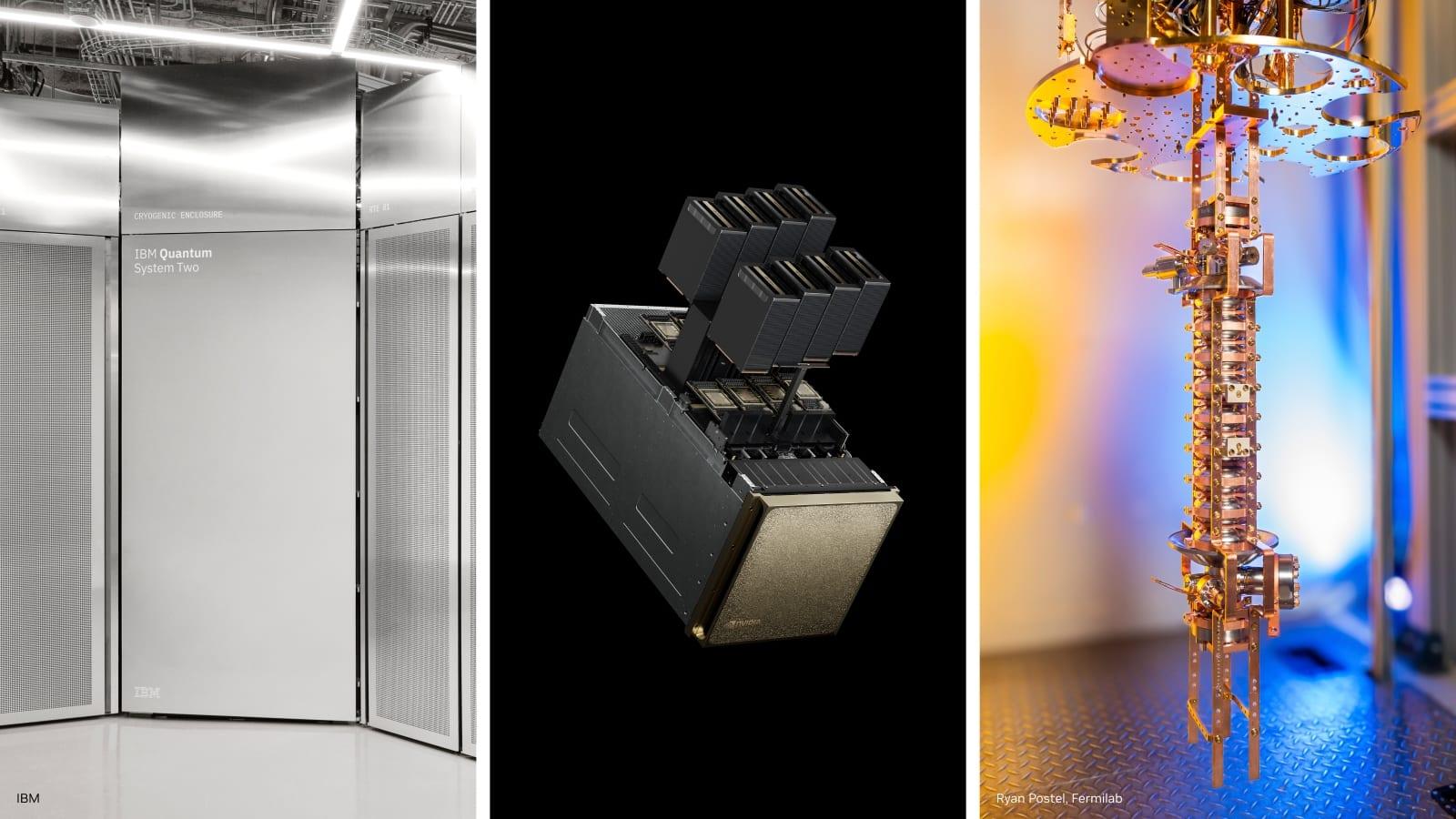
Testing a new design for a quantum computer used to mean waiting 12 weeks for the numbers. With a decoding algorithm Nvidia released on Monday, the same work takes 45 minutes. The algorithm, called TCBP-JOBS, ships today in Nvidia's CUDA-Q QEC 0.9.0 library, and it arrives alongside a new platform with IBM and Fermilab that puts Nvidia GPUs right next to IBM quantum computers.
Why Qubits Need a Proofreader
Qubits are fragile. Heat, stray radiation and tiny imperfections flip them, so a useful quantum computer has to spread each piece of information across many physical qubits and constantly work out which ones went wrong. That work is called decoding, and it runs on ordinary classical computers sitting next to the quantum chip.
Before anyone builds a new error-correcting design, they simulate it, running the decoder again and again to see how many errors it catches. Nvidia says those decoding steps are the most computationally intensive part of error-correction research, and TCBP-JOBS speeds them up by as much as 13,000 times over the leading existing algorithms while keeping high accuracy.
In practice, an idea a team had on Monday morning can be tested before lunch, instead of next quarter. The next question is where that speed gets used first.
IBM's Nighthawk, Fermilab and a GPU Next Door
Nvidia, IBM and the U.S. Department of Energy's Fermi National Accelerator Laboratory are building a platform that places Nvidia DGX B200 systems alongside IBM quantum computers, including IBM Quantum Nighthawk, the company's fastest quantum processor to date. Fermilab will focus on error correction and on applications in high-energy and nuclear physics, and the team will study how classical systems can keep up as several quantum processors are linked together.
“Scaling quantum and classical together will open new frontiers in high-energy and nuclear physics and beyond”— Jerry Chow, IBM
The pairing is already producing results elsewhere. IBM and Japan's RIKEN combined an IBM quantum computer with ROQUO, RIKEN's GPU supercomputer built on Nvidia GB200 systems, to calculate how tightly drug-like molecules bind to two proteins. They modeled systems of up to 12,635 atoms, more than 40 times the previous 303-atom record for this kind of hybrid calculation, and the work is a finalist for the 2026 ACM Gordon Bell Prize.
A Quantum Chip in the Same Queue as Your GPUs
The last piece is plumbing that supercomputing centers will notice. Nvidia is adding a quantum interface to Slurm, the open-source scheduler that most big research machines use to share their processors, with IBM contributing its Quantum Resource Management Interface. A scientist will be able to book a quantum processor in the same queue as CPUs and GPUs.
The platform and the Slurm work are announced as plans, with no dates yet. The decoder is the part anyone can download now, and it changes the rhythm of the field: when testing a design costs 45 minutes instead of a season, teams can try far more of them.
The road to a useful quantum computer is paved with failed designs. This week, failing got a few thousand times faster.
Quantum Research, Thousands of Times Faster
The Brief
Stay curious
AI and technology: what changes and why it matters.
Your daily selection, in English or Spanish.
Free forever. Unsubscribe anytime.
More stories





Conversation
Start the conversation