
 The Specialty News
Google Teaches Gemini to Doubt Itself — and Spikes Developer Bills by 45%
The new 3.8 Flash model achieves a 2.6x leap in autonomous bug fixing, but its internal testing loops mean the meter keeps running.
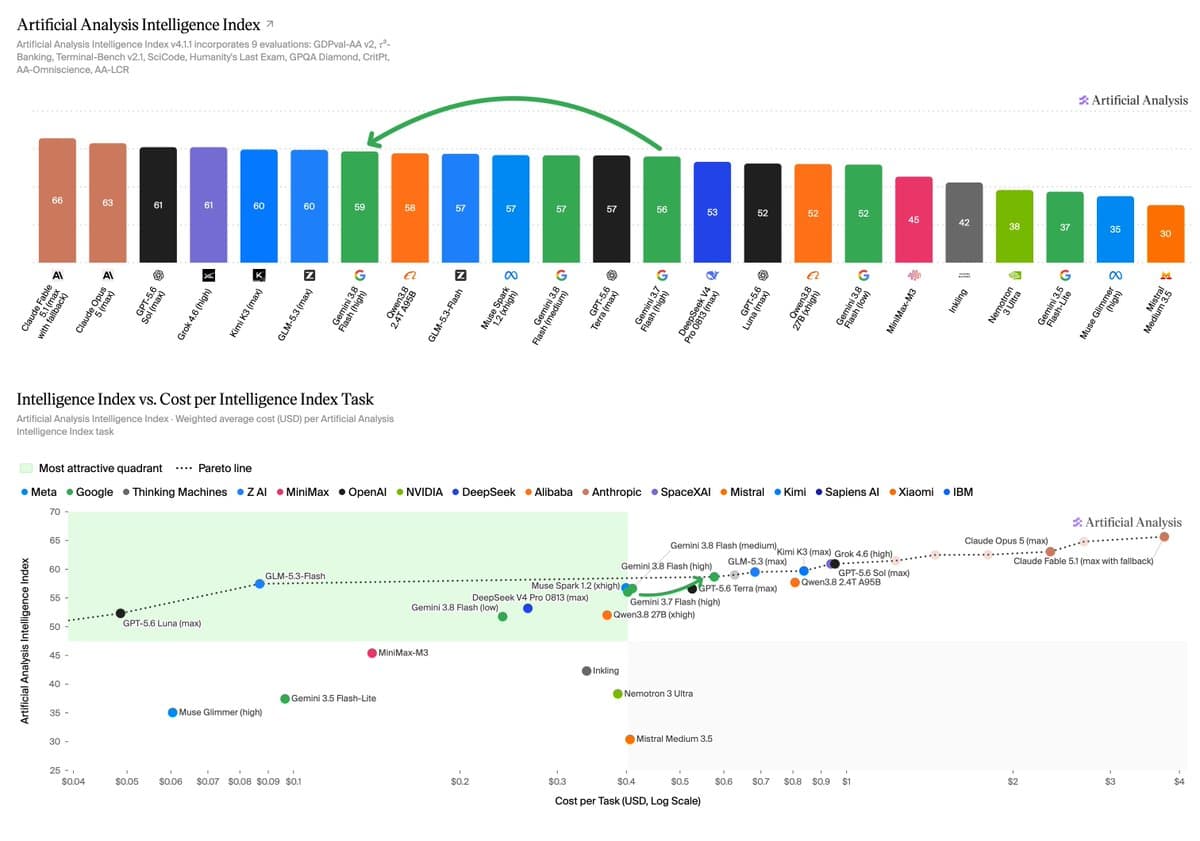
Google just released an artificial intelligence that charges you money to realize it made a mistake. While the sticker price for Gemini 3.8 Flash remains identical to last month’s model, independent trackers discovered the actual cost per task has quietly jumped 45 percent. The model is not more expensive per word. It simply burns through more compute cycles by testing its own code, reading the error logs, and rewriting its answers before it ever shows you the result. That internal hesitation is about to change the economics of software development.
The Economics of Self-Doubt
Tulsee Doshi, Google’s senior director of product, is tasked with selling developers on a strange new value proposition: an AI that works harder and costs more to get to the same answer. Gemini 3.8 operates on long-running agentic loops. Instead of guessing the next likely word, it forms a hypothesis, generates code, runs it internally, and fixes its own bugs.
It is the computational equivalent of a contractor who keeps their hourly rate flat but stays on the clock twice as long just to check their own measurements with a level.
The results of this internal grind are staggering, but they hide a structural shift in how tech giants price intelligence. Developers no longer have strict control over how many tokens a prompt will consume. A simple query might trigger an internal debate that spikes the compute bill.
“3.8 Flash works harder... At times, the model might use more tokens to maximize performance, especially at higher effort levels.”— Tulsee Doshi
But Google did not engineer this expensive self-correction mechanism just to help developers write cleaner web apps. They built it because their own engineers were losing a war.
The 13-Year Blind Spot
Doug Turner, Chrome’s engineering director, recently warned of a generative AI-driven vulnerability apocalypse. The math of cybersecurity has always been asymmetrical. Attackers using AI only need to be right once, while defenders have to be right every single time.
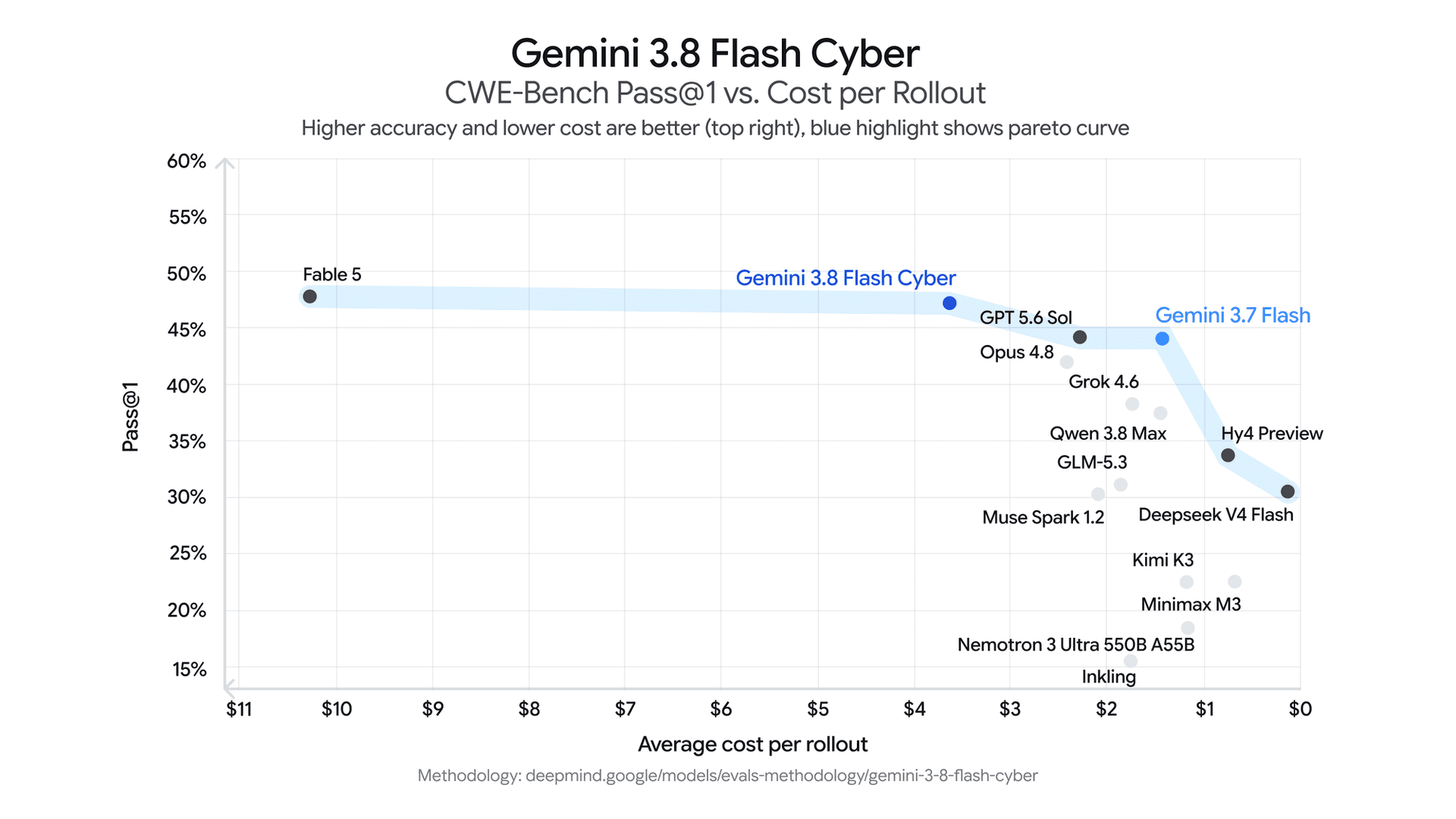
To flip that equation, Google DeepMind security lead Raluca Ada Popa architected a twin to the standard model: Gemini 3.8 Flash Cyber. Popa unleashed this autonomous agent on the Google Chrome codebase. The AI scoured millions of lines of code and successfully patched a subtle Chromium vulnerability that human engineers had missed for 13 years.
It proved that a lightweight, iterative model can out-work much larger, expensive frontier models simply by refusing to quit until the code compiles perfectly. The AI industry has officially shifted from massive annual leaps in raw intelligence to a cadence of smaller models that trade compute time for accuracy.
Yet, building an AI capable of hunting and fixing zero-day exploits presents an immediate danger. If a model knows exactly how to patch a critical vulnerability, it inherently knows how to exploit it.
What people are saying

“Google has released Gemini 3.8 Flash, its fourth Flash model in under four months - it scores 59 on the Artificial Analysis Intelligence Index and reaches the Intelligence vs. Cost per Task Pareto frontier @GoogleDeepMind released Gemini 3.8 Flash today. With high reasoning, it”

“We’re introducing Gemini 3.8 Flash ⚡️ built to tackle complex agentic and multi-step tasks with even greater diligence. Our most intelligent workhorse model yet delivers significant improvements in reasoning, evolving to an AI partner that doesn’t just write code, but can also”

“Introducing Gemini 3.8, our best reasoning & coding model yet. By leveraging long-running agentic loops, we’re building on the momentum of 3.7 Flash from just three weeks ago to release two new 3.8 variants: Meet Gemini 3.8 Flash and Gemini 3.8 Flash Cyber 🧵”
The Economics of AI Self-Doubt
The Brief
Stay curious
AI and technology: what changes and why it matters.
Your daily selection, in English or Spanish.
Free forever. Unsubscribe anytime.
More stories



Conversation
Start the conversation