
 The Specialty News
Cloudflare Frees 100 Terabytes of RAM With a 533-Byte Tweak — and Exposes a Big Tech Paradox
A microscopic adjustment to the 1.1.1.1 DNS cache triggered a 19 percent speed boost and reignited a fierce debate over premature optimization.

By deleting a single unused capacity field from a Rust data structure, Cloudflare instantly recovered 15 terabytes of RAM. Five subtle structural tweaks later, they shrank a single DNS cache entry by 533 bytes. At planetary scale, those microscopic adjustments compounded to free up an astonishing amount of memory globally. Software is often treated as abstract and weightless, but this change proved exactly how heavy code actually is.
The Geometry of Silicon
Cloudflare's 1.1.1.1 resolver operates a massive platform known internally as the Big Pineapple. It holds roughly 250 billion active DNS cache entries at any given moment. When a dataset is that massive, the standard conveniences of high-level programming languages become a severe financial liability.
Systems engineer Sebastiaan Neuteboom and his team started hunting for padding, memory alignment gaps, and pointer offsets in Rust. They realized that standard data containers reserve hidden memory so they can grow later. But DNS cache entries are entirely immutable. By switching to exact-size boxes, compressing eight-byte pointers into two-byte offsets, and packing booleans into bitflags, the team eliminated the structural bloat.
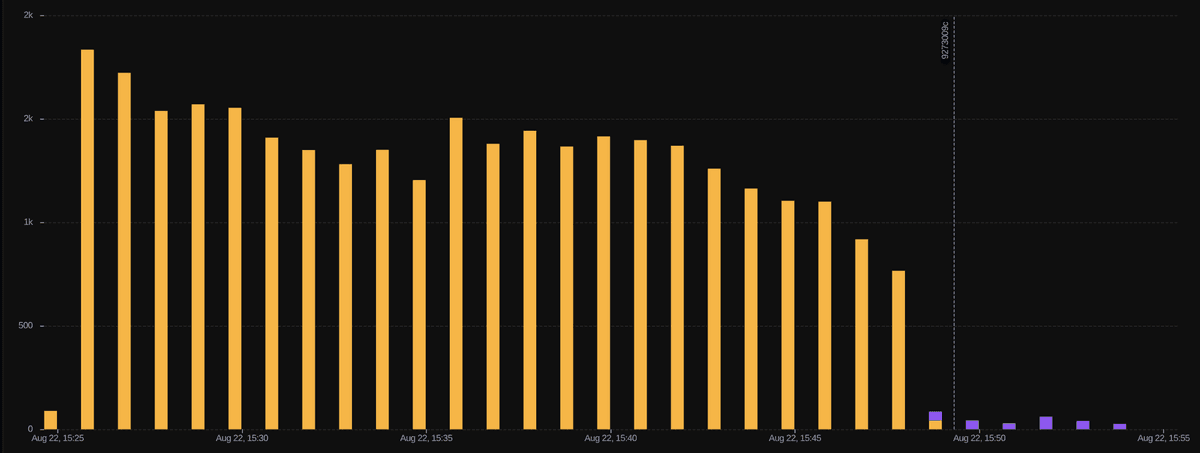
The engineers quietly rolled out the new memory structures in May 2026. By July, dashboards showed memory consumption plunging in a perfect stair-step pattern. The team freed 100 terabytes of memory, which is exactly enough to fully populate the physical RAM slots inside 130 of Cloudflare's Gen 13 servers. Yet the technical triumph immediately drew a highly skeptical crowd.
The Eager Efficiency Trap

When Cloudflare published the technical details in August, it shot to the top of Hacker News. The immediate question from critics was blunt: why was a massive infrastructure company using generic, bulky data structures on the hottest path of the internet in the first place? Some engineers argued the team should have used raw memory arenas or custom allocators from day one, rather than waiting eight years to fix it.
This critique highlights a persistent structural flaw in corporate software development. Engineers rarely get promoted for building something perfectly efficient from the start. They get promoted, and earn legendary status, for saving massive amounts of money by fixing inefficiencies years later when the scale begins to hurt.
“You get rewarded for doing efficiency work on demand, not eagerly.”— scottlamb
The pragmatic ship-first camp fired back immediately. If Cloudflare had hand-rolled these hyper-dense byte structures back in 2018, the resulting rigidity might have blocked them from adding crucial new features like DNS-over-HTTPS or family filtering. You have to survive long enough to have a scaling problem before you can fix one. And the fix itself brought an entirely unexpected side effect.
The Locality Paradox
Conventional computer science suggests that hyper-compressing memory slows down a system. The CPU usually has to burn extra cycles unpacking the tightly bundled data. But the Big Pineapple didn't slow down.
Because the data structures were significantly smaller, they fit much closer together in the hardware. This tight packing drastically improved memory locality, causing CPU cache hit rates to spike. Insert throughput rose by 43 percent, and lookup latency dropped 19 percent. Optimizing for memory turned out to be optimizing for pure speed.
This newly found headroom allows Cloudflare to support EDNS Client Subnet, a feature requiring the cache to store thousands of regional variations for a single domain, all without purchasing new hardware. The lesson extends far beyond Rust programming or DNS protocols. At planetary scale, you stop writing code and start managing the physical geometry of silicon.
What people are saying

“errors are back down down to near zero after some more optimizations + allocating more resources thank you to the @Cloudflare team for jumping in and enabling that inference is a quirky workload with some unique challenges - post on that soon”

“We're now doing around 20,000 Omarchy ISO downloads PER DAY!! I'm oh so happy that we have @eastdakota on as a Founding Patron, and that we're serving from @Cloudflare's amazing CDN. Otherwise we'd be toast! That's well over 100TB/day. Just for ISO. Packages are extra.”

“OX Alpha is hosted in America!! 🇺🇸 I sent 49 identical one-token requests from 7 Cloudflare regions, rotated the order to control for load and matched every response to OpenRouter’s per-generation server timing. This isolated the geographic network floor: ATL: 57 ms DFW: 76 ms”
How 533 Bytes Freed 100TB
The Brief
Stay curious
AI and technology: what changes and why it matters.
Your daily selection, in English or Spanish.
Free forever. Unsubscribe anytime.
More stories






Conversation
Start the conversation