
 The Specialty News
Tiangong Ultra Smashes Usain Bolt's 100-Meter Sprint Record
In just 12 months, bipedal machines shaved 12 seconds off their sprint time to officially eclipse peak human athleticism.
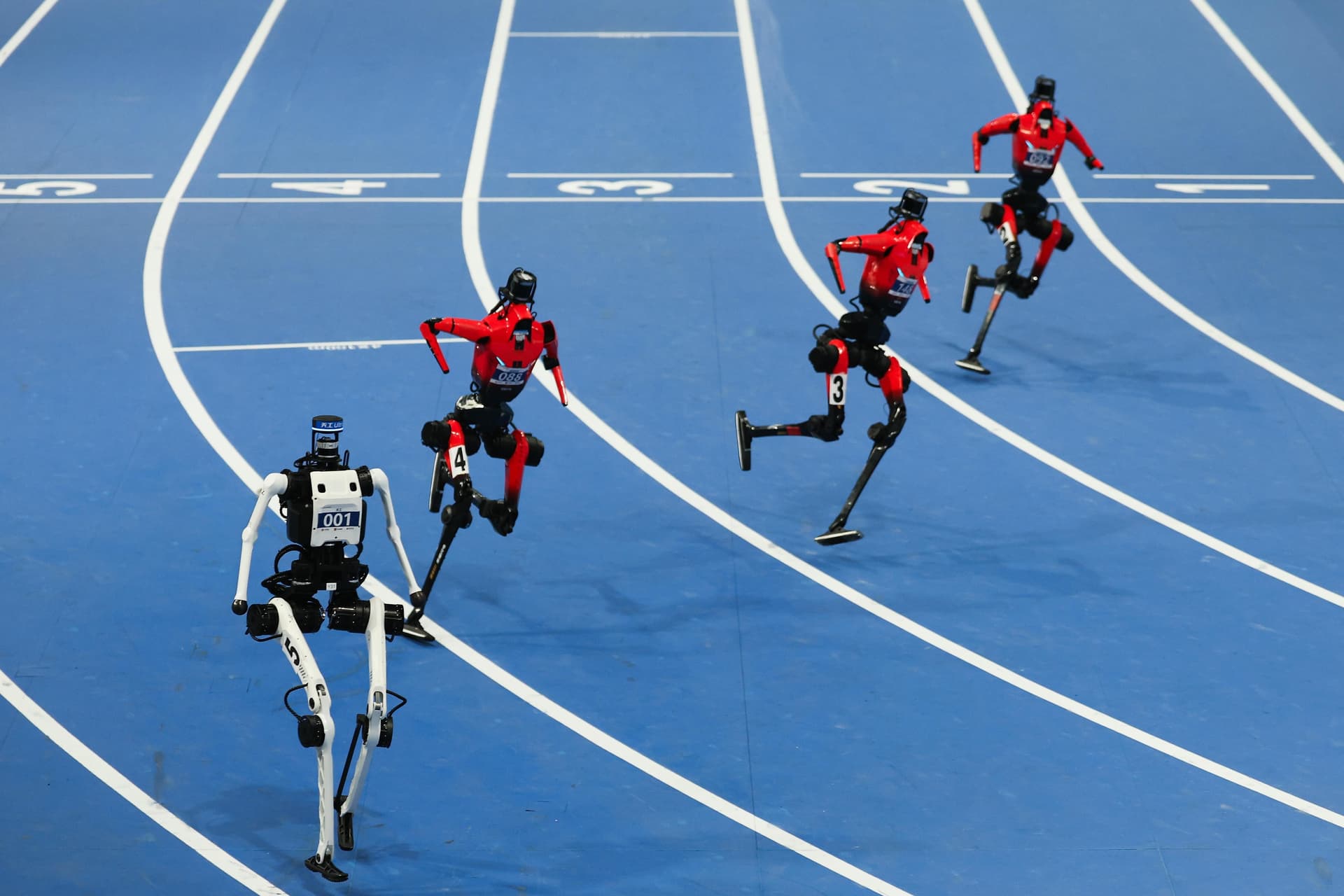
In 1912, American sprinter Donald Lippincott ran the 100-meter dash in 10.6 seconds. It took humanity nearly a century of nutritional science, biomechanical perfection, and athletic evolution to shave a single second off that time, culminating in Usain Bolt’s legendary 9.58-second run in 2009. It took bipedal robots exactly one year to do something even wilder. At the 2026 World Humanoid Robot Games in Beijing, a machine named Tiangong Ultra crossed the finish line in 9.39 seconds, officially proving that peak human athleticism can be eclipsed by steel, silicon, and real-time processing.
The Anatomy of a 9.39-Second Sprint
The sheer physics of bipedal running makes this achievement staggering. Walking is essentially a series of controlled falls; running at 23.8 miles per hour on two legs requires immense processing power, highly responsive actuators, and instantaneous balance correction. Tiangong Ultra, built by the state-backed Beijing Humanoid Robot Innovation Center, didn't just walk. It launched from a standing start and blitzed the track entirely autonomously, operating without remote controls or external tethers.
Close behind was Lightning, a robot developed by smartphone giant Honor, which clocked in at a blazing 9.47 seconds. The backdrop to this showdown was a massive convention featuring 2,056 robots from 666 teams competing across 51 events, but the sprint commanded the world's attention. Just 12 months ago, the very first iteration of this race was won by Tiangong with a sluggish time of 21.50 seconds. Shaving 12 seconds off a highly complex physical maneuver in a single year represents a Moore’s Law-style acceleration applied to the physical world.
But there is a glorious, chaotic catch to this mechanical triumph. The robots have mastered acceleration, but they are utterly clueless about deceleration. Neither Tiangong Ultra nor Lightning possesses the biological finesse to brake voluntarily. After crossing the finish line at nearly 24 miles per hour, both machines violently slammed into thick foam crash pads. Tiangong careened into the sidelines, while Lightning collapsed entirely into the padding and had to be carried away on a stretcher.
The Crash Pad is Just the Beginning
That violent finish highlights exactly where the robotics industry is heading next. Maximum straight-line velocity has been solved. The new engineering frontier is dynamic kinetic control, which will require advanced predictive algorithms and regenerative braking in robotic joints. Future iterations must learn to smoothly decelerate, corner, and recover from stumbles without destroying their own hardware in the process.
This matters far beyond the novelty of a mechanical track meet. The algorithms developed to keep a heavy metal frame upright while sprinting at 23 miles per hour are the exact same systems required for high-stakes, real-world applications. A machine that can process balance at those speeds possesses the foundational code required to navigate a chaotic disaster zone, maneuver through a complex industrial warehouse, or walk down a cluttered staircase in your home without faltering.
Major tech players like Honor are not pivoting their massive research budgets into robotics just to build track stars. They are using these viral spectacles as high-stakes stress tests to prove out battery life, actuator durability, and physical AI in front of a global audience. As commentators noted following the viral broadcast, betting against these machines learning to stop within the next few years is a fool's errand. The crash pads at the finish line might look comical today, but they mark the messy, incredibly rapid birth of next-generation physical AI. When these machines finally learn how to stop, they are going to change how we live and work.
“The crash pads at the finish line might look comical today, but they mark the messy, incredibly rapid birth of next-generation physical AI.”
What people are saying

“Tiangong Ultra ganó una serie preliminar de los Juegos Mundiales de Robots Humanoides con un registro inferior a los 9,58 segundos que el velocista jamaiquino estableció en Berlín en 2009.”

“Chinese Humanoid Robot Tiangong Ultra Runs 100m in 9.39 Seconds, Beats Usain Bolt's 9.58-Second Record - Sky News”

“TienKung, the robot manufactured by the Beijing Centre for humanoid Robotics eclipsed Usain Bolts 100m World record today at the WHRG. It ran 100m in 9.39s vs Bolt's record of 9.58s This is a hugely impressive feat. Last years winning time was 21.50s. In 1 year alone the robots”
Humans vs. Robots: 100m Sprint
The Brief
Stay curious
AI and technology: what changes and why it matters.
Your daily selection, in English or Spanish.
Free forever. Unsubscribe anytime.
More stories






Conversation
Start the conversation