
 The Specialty News
OpenAI’s Jalapeño Chip Breaks Nvidia’s Hardware Monopoly
Delivering 1.9x more throughput at half the power of a Blackwell GPU, the new custom silicon targets ChatGPT's ballooning $14 billion server bill.

OpenAI spent $8.4 billion last year just to keep ChatGPT thinking. With 900 million weekly users projected for this year, that operational bill is rocketing toward an unsustainable $14 billion. To survive, the world's most famous AI company had to do exactly what Apple and Google did before them: build their own silicon.
Half the Power, Double the Speed
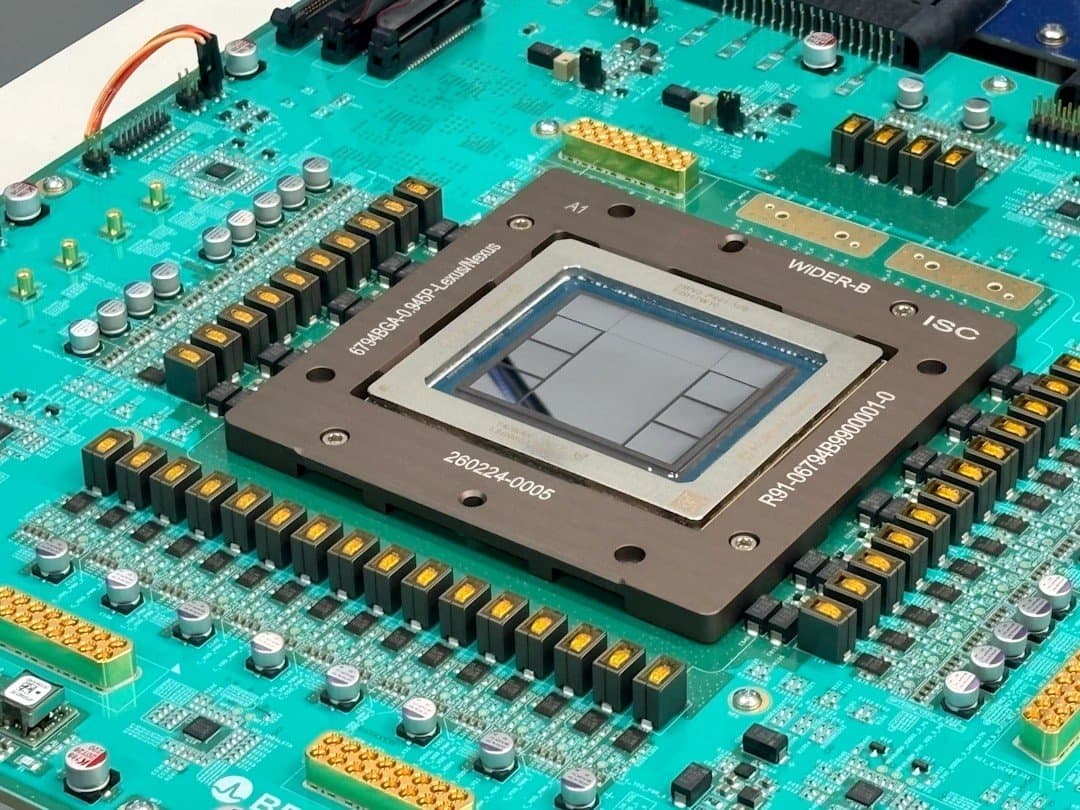
OpenAI pulled back the curtain on its first custom AI processor at the Hot Chips 2026 conference. Codenamed Jalapeño, the Application-Specific Integrated Circuit (ASIC) turns a persistent industry rumor into a benchmark-shattering reality. Manufactured on TSMC's cutting-edge 3nm process, it represents a direct assault on the fundamental bottleneck of modern AI: electricity.
In public InferenceX benchmarks, Jalapeño delivered up to 3.6x lower latency and nearly double the throughput per watt compared to Nvidia’s flagship GB200 and GB300 systems. It achieved this while drawing between 550W and 700W, roughly half the power footprint of Nvidia’s 1,400W behemoths.
Crucially, the chip didn't just excel on OpenAI's proprietary models. Testers saw massive performance gains on major open-weight models like the 1-trillion-parameter Kimi K2.5 and DeepSeek R1. With Samsung's next-generation HBM4 memory providing 15.4 TB/s of bandwidth, Jalapeño tackles the heavy data movement that usually chokes inference workloads.
Escaping the 75% Margin Tax
The motivation behind Jalapeño is ruthlessly financial. Nvidia currently commands profit margins around 75% on its hardware, a toll every AI developer is forced to pay. By designing an ASIC specifically for inference—the process of answering user queries, rather than training the model initially—OpenAI is cutting out the middleman.
“OpenAI Jalapeño is spicy. Usually first-generation chips aren't competitive, but OpenAI is beating Nvidia Blackwell and even Rubin.”— Dylan Patel
To pull this off in just 16 months, OpenAI poached Richard Ho, the former lead of Google's Tensor Processing Unit project. Ho's team partnered closely with Broadcom to co-develop the silicon engineering and networking architecture. By tailoring the hardware directly to their own software stack's memory movement patterns, they stripped out the inefficiencies inherent to general-purpose merchant silicon.
The Gigawatt Reality Check
Acing public benchmarks on a small test rack is impressive, but keeping a multi-gigawatt data center running flawlessly is an entirely different sport. Tech analysts are already waving red flags about the realities of deploying a version-one chip at a global scale.
The supply chain presents an equally brutal challenge. By relying on TSMC's 3nm nodes and Samsung's HBM4 memory, OpenAI is stepping into a fiercely contested arena. They are now directly competing for manufacturing capacity against titans like Apple, AMD, and Nvidia itself.
Furthermore, Nvidia is not standing still. The hardware giant is already shipping its next-generation "Vera Rubin" architecture. OpenAI has carefully maintained that they still view Nvidia as a critical partner for the compute-heavy task of training new models, keeping a vital bridge intact.
The Apple Silicon Moment for AI
Jalapeño validates the "Apple Silicon" thesis for the artificial intelligence era. When the team designing the software algorithms sits across the hall from the engineers designing the hardware, the resulting vertical integration unlocks performance that modular systems simply cannot match.
This breakthrough paves the way for a new generation of hyper-fast, deeply capable autonomous agents. Lower latency and cheaper compute mean AI models can "think" out loud, correct their own mistakes, and execute complex workflows in real time without bankrupting their creators.
The era of treating AI companies purely as software outfits is over. To build the future of machine intelligence, you have to pour the silicon yourself.
What people are saying

“OPENAI’S JALAPENO CHIP OUTPACES NVIDIA IN TESTS OpenAI says its new Jalapeno AI chip beat Nvidia’s GB300 in power efficiency and response speed during testing. Developed with Broadcom, Jalapeno targets AI inference and could lower data-center costs while handling large models.”

“OpenAI just published the first detailed numbers for Jalapeño. The custom inference ASIC, co-designed with Broadcom, is built specifically for large-language-model serving rather than training. On the InferenceX benchmark suite it delivered 1.5–1.9× more AI work per watt at”

“OpenAI 第一代自研芯片(Jalapeño)推理效率就打赢了 Nvidia Blackwell,连 Rubin 也落败。 这不是硬件新闻,是护城河公告。 Nvidia 的 GPU 任何人都能买。Jalapeño 只属于 OpenAI 一家。 效率越高,锁定越深: — 推理成本内化 → 利润更厚 — 吞吐量领先 → 难以复制 —”
Jalapeño vs Nvidia Blackwell
The Brief
Stay curious
AI and technology: what changes and why it matters.
Your daily selection, in English or Spanish.
Free forever. Unsubscribe anytime.
More stories






Conversation
Start the conversation