
 The Specialty News
Google DeepMind Puts Humanoids on Mercedes Lines, Sorting Parts at 96% Success
Apptronik's Apollo 2 robots ran on Gemini Robotics 2.5 at plants in Hungary and Germany; the model, tested on 200 tasks, is now rolling out to partners.
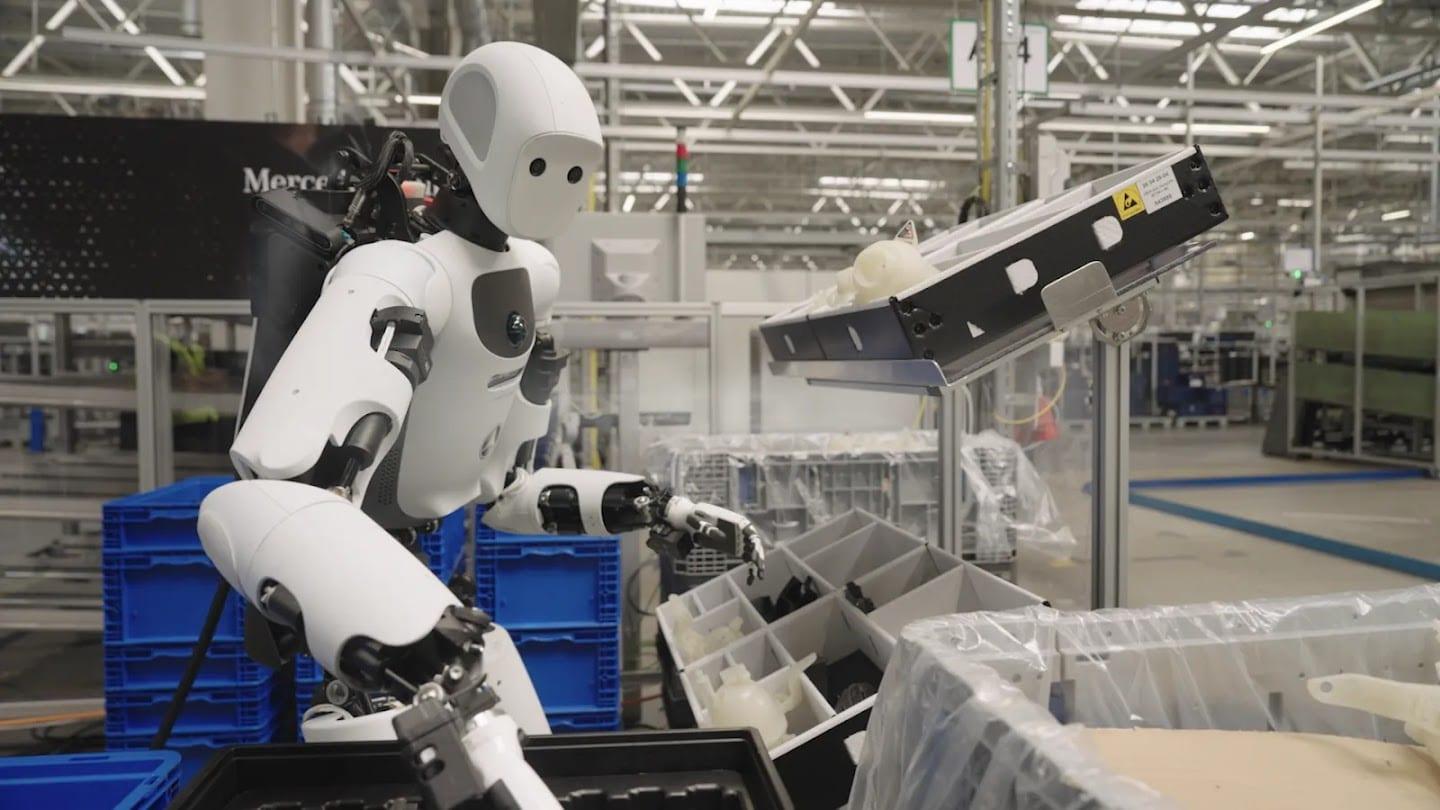
On two working Mercedes-Benz assembly lines, in Kecskemét, Hungary, and Sindelfingen, Germany, a white humanoid called Apollo 2 has been reaching into bins of metal brackets and placing them into trays in the exact order each car needs. It got the job right 96% of the time. The software steering its hands is Gemini Robotics 2.5, which Google DeepMind introduced on November 10 and is rolling out to its robotics partners. For plants that struggle to staff repetitive prep work, it is one of the clearest signs yet that a general-purpose robot model can leave the lab.
The Chore Behind Every Car on the Line
The task is called kitting. Before a car reaches each station, someone has to pull individual parts from bulk bins and lay them into sequencing trays in the precise order the line will use them. It is the factory version of a chef's mise en place, repeated for every vehicle, all shift long, and it is physically taxing work.
In the proof of concept, two Gemini models split the job. Gemini Robotics ER, DeepMind's embodied reasoning model, keeps track of the workflow, while the Gemini Robotics 2.5 actions model controls Apollo's hands and arms as it reaches into supply bins, picks up metal brackets and fills the containers, correcting for gaps as it goes.
Jeff Cardenas, chief executive of Apptronik, the company that builds Apollo, says the models improved dramatically in just a few weeks of post-training and carried over to Mercedes-Benz production with very little drop-off.
“This is what we built Apollo for: useful work alongside people in real industrial settings.”— Jeff Cardenas
So how does one model learn enough to handle a car plant, a kitchen counter and a lab bench?
200 Tasks, From Gift Bows to Pipettes
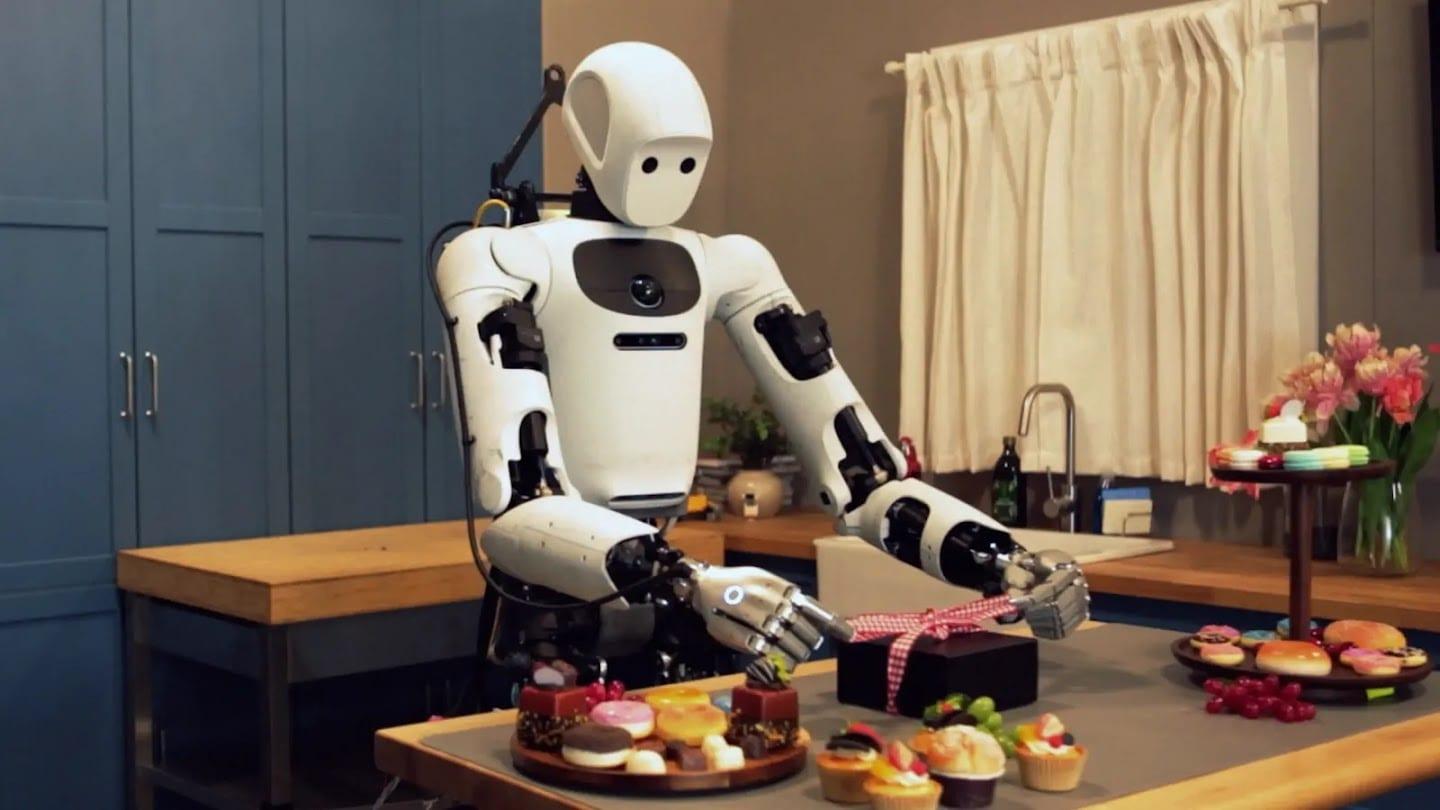
DeepMind tested Gemini Robotics 2.5 on more than 200 distinct tasks, chosen to stretch a robot's fingers: serving food with tongs, tying a bow on a gift box, pipetting a liquid. Each mixes tool use with delicate or flexible objects, which is exactly where robots programmed for one fixed motion fall short.
Against the previous baselines, the new model succeeds 30% to 100% more often depending on the type of task, and finishes 20% to 30% faster. It also runs on very different bodies: Apollo 2, with its five-finger, 22-degree-of-freedom SharpaWave hand, and the Franka Duo platform, which has simple two-fingered grippers.
Much of the speed-up came from another model. DeepMind used Gemini 4 Argon as a simulation engine: from a single real camera scene it can build a realistic digital twin and generate thousands of varied practice runs, which are combined with real demonstrations. Argon can also watch footage of a failed attempt, suggest why it went wrong and help test fixes in simulation and on real robots.
A robot that learns this fast will soon be working near people, and that is the question DeepMind spent the rest of its announcement on.
A Robot That Steps Around People and Refuses Bad Orders
Gemini Robotics 2.5 reasons about physical hazards while it acts, a guidance layer DeepMind compares to the safety classifiers around Gemini's chat answers. In its evaluations, that raised safe task completion by 33% around obstacles and by 43% around nearby people.
The lab also published ASIMOV-Jailbreak, an open-source benchmark with hundreds of prompts that disguise unsafe requests across dozens of scenes. Gemini 4 Argon resisted 99.5% of them, up from 82% for the previous baseline, Gemini Robotics ER 2. Anyone building robots can now test their own models against the same set.
What is left to solve is scale. The Mercedes-Benz work is a proof of concept on two lines, and the model goes first to DeepMind's partners; the lab thanked teams at Agile, Apptronik and Mercedes-Benz for their support on the release. The pace is the encouraging part: the first Gemini Robotics model appeared in March 2025, and twenty months later its successor is filling parts trays on working car lines.
The next time a car rolls off a line in Sindelfingen, some of its brackets may have been placed by a robot that learned the job in weeks.
20 Months to the Factory Floor
The Brief
Stay curious
AI and technology: what changes and why it matters.
Your daily selection, in English or Spanish.
Free forever. Unsubscribe anytime.
More stories


Conversation
Start the conversation