
 The Specialty News
Apple Turns the Mac Mini Into a Local AI Server With 2nm M6 Chip
A surprise hardware drop brings quad-die architecture and massive 512GB memory limits to the desktop, directly challenging cloud-based AI.
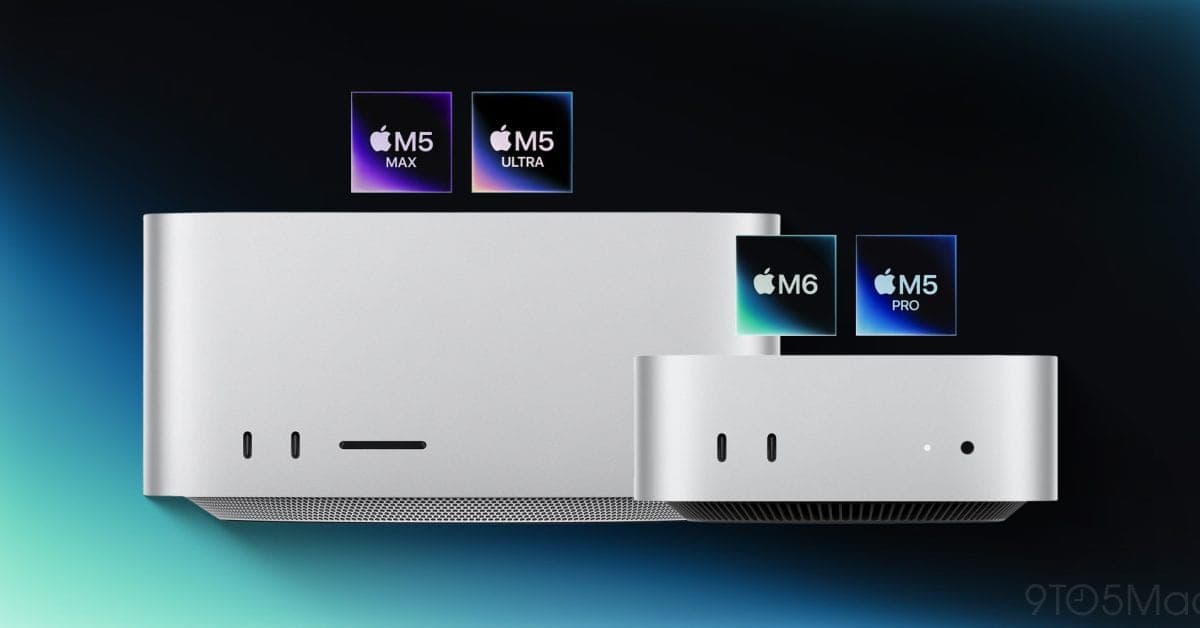
On Tuesday, Apple bypassed its traditional September pomp to drop a hardware bombshell: a totally overhauled desktop lineup featuring the new M6 Mac mini and M5 Ultra Mac Studio. But the real surprise isn't the timing. It's the mission. Apple is explicitly positioning these machines not as standard personal computers, but as "always-on agentic" nodes designed to sever your reliance on the cloud.
The 2-Nanometer Gamble
Rather than offering a standard iterative upgrade, Apple leaped directly to its first commercially available 2-nanometer processor for the M6 Mac mini. Shrinking the transistor size to this microscopic scale allows Apple to cram unprecedented processing power and energy efficiency into a compact chassis. The result is a machine custom-built to run complex, independent AI agents directly on your desk.
This leap in performance comes with a notable shift in pricing economics. The rapid buildout of global AI data centers has created a severe squeeze on memory and storage chips industry-wide, and Apple is passing those costs along. The entry-level Mac mini now starts at $899, a steep climb from the $599 price tag of the M4 era. To soften the sticker shock, Apple made 16GB of unified memory, Wi-Fi 7, and 2.5Gb Ethernet standard across the board.
Overcoming the Limits of Silicon
For professionals and enterprise researchers, the Mac Studio brings an even more radical architectural shift. The M5 Ultra introduces Apple's first quad-die architecture, effectively fusing four individual M5 Max chips together via an interconnect Apple calls UltraFusion.
This approach solves a massive physical bottleneck in modern chipmaking. Manufacturing massive, defect-free silicon wafers is practically impossible, so by stitching smaller chips together, Apple scales performance linearly without melting the processor. The M5 Ultra boasts up to a 36-core CPU, an 80-core GPU, and an eye-watering 1.2TB/s of memory bandwidth.
Most importantly, the M5 Ultra supports up to 512GB of unified memory. This is a watershed milestone for data scientists. It opens the door to running enormous Large Language Models entirely on-device, offering extreme privacy, zero latency, and a permanent escape from expensive cloud computing subscriptions.
Defending the Edge Against NVIDIA
This aggressive push is spearheaded by Apple’s silicon division, led by Johny Srouji. The motivation goes far beyond selling faster video-editing rigs. Apple is actively defending its territory against rivals like NVIDIA, who are pushing compact AI edge modules like the Jetson Orin Nano 2 for robotics and local processing.
“Mac mini has always been our most versatile Mac. Whether it’s being used as a home computer, powering a professional studio, or as an always-on agentic device, it’s the little Mac that can do it all.”— Johny Srouji
By supercharging on-device AI performance, Apple maintains its privacy-first ethos. The goal is to give developers the hardware headroom they need to build powerful localized AI applications that do not have to harvest user data or route requests through centralized server farms.
The Era of the Personal Compute Node
When Steve Jobs introduced the original Mac mini in 2005, it was marketed as a "Bring Your Own Display, Keyboard, and Mouse" budget machine for people tentatively switching from Windows. Today, its evolution is complete. It is no longer an entry-level stepping stone.
The new Mac mini and Mac Studio represent a fundamental shift in how we think about desktop computers. They are morphing into primary, always-on AI servers that rival the heavy tower workstations of the past decade. As AI becomes more autonomous and deeply integrated into our daily workflows, having a dedicated local brain on your desk isn't just a luxury—it's about to become the new baseline.
What people are saying

“Apple has introduced the M6 and M5 Ultra. Focus on performance and running AI locally. M6 is Apple’s first chip built on a 2nm process and debuts inside the new Mac mini. It features: • New 12-core CPU with 2 super cores, 4 performance cores and 6 efficiency cores • Up to”

“$AAPL LAUNCHES NEW MAC MINI WITH M6 AND M5 PRO Apple unveiled a new Mac mini lineup, with preorders starting today and availability beginning Sept. 22. M6 Mac mini: • Starts at $899 • 12-core CPU / 12-core GPU • Up to 40% faster CPU performance vs. M4 • Up to 4x faster AI”

“Apple's new Macs is huge leap for local AI: M6 Mac mini: • 12-core CPU / 12-core GPU • 32GB unified memory • 170GB/s bandwidth • Up to 13.5× faster LLM prompt processing vs M1, 4.8× vs M4 M5 Ultra Mac Studio: • 36-core CPU / 80-core GPU • 512GB unified memory • 1.2TB/s”
Apple's Local AI Servers
The Brief
Stay curious
AI and technology: what changes and why it matters.
Your daily selection, in English or Spanish.
Free forever. Unsubscribe anytime.
More stories





Conversation
Start the conversation