
 The Specialty News
Alibaba's AI Cloud Sales Jump 53% to $9.1 Billion in One Quarter
Revenue from AI products grew by triple digits for the thirteenth quarter in a row, and the cloud unit's profit more than doubled.
Alibaba's AI cloud took in RMB61 billion, about $9.1 billion, in the three months to September, 53% more than a year earlier. Revenue from outside customers grew even faster, 64%, as carmakers, banks, biotech labs and robotics companies rented more of its computing power. For a company best known for online shopping, the cloud is now the part growing fastest, and its profit is growing faster still.
Thirteen Quarters of Triple-Digit Growth
The number Alibaba led with on Thursday was a streak. Revenue from AI-related products reached RMB17.9 billion, about $2.7 billion, and grew at triple-digit rates for the thirteenth quarter in a row. That is more than three years of AI sales at least doubling every year.
The customers are no longer only AI labs training models. Alibaba says companies in the internet, automotive, embodied AI, financial services and biotechnology sectors all expanded their use of its cloud. Recurring revenue from outside customers, the subscriptions and pay-as-you-go bills that keep coming back, grew 67%.
Growth that fast usually costs margin. Here it did the opposite: the cloud unit's adjusted EBITA, a common measure of operating profit, rose 121% to RMB8.8 billion, and its margin reached 14.5%. Group revenue rose 10% to RMB271.5 billion, ahead of the RMB269.8 billion analysts expected, according to LSEG data.
Keeping that streak alive takes hardware, and Alibaba is buying and building a lot of it.
The Chips, the Models and a 20-Gigawatt Plan
Capital spending rose 60% to RMB50.5 billion, about $7.5 billion, in a single quarter. Alibaba gave four reasons: scaling up compute, higher prices for many chip components, more ordinary CPU capacity for the AI agents it expects customers to run, and the timing of its purchases.
Part of the answer is its own silicon. T-Head, Alibaba's chip unit, unveiled the Zhenwu V900 for training and inference in September, with commercial release scheduled for the first quarter of 2027, and open-sourced the software stack that runs on it. Reuters reports that T-Head confidentially filed for a Hong Kong listing earlier this month.
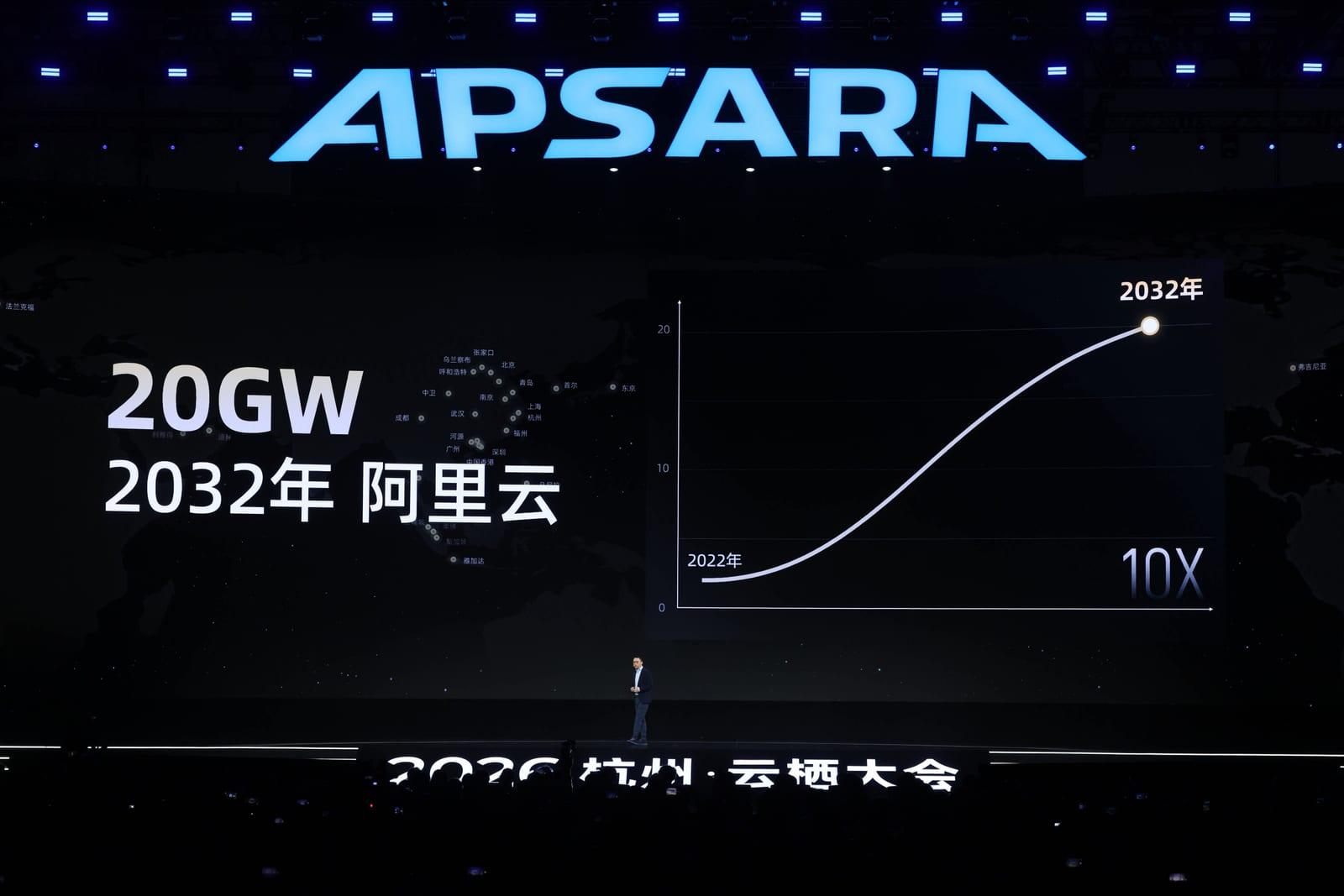
On top sit the models. Alibaba recently launched Qwen4-Max, built on 2.4 trillion backbone parameters, and its QwenWork agent platform now handles merchant chores on Taobao and Tmall from store operations to customer service. At its Apsara conference in September, the company set a goal of more than 20 gigawatts of data center capacity worldwide by 2032.
All of that is paid for upfront. The more interesting question is where the money returns.
Where the Money Has to Come Back
Not every AI unit is profitable yet. The AI Labs and Applications segment, home to the Qwen models and the consumer Qwen app, lost RMB10.5 billion on an adjusted basis, up from RMB3.4 billion a year earlier, mostly because of heavier investment and the cost of serving answers to Qwen app users. Free cash flow was negative RMB34.5 billion.
The older business is carrying weight it used to carry more easily. China e-commerce revenue fell 5% and international e-commerce fell 8% after European Union customs reforms, while quick commerce grew 22% and narrowed its losses. Reuters notes Alibaba's shares are down about 40% this year on worries about Chinese consumers and the cost of AI.
“As AI monetization continues to ramp up, we will maintain disciplined investments in AI capabilities with a focus on return on invested capital while targeting to achieve positive free cash flow.”— Toby Xu, CFO of Alibaba Group
That is the bargain on the table: spend now, and let a cloud business growing 53% a year pay it back. Non-GAAP net income already rose 92% to RMB19.9 billion this quarter. For a carmaker in Hangzhou or a biotech lab that would never build its own data center, the result is simpler still: the computing power is there to rent today.
Alibaba's Cloud Year in Numbers
The Brief
Stay curious
AI and technology: what changes and why it matters.
Your daily selection, in English or Spanish.
Free forever. Unsubscribe anytime.
More stories





Conversation
Start the conversation