
 The Specialty News
AfD Wins 39 Seats in Saxony-Anhalt — and Germany’s Post-War Firewall Faces Collapse
A former room-fragrance salesman used TikTok to bring a confirmed extremist party within three seats of total state control.

A 35-year-old former room-fragrance salesman who bypassed traditional media to campaign on TikTok just drove voter turnout in Saxony-Anhalt to its highest level since German reunification. Ulrich Siegmund didn't just win an election; he brought a party officially classified as a right-wing extremist group to the absolute brink of state power. His Alternative for Germany (AfD) captured 43.8% of the vote, doubling its previous result and dealing a catastrophic blow to Chancellor Friedrich Merz’s deeply unpopular national government.
The Math of an Earthquake
Siegmund's insurgent campaign focused on halting immigration, banning rainbow flags in schools, and swapping the state's "Think Modern" slogan for "Think German." It worked flawlessly. The AfD secured 39 seats in the 83-member state parliament.
To visualize how close they are: in a chamber of 83 desks, Siegmund’s faction now occupies nearly half the room, needing just three politicians to cross the aisle to claim absolute control. For 24 years, the center-right Christian Democrats (CDU) governed this eastern German state. On Sunday, their representation evaporated, plunging from 40 seats in 2021 down to a mere 15.
The sheer volume of the victory—achieved on a massive 77.8% turnout—erases any remaining illusion that the AfD is merely a fringe repository for protest votes. But winning the most votes in Germany does not automatically grant power, thanks to a deeply entrenched political doctrine that is about to face its ultimate stress test.
The Coalition of Losers

Since the founding of the modern German republic in 1949, establishment parties have maintained a gentleman's agreement known as the "firewall"—a blanket refusal to form coalitions with the far-right. Merz addressed a stunned press corps in Berlin, acknowledging the CDU's worst defeat in decades while promising that Germany's institutions remain stable.
Siegmund viewed the national leadership not as a threat, but as his greatest asset. He openly mocked the political establishment's disconnect from eastern German voters.
“A very good campaigner for us in this election campaign was Friedrich Merz. Every day this man is in the chancellery is one too many.”— Ulrich Siegmund
To uphold the firewall, the remaining mainstream parties—conservatives, socialists, and greens—must now attempt to build an ideologically fractured "coalition of losers" to block Siegmund. They must also grapple with the newly formed Sahra Wagenknecht Alliance (BSW), a populist, pro-Russia left-wing faction that just won five seats. The BSW mathematically holds the power to push the AfD over the line if they choose to break the blockade, but even if they stay out, the establishment faces a constitutional trap door.
The Third-Ballot Trap
The immediate battleground is the election of the state premier. If the establishment parties unite, they can technically install their own leader. However, assembling a stable government from the shattered, ideologically opposed remnants of the mainstream center and left will be extraordinarily fragile.
Here is the critical catch: under state law, a premier must be elected by an absolute majority in the first two rounds of voting. But if the parliament deadlocks and goes to a third ballot, the requirement drops to a simple plurality—meaning the candidate with the most votes wins.
Siegmund has already stated on public television that his party will not settle for a toothless minority role, threatening new elections if necessary. If the anti-AfD alliance fractures even slightly in a secret ballot, Siegmund could legally walk through the back door to become the first far-right state premier since World War II. For seventy-five years, Germany’s democratic firewall held by sheer mathematics. Now, it survives only on the fragile hope that a broken establishment won't blink.
What people are saying

“Germany: Saxony-Anhalt regional parliament election today 🇩🇪 🇪🇺 Infratest dimap exit poll Majority: 42 seats AfD-ESN: 39 (+16) CDU-EPP: 16 (-24) LINKE-LEFT: 8 (-4) GRÜNE-Greens/EFA: 8 (+2) SPD-S&D: 7 (-2) BSW-NI: 5 (new) More: #ltwst #ltwlsa”

“🇩🇪 SAXONY-ANHALT • GERMANY • EXIT POLLS 2026 Saxony-Anhalt State Election Infratest dimap Exit Poll 6 PM ⤴️ AfD: 44.5 | 39 seats ⚫️ CDU: 18.5 | 16 🚩 Linke: 9.5 | 8 🌻 Grüne: 9.0 | 8 🌹 SPD: 8.0 | 7 🟪 BSW: 5.0 | 5 ... Numbers in % ——— #SaxonyAnhalt #SachsenAnhalt #LTWST”
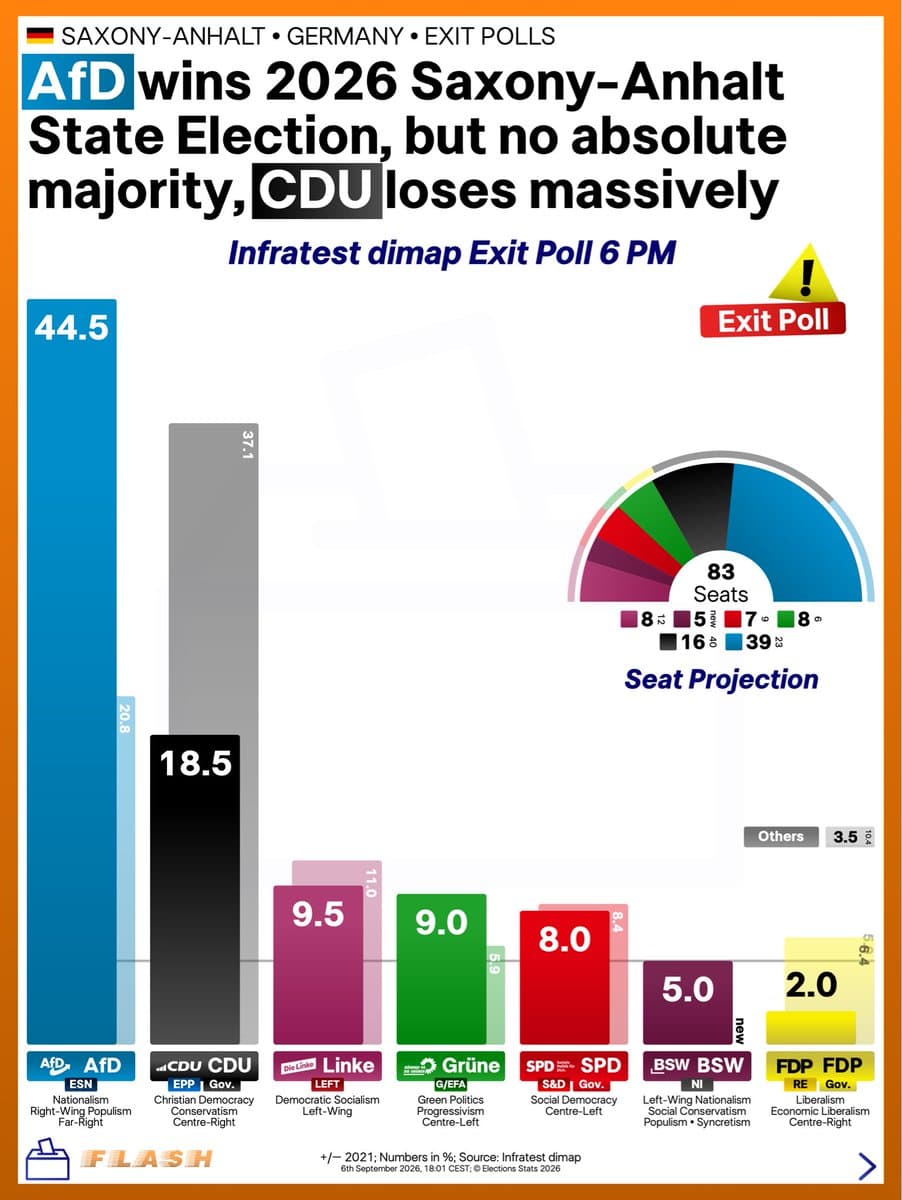

“🇩🇪 AfD has made history in Saxony-Anhalt, surging to around 44% and coming within touching distance of an absolute majority. The CDU collapsed from 37% to about 18%. Now the only way to keep AfD out of government may be a stretched anti-AfD coalition of CDU, SPD, Greens and the”
AfD Pushes Firewall to Collapse
The Brief
Stay curious
AI and technology: what changes and why it matters.
Your daily selection, in English or Spanish.
Free forever. Unsubscribe anytime.
More stories





Conversation
Start the conversation