
 The Specialty News
Meta Cuts Muse Spark API Costs by 92% — If You Hand Over Your Code
Muse Spark 1.3 officially beats OpenAI and Google in coding benchmarks, but its aggressive new pricing tier is quietly vacuuming up developer IP.
Developers are happily bartering their private codebases to Mark Zuckerberg in exchange for raw compute power. On Thursday, an open-source platform called OpenCode announced it was making Meta’s new Muse Spark 1.3 model completely free to its users, flooding Meta’s servers with a firehose of fresh engineering data disguised as a developer tool. The AI pricing war has officially mutated into a data harvest.
The Trojan Horse Model
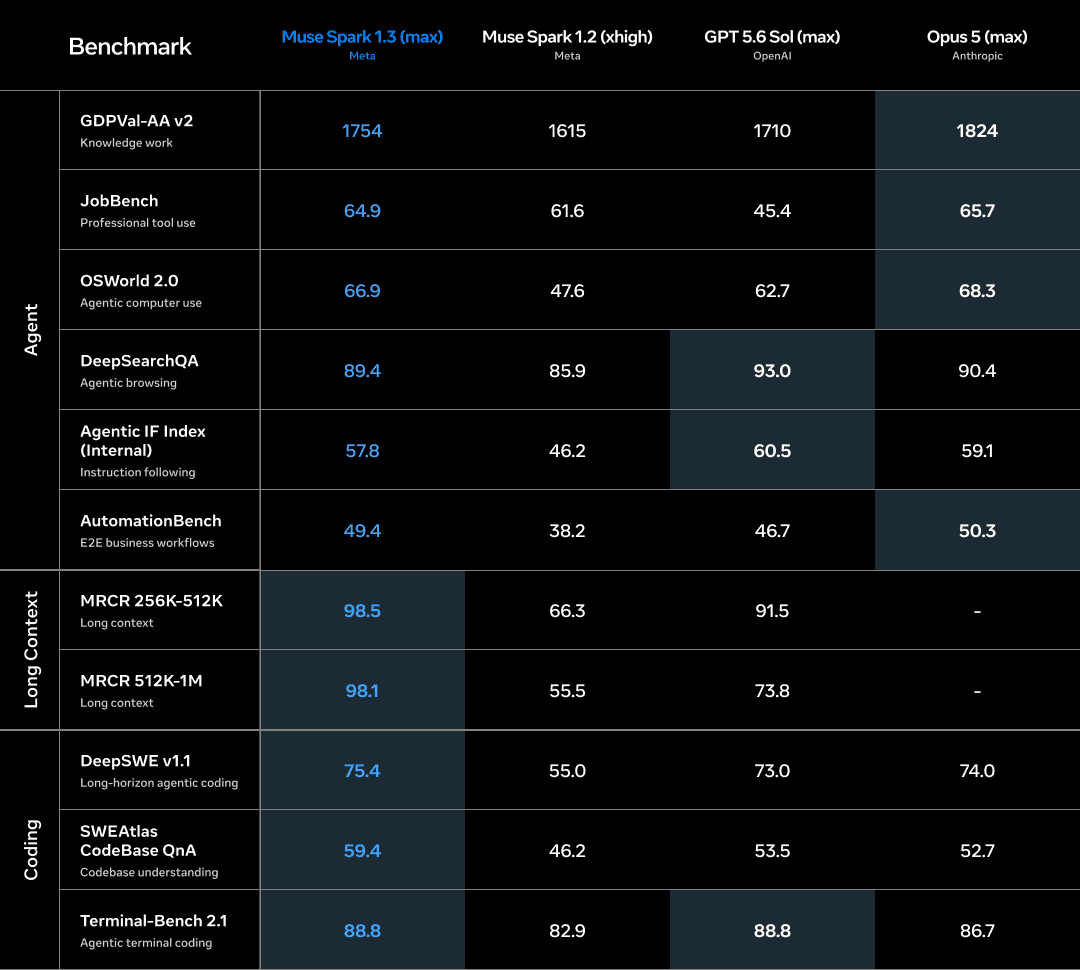
Today, Muse Spark 1.3 has dethroned Google’s Gemini 3.8 Flash and tied OpenAI’s GPT-5.6 Sol in long-context coding tasks. Hitting a score of 61 on the Artificial Analysis Intelligence Index, the model relies on heavy optimizations to use 20 percent fewer tool calls while navigating a million-token context window.
But Meta is not just selling access to this system. The company is aggressively acquiring the raw material for version 1.4 by introducing a "Contributor" pricing tier. This option drops API costs to near zero, provided developers grant Meta permission to train on their inputs.
When the developer platform OpenCode integrated this tier into its Zen service on Thursday, the cost dropped to exactly zero. Overnight, thousands of engineers hooked their repositories up to a highly capable, semi-autonomous agent. But the bill always comes due, and Meta has found a novel currency to collect.
The 92 Percent Faustian Bargain

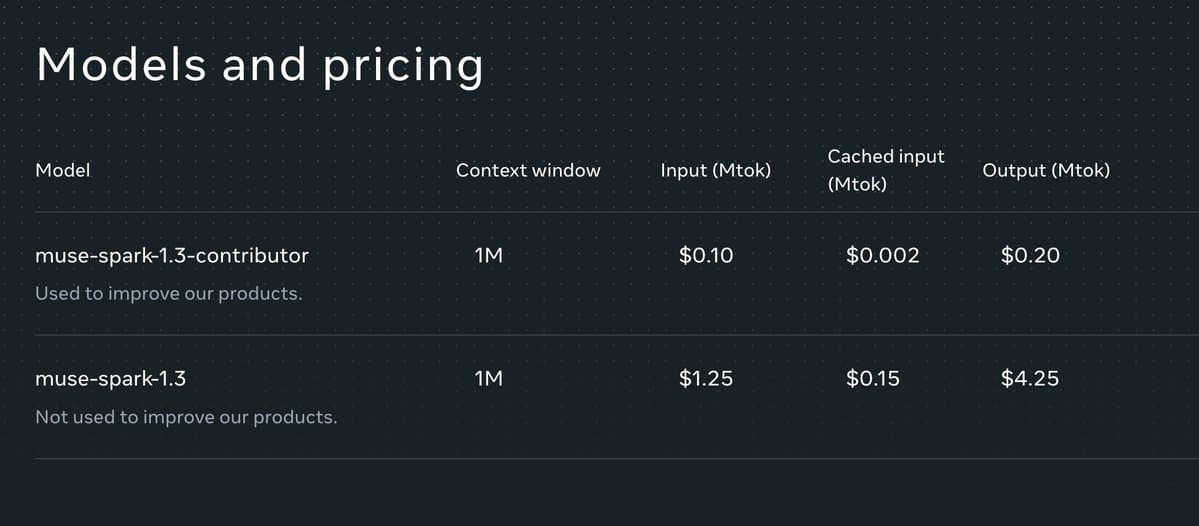
To understand the aggression of Meta’s strategy, look at the spread between its tiers. The standard enterprise API for Muse Spark 1.3 keeps data strictly private and costs $1.25 per million input tokens.
That 12-to-21-times price advantage against rival models drops the cost of renting a supercomputer to the price of a parking meter. Mark Zuckerberg is playing a ruthless volume game. Having pivoted from purely open-source weights to commercial models, he framed the release as delivering frontier performance "almost too cheap to meter."
“We get cheap models, they get cheap training data.”— Reddit user pigletmonster
The open-source community is fiercely divided over the arrangement. Pragmatists see a fair exchange of intellectual property for raw engineering power. Skeptics point out the obvious risk of feeding proprietary architecture into Meta’s servers to save a handful of dollars. For now, the allure of subsidized intelligence is winning, but it masks a much larger liability forming inside corporate IT departments.
The Corporate Timebomb
By subsidizing the Contributor tier so heavily, Meta is practically daring developers to paste private company code into OpenCode. The setup is a ticking clock. Eventually, a major corporation will discover its trade secrets were ingested by Meta’s training clusters because a rogue mid-level engineer wanted a free coding assistant.
The security questions compound when applied to Muse Spark 1.3’s architecture. This is a long-horizon agentic model designed to operate autonomously across repositories and execute terminal commands. Handing widespread, unmonitored access to an agent of this caliber opens vulnerabilities that enterprise security teams are completely unprepared to track.
The current zero-dollar price tag on OpenCode is also a documented limited-time promotion designed to build dependency. Once engineers are thoroughly embedded in the Muse Spark workflow, they will have to decide whether to start paying cash or continue trading their source code. The era of subsidized AI is ending, replaced by a ruthless new barter system where your data is the only currency that matters.
What people are saying

“Muse Spark 1.3 is now available in Muse Code and Meta Model API. It’s tuned for the agentic builds developers actually ship, including long-running, multi-agent workflows. 🧵👇(1/4)”

“Muse Spark 1.3 contributor pricing is just mind-blowingly unreal its literally deepseek pricing moment from a US AI lab”

“1/ today we’re releasing muse spark 1.3—available in muse code & the meta model api. this is our most capable model yet—frontier performance almost too cheap to meter. much stronger at agentic and coding with better usability. we think users will really notice the jump.”
Meta's 92% Faustian Bargain
The Brief
Stay curious
AI and technology: what changes and why it matters.
Your daily selection, in English or Spanish.
Free forever. Unsubscribe anytime.
More stories






Conversation
Start the conversation