
 The Specialty News
Gemini 4 Neon Ranks Third Overall at Up to 80% Less per Task
Google's new middle model costs $3 per million input tokens and, by Google's count, finishes a task for 50-80% less than the top rival frontier models.
Gemini 4 Neon, the model Google released on November 18, scores 61 on the Artificial Analysis Intelligence Index, third in the world, just behind larger and slower models. It costs $3 per million input tokens and $15 per million output tokens, 25% below the flagship Carbon's full rate. For developers who pay by the task, that gap is the story: by Google's count, Neon finishes the same job for roughly 50-80% less than the top competing frontier models.
Third Place From the Middle of the Family
Google now sells three Gemini 4 models. Carbon is the biggest, built for the hardest long-horizon projects. Hydrogen, released six days earlier, is the fast everyday model at $1.50 per million input tokens. Neon sits between them, and Google describes it as the one that "balances depth and efficiency".
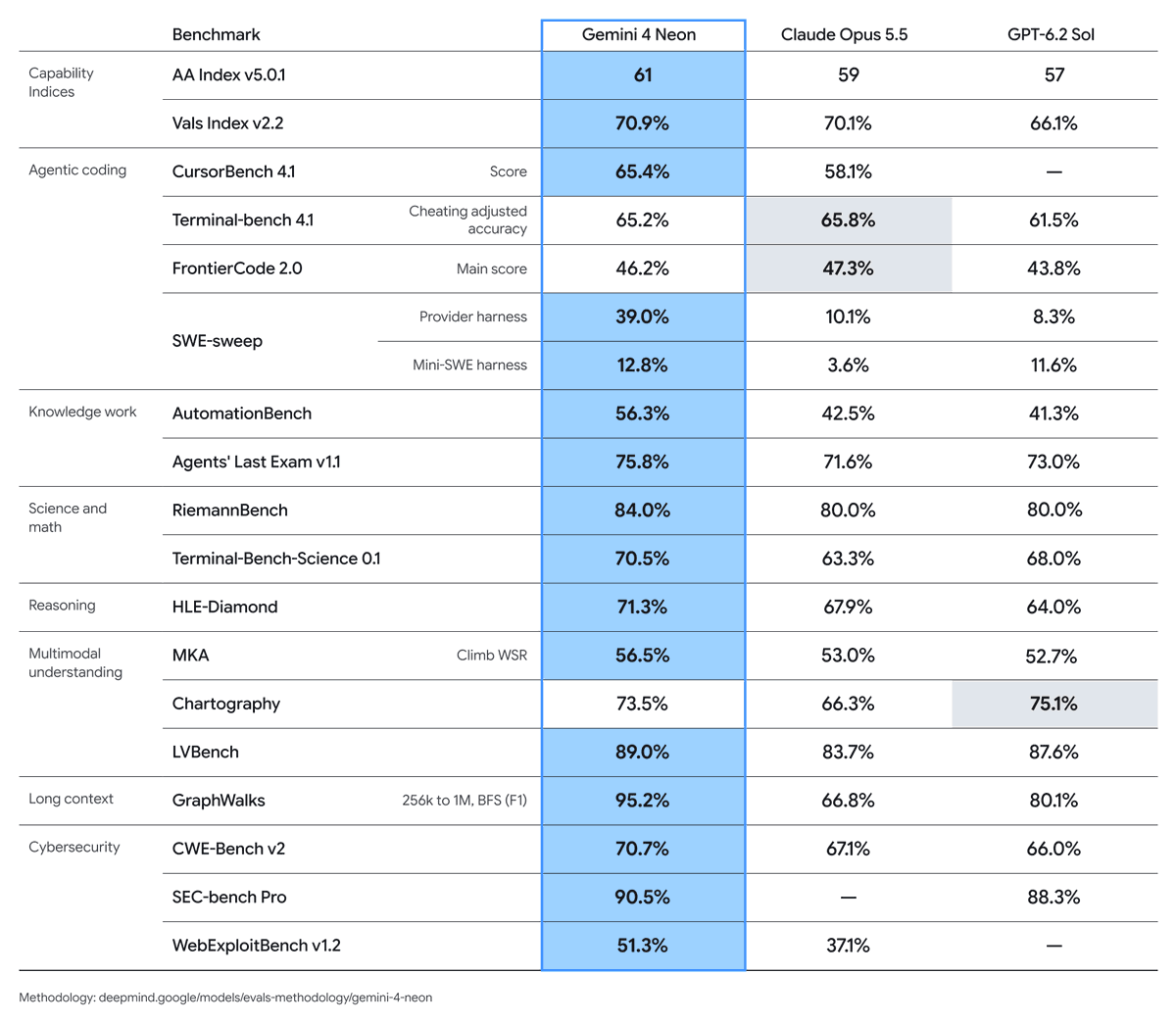
The scores suggest the middle seat is a strong one. Neon tops the Artificial Analysis Coding Agent Index with 58.6, ranks first on AutomationBench at 56.3% and runs the most profitable simulated shop on Vending-Bench 2, ending with $16,843. On the Agent Arena index, built from more than 4,200 real sessions, it debuted second in the world with 1,336 points.
“To me, Neon feels like the right balance of intelligence, speed, and usability.”— Logan Kilpatrick, Google
Science is where Google pushed hardest. Neon posts 70.5% on Terminal-Bench Science, 84.0% on RiemannBench and 71.3% on HLE-Diamond, all three best in class according to Google. Which raises the practical question for anyone with a budget: what does a task actually cost?
What $3 per Million Tokens Buys
At its default "high" thinking setting, Neon completes a task for 32% less than Carbon, Google says, and for roughly 50-80% less than the top competing frontier models. Cached input drops to $0.15 per million tokens, a 95% discount for agents that reread the same codebase or documents all day.
The list price helps too. Carbon and Argon sell at an introductory $2 and $10 until November 30, then move to $4 and $20 per million tokens. From December, Neon will cost 25% less than both while scoring close to them. Its one-million-token context window holds a mid-sized codebase or a stack of contracts in a single request.
Koray Kavukcuoglu, who leads Google DeepMind's technical work and signed the announcement, framed it for production work: "Neon is built for complex coding, analytical reasoning, and production-grade enterprise workflows." Early users went straight to the creative end. Sundar Pichai shared a clip of Neon building a photorealistic 3D lab in Blender, driven from inside Google's agent editor, Antigravity.
Where Opus 5.5 Still Leads, and Who Gets Neon Today
Google's own benchmark table shows the race is close. Neon scores 65.2% on Terminal-Bench 4.1 and 46.2% on FrontierCode 2.0, two coding tests where Anthropic's Opus 5.5 still edges it by a small margin. On the Artificial Analysis index, the two models above it are larger and slower, which is the trade Neon was designed to make.
Access is wide from day one. Developers on the paid Gemini API tier can call it in AI Studio and Android Studio, businesses get it through Gemini for business, and Google AI Pro and Ultra subscribers can pick it in the Gemini app and in Antigravity. Security teams get it through Google's Fairwind program for cyber defenders over the next few days. Developers are already mixing it in: Theo Browne, who runs several models side by side, now gives Neon the writing while others code and test.
For a startup paying per task, a model that ranks third in the world and finishes a task for a third less than the flagship turns ambitious agents from a demo into a line item it can afford.
What people are saying

“Introducing Gemini 4 Neon! Pushing the frontier across domains and punching above its model class in a meaningful way. To me, Neon feels like the right balance of intelligence, speed, and usability. Available now across @GoogleAIStudio, the API, and more!”

“Below Neon 3D modeled a photorealistic lab simulation in Antigravity via Blender MCP 🔥”
Three Gemini 4 Models in Three Weeks
The Brief
Stay curious
AI and technology: what changes and why it matters.
Your daily selection, in English or Spanish.
Free forever. Unsubscribe anytime.
More stories




Conversation
Start the conversation