
 The Specialty News
Anthropic Lets Companies Run Claude's Agents Entirely on Their Own Servers
The private beta moves the agent loop, sandboxes, credentials and session history inside the customer's walls, with Claude served by Anthropic, AWS, Google or Microsoft.

Until this week, a company that wanted Claude's agents to live entirely behind its own firewall had to build the agent platform itself. On November 12, Anthropic opened a private beta of self-hosted Claude Managed Agents, which lets customers run the whole service, from the agent loop to the session history, in their own cloud or data center. For banks, hospitals and governments that have watched AI agents from the sidelines, it takes one large item off the security review.
Every Piece Moves Inside the Fence
Managed Agents started as a hosted service. Anthropic ran the harness that loops Claude through a task, the sandboxes where its code runs and the database that remembers each session. In May the company let customers bring their own sandboxes, so tool execution could happen on their machines while the rest stayed with Anthropic.
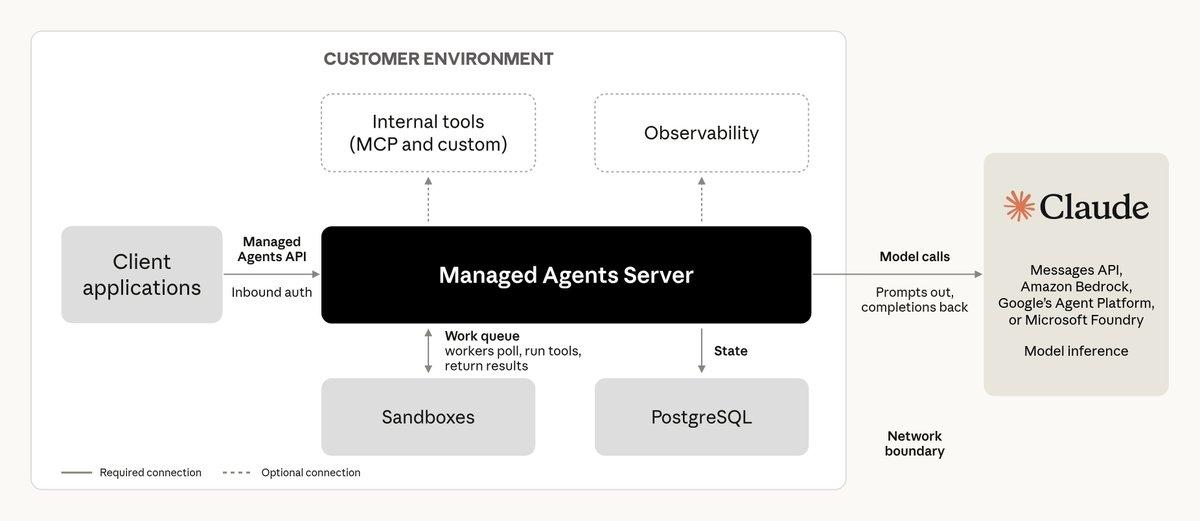
The new beta moves the rest. The customer runs a Managed Agents server that serves the API, drives the agent loop and stores agents, sessions and history; a PostgreSQL database, version 16 or later, that holds that state; and workers that execute the agent's shell and file tools in sandboxes the customer controls. Staff sign in to a console on that server through the company's own identity provider, and credentials can stay in the company's own secrets manager.
“Until now, that meant building the platform themselves.”— Anthropic
That sentence describes a real cost. An agent platform is unglamorous plumbing: queues, retries, permissions, logs and a record of every step an agent took. Teams in regulated industries were rebuilding that plumbing so the record would never sit on a vendor's servers. Now they can install it instead, which leaves one piece that still travels: the model itself.
Four Ways to Reach Claude, One Database to Keep
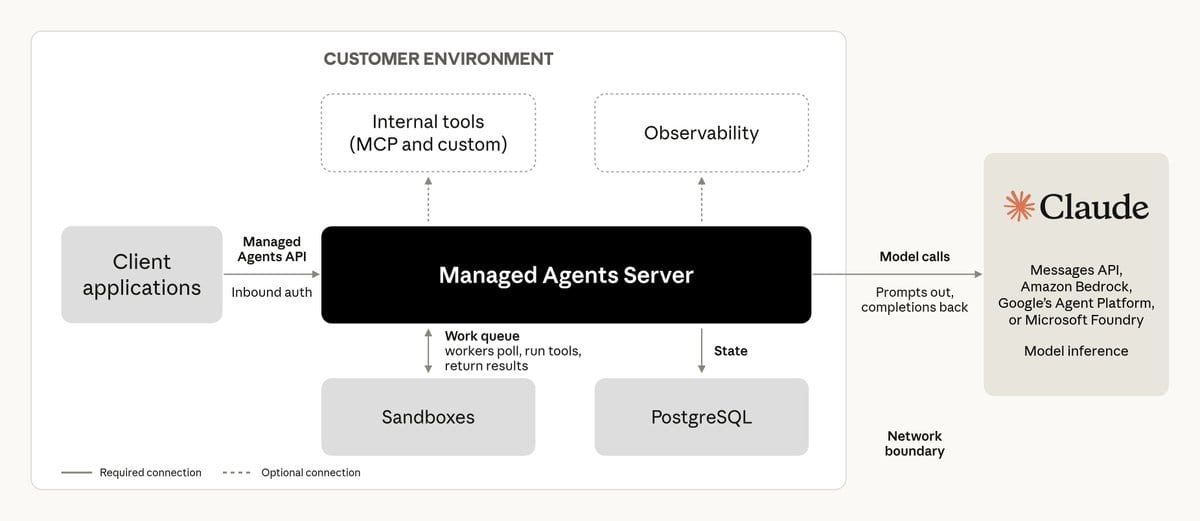
Claude still runs outside the customer's network. For each model call, the server sends the conversation so far, including tool inputs and results, to the provider the customer picks: Anthropic's Claude API by default, Amazon Bedrock, Google's Agent Platform, Microsoft Foundry, or a model gateway the company runs itself.
That choice matters more than it sounds. A company that already has a contract and a data agreement with AWS, Google or Microsoft can point its agents at the cloud its lawyers have already approved. Prompts go out and completions come back, while the agent's files, its memory and the full history of what it did stay in the company's own database.
The documentation is plain about what the customer now owns. The bash tool is a real shell with the worker's permissions and network access, so Anthropic recommends running workers in a disposable container or virtual machine, with a separate deployment for each trust level. Patching, firewall rules and spotting unusual usage become the customer's job as well. Which raises the interesting part: who signs up for that work?
Built for the Customers Who Said Not Yet
Access goes through Anthropic's account teams, the route reserved for large organizations, and the company has not published a price for the self-hosted version. The hosted service bills $0.08 per session-hour plus tokens. Nothing migrates automatically: agents, skills, vault credentials and memory stores are created again on the new server.
The people who gain the most are the ones who turned down hosted agents for good reasons. A hospital that cannot let patient records sit in a vendor's session log. A bank whose regulator wants every system on an approved list. A ministry with servers that never touch the public internet. For them, the question shifts from whether an outside agent platform can be trusted to whether their own team can run one.
For the developers inside those organizations, it means skipping months of plumbing and starting with agents that already loop, retry and remember. The agent can now live wherever the data already does.
What people are saying

“Self-hosted Claude Managed Agents is now in private beta. You can host the agent harness, sandboxes, and session history, in your own cloud or on-premises, and choose where requests to Claude are sent.”
Who Runs What, Now
The Brief
Stay curious
AI and technology: what changes and why it matters.
Your daily selection, in English or Spanish.
Free forever. Unsubscribe anytime.
More stories





Conversation
Start the conversation