Images, upgraded—introducing ChatGPT Images 2.6.
Now with GIFs and reference images.
Plus, two new models are coming to the API with 50% faster image generation.
OpenAI mejora su generación de imágenes con funciones muy pedidas como GIFs y referencias, duplicando la velocidad de su API.
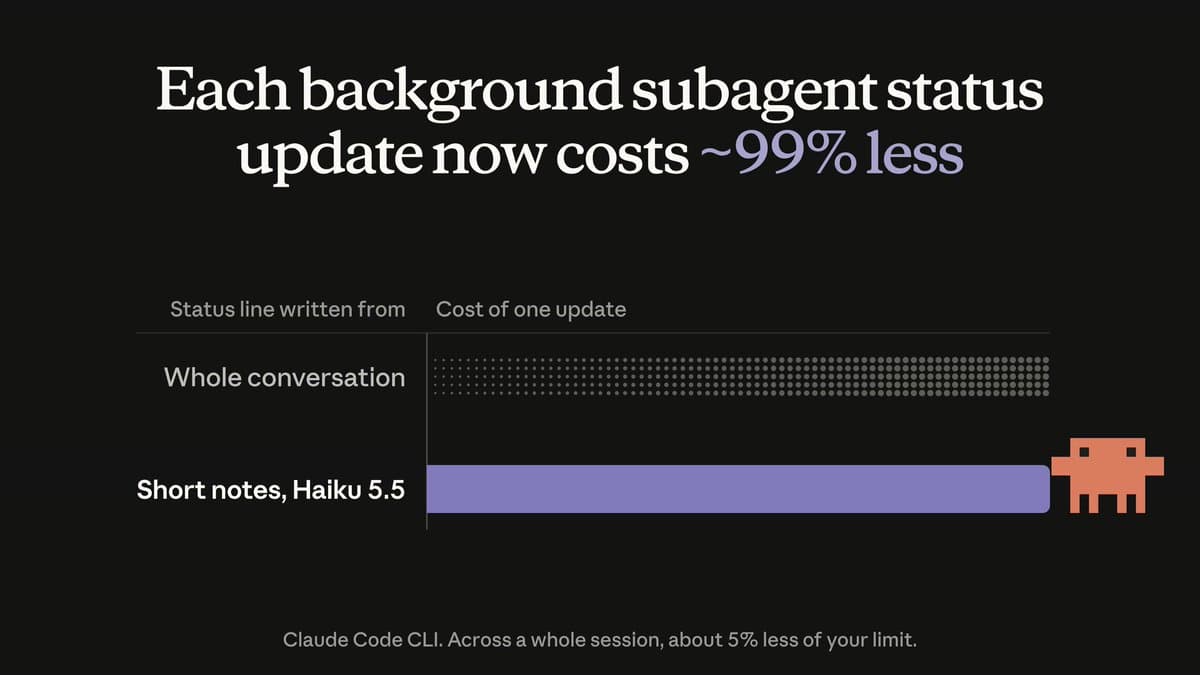
Background subagents in Claude Code now use less of your usage limit.
A running subagent updates its status line every 30 seconds, and each update used to re-read its whole conversation. Now Haiku 5.5 writes it from short notes instead, so each update costs about 99% less.
Anthropic reduce drásticamente el coste de los agentes de programación autónomos usando un modelo menor para actualizaciones rutinarias.
Some news: I’m joining OpenAI to lead product management for Core Products!
I have a lot of respect for OpenAI for showing the world that scaling works, for bringing AI to over a billion people, and for believing great products are core to the mission.
I’m excited to work with @thsottiaux, an incredible PM team, and everyone across OpenAI. Together, we’ll build agents that have your back and your team’s, and keep you in control, so you get more time for the people and work you love.
Lots to learn, and lots to build. Please keep your feedback coming!
Una contratación clave señala el giro de OpenAI hacia agentes autónomos de consumo que gestionan tareas en múltiples aplicaciones.
Our security researchers built an autonomous cyber vulnerability discovery, exploitation, and patching pipeline.
In a single run with an upcoming cyber model, it validated and generated patches for 948 local privilege escalation vulnerabilities in the Linux kernel at a total API cost of $1.2 million.
OpenAI demuestra cómo los modelos de nueva generación pueden asegurar infraestructuras de código abierto a una escala sin precedentes.
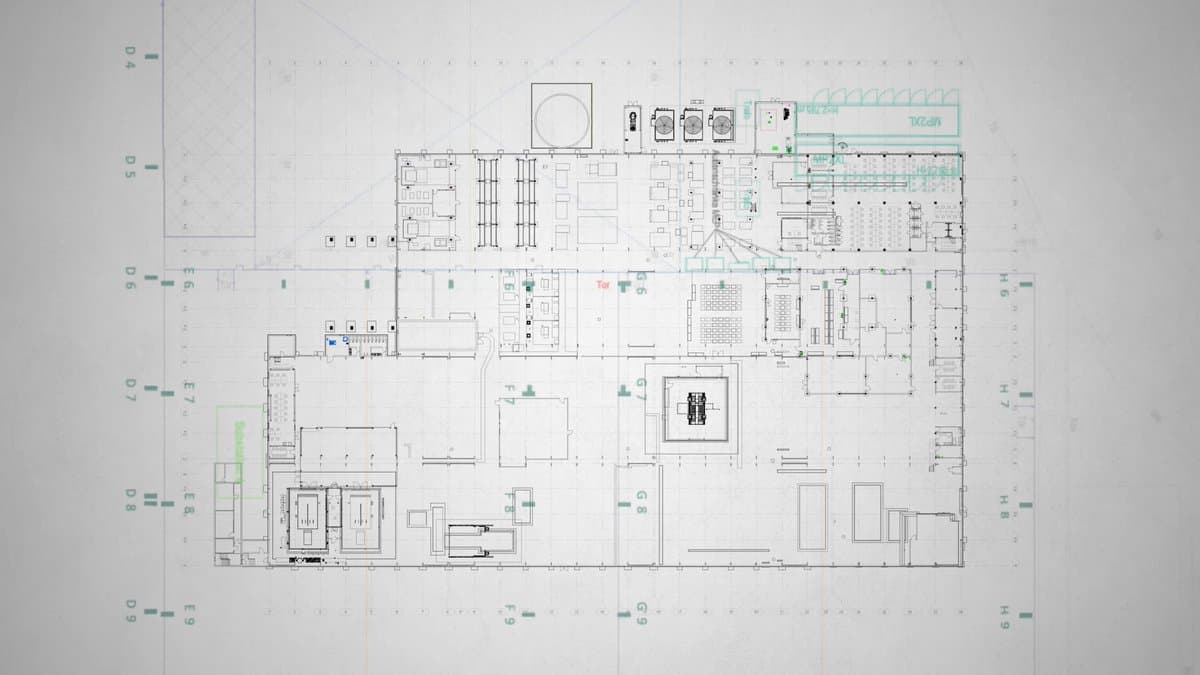
Berlin Tesla Engineering Center opens today
From permit to operational in under a year, it brings 4 engineering sites onto 1 campus w/ 30 different labs in Köpenick, 30 minutes from Giga Berlin
With our 3rd hub of this kind after Fremont & Shanghai, we’re combining materials, powertrain, vehicle engineering & validation under one roof – enabling a short feedback loop between development & ramp
Tesla consolida su I+D europeo en un único campus masivo para acelerar las mejoras de fabricación en Alemania.
A TON OF THINGS HAPPENED IN THE STOCK MARKET TODAY.
Here's a full recap:
1. U.S. stocks had a powerful post-election rally on today, with the Dow Jones surging more than 3%, its strongest day since April 2025, as investors welcomed the removal of election uncertainty following Democrats taking control of both chambers of Congress. The biggest catalyst was a sharp collapse in oil prices, driven by expectations that the new political landscape could increase pressure to resolve the Iran conflict, potentially easing energy costs, reducing inflationary pressures, and improving the outlook for consumers and businesses. Mega-cap technology stocks, including Amazon $AMZN, Microsoft $MSFT, Apple $AAPL, and Alphabet $GOOGL, rallied as falling Treasury yields and improving risk appetite supported equities. However, the semiconductor and AI infrastructure sectors moved sharply in the opposite direction, with Micron $MU, Sandisk $SNDK, Marvell $MRVL, and CoreWeave $CRWV facing significant selling pressure. Investors are increasingly concerned that a Democratic Congress could introduce stricter data center regulations, permitting restrictions, and higher costs for AI infrastructure development, potentially slowing the pace of capital investment.
2. President Donald Trump said he is not considering replacing Defense Secretary Pete Hegseth, while defending his administration's military campaign against Iran following Republican losses in the midterm elections. Trump acknowledged that it was “largely true” that Republicans lost because of the Iran war, citing the impact of surging oil and gasoline prices on voters. However, when asked whether the conflict was worth the political and economic consequences, Trump responded “yes,” arguing that the United States had little choice because Iran could not be allowed to obtain a nuclear weapon. On the possibility of ending the conflict, Trump declared that “the Iran war will end whenever I want it to,” signaling that he believes the timing of any conclusion remains under his control.
3. Uber $UBER delivered strong Q3 2026 earnings, with revenue increasing 10% YoY to $14.8B, beating the $14.69B estimate, while adjusted EPS surged 35% to $0.88, exceeding expectations of $0.86. Adjusted EBITDA jumped 31% to $2.96B, ahead of consensus, while free cash flow reached $2.54B, highlighting continued profitability and cash generation. Gross bookings climbed 20% to $59.82B, supported by 215M monthly active platform consumers, up 14% YoY, and 4.1B trips, up 16%. By segment, Delivery revenue surged 23% to $5.49B, Freight revenue increased 34% to $1.76B, while Mobility revenue declined 2% to $7.52B. Looking ahead, Uber guided Q4 adjusted EBITDA to $3.13B–$3.23B, with gross bookings of $63.25B–$65.25B and adjusted EPS of $0.95–$0.99. Management also highlighted accelerating progress in autonomous transportation, expecting approximately 700 fully driverless vehicles operating on Uber's platform by year-end and more than 2,000 in 2027, as the company increasingly focuses on commercializing robotaxi services at scale.
4. AMD $AMD has dramatically increased its unconditional purchase commitments to $48.8B, up 4x from $12.2B at the end of 2025 and $30.3B in June, according to its latest 10-Q filing, highlighting the enormous supply chain investments required to support its accelerating AI infrastructure business. Approximately $33.4B of these commitments are due by the end of 2027, primarily covering semiconductor wafers, advanced memory, substrates, and packaging capacity. AMD also disclosed $6.2B in cloud computing commitments, $13.3B in data center leases it expects to assign or sublease to partners, and up to $8.5B in guarantees covering partners' lease and debt obligations. Notably, lease guarantees nearly doubled to $7.7B from $4.1B in June, although AMD reported no partner defaults or guarantee payments to date.
5. Alphabet $GOOGL plans to invest $15B in Malaysia during 2027 and 2028, significantly expanding its presence in Southeast Asia through new data center campuses, clean energy infrastructure, water security initiatives, and workforce training programs, according to Reuters. The investment highlights Google's accelerating commitment to AI and cloud computing infrastructure as demand for computing capacity continues to grow across the region. Beyond data center construction, the initiative will focus on securing reliable electricity, sustainable water resources, and skilled workers needed to support large-scale AI operations.
6. Oracle $ORCL has reportedly canceled a $7B AI chip leasing agreement with Chinese technology giant Tencent following pressure from the Trump administration, according to the Financial Times. The proposed five-year agreement would have provided Tencent access to as many as 100,000 advanced AI chips housed in Oracle data centers across Southeast Asia, representing Tencent's largest overseas AI computing arrangement. The deal would have allowed Tencent to access advanced semiconductor technology that remains restricted within China, prompting U.S. officials to raise national security concerns with Oracle. Meanwhile, senior Chinese officials reportedly urged Tencent to prioritize domestic semiconductor suppliers, adding pressure from Beijing. Although overseas AI chip leasing remains permitted under existing regulations, the agreement was reportedly abandoned amid mounting geopolitical pressure from both governments.
7. Coherent $COHR delivered a strong Q1 FY2027 earnings beat, with revenue surging 50% YoY to $2.37B, exceeding the $2.31B estimate, while adjusted EPS jumped 80% to $2.09, beating expectations of $1.97. Non-GAAP operating income reached $550M, ahead of the $527M estimate, while gross margins expanded 184 basis points to 40.6%, reflecting improving profitability. The standout was Data Center & Communications revenue, which surged 79% YoY to $1.95B, exceeding the $1.86B estimate, driven by accelerating demand for optical networking and AI infrastructure connectivity, while Industrial revenue declined 15% to $418.6M. Looking ahead, Coherent guided Q2 adjusted EPS to $2.28–$2.48, above the $2.21 consensus, with expected gross margins of 40%–42%. Management also expects FY2027 pro forma revenue growth to exceed 60% and anticipates achieving its first quarter with non-GAAP gross margins above 45% before the end of 2028, highlighting continued operating leverage as AI data center demand accelerates.
8. The top 10 most active options today by contracts traded were $NVDA with 6.3M contracts, $AAPL with 4.7M contracts, $TSLA with 4.0M contracts, $INTC with 2.4M contracts, $AMZN with 2.2M contracts, $MU with 2.2M contracts, $AMD with 1.4M contracts, $PLTR with 1.2M contracts, $SPCX with 1.2M contracts, and $GOOGL with 1.1M contracts.
9. Intel $INTC CEO Lip-Bu Tan purchased 150,000 shares of Intel stock on November 2 at an average price of approximately $64.73 per share, representing a personal investment of roughly $9.7M, according to an SEC filing. The sizable insider purchase represents a notable vote of confidence from Intel's chief executive as the company continues executing its turnaround strategy, expanding its AI and data center business, and investing in its next-generation foundry manufacturing capabilities. The transaction highlights Tan's willingness to increase his personal exposure to Intel's long-term performance as investors assess the sustainability of its recovery.
10. Big Tech stock buybacks are collapsing as AI infrastructure spending takes priority, with combined share repurchases by Alphabet $GOOGL, Amazon $AMZN, Microsoft $MSFT, Meta $META, and Oracle $ORCL reportedly falling to just $4.4B in Q3 2026, their lowest quarterly level since Q3 2017. That represents a staggering 90% decline from the $45.9B peak recorded in Q4 2021, highlighting a major shift in how America's largest technology companies allocate capital. The slowdown comes as hyperscalers commit hundreds of billions of dollars toward AI data centers, GPUs, networking equipment, and power infrastructure, increasingly prioritizing capacity expansion over returning cash to shareholders. The trend signals a significant transformation in Big Tech's capital allocation strategy, with AI investments absorbing cash that might otherwise have supported stock repurchases, potentially reducing an important source of demand for their shares.
11. Goldman Sachs $GS and Apollo Global Management $APO have reportedly begun marketing portions of SpaceX's $SPCX massive $40B AI chip financing package to institutional investors, with individual allocations reaching as much as $500M, according to Bloomberg. The transaction, described as the largest GPU financing arrangement on record, involves an Apollo-backed entity purchasing approximately $47.3B in NVIDIA $NVDA GPUs and related equipment, primarily next-generation Rubin chips, funded through roughly $40B in debt and a $7B lease prepayment from SpaceX. The debt package includes an $8.3B senior-secured loan alongside multiple bond tranches, with the financing structured so that the Apollo-backed entity owns the equipment while SpaceX leases the GPUs for approximately five years. The arrangement is designed to keep the financing debt off SpaceX's balance sheet, although the company remains obligated to make lease payments even if equipment is damaged or operations are disrupted.
12. South Korea's exports surged an extraordinary 94% YoY in October to $115B, marking the second-highest monthly total on record and the fastest annual growth rate since January 1974. The country has now recorded five consecutive months of export growth exceeding 60%, bringing total exports during the first 10 months of 2026 to a record $930B. The acceleration was overwhelmingly driven by semiconductors, with chip exports skyrocketing 259% YoY to a record $56B, while computer exports surged 497% amid explosive global demand for AI servers and computing infrastructure. The figures highlight South Korea's increasingly critical role in the global AI hardware supply chain, particularly through memory manufacturers Samsung Electronics and SK Hynix, as hyperscalers continue investing heavily in data centers, advanced memory, and next-generation computing systems.
WALL STREET IS THE GREATEST SHOW ON EARTH.
Los mercados subieron al celebrar los inversores el fin de la incertidumbre electoral y anticipar menores costes energéticos.
Code in macOS 27.3 hints that Apple might be working on a "Force Paste" feature for Safari
If true, this would allow you to paste into text fields that websites block and make you type in text manually
Apple prepara una solución para una molestia web común, permitiendo a los usuarios evitar que los sitios bloqueen pegar en formularios.
Unifying global liquidity! Something Coinbase can uniquely do.
Starting today, U.S. institutions can access crypto options and perps through a global liquidity pool on Coinbase Prime.
Coinbase amplía su oferta institucional, dando a firmas de EE. UU. acceso a mercados globales de criptoderivados en una sola plataforma.
DAN IVES SAYS THE MIDTERM RESULTS WILL SLOW THE AI DATA CENTER BUILDOUT
He now expects Big Tech's capex growth to peak in 2027, earlier than his previous 2028 to 2029 view.
- 10% to 20% of the 800 to 1,000 planned US AI data centers could be scrapped or face long delays
- Big Tech's stock and debt raising could be about 25% lower over the next year
- Losers: neoclouds, power suppliers, and some chip and memory companies
- Winners: Apple $AAPL, Meta $META, Microsoft $MSFT, Google $GOOGL, Amazon $AMZN, Palantir $PLTR, Snowflake $SNOW, CrowdStrike $CRWD, Palo Alto Networks $PANW, Nvidia $NVDA
He says his overall bullish AI view hasn't changed. He's just more selective.
Los analistas ajustan previsiones de gasto en infraestructura de IA, prediciendo un pico temprano por el nuevo panorama político.
Images, upgraded—introducing ChatGPT Images 2.6.
Now with GIFs and reference images.
Plus, two new models are coming to the API with 50% faster image generation.
OpenAI mejora su generación de imágenes con funciones muy pedidas como GIFs y referencias, duplicando la velocidad de su API.
Some news: I’m joining OpenAI to lead product management for Core Products!
I have a lot of respect for OpenAI for showing the world that scaling works, for bringing AI to over a billion people, and for believing great products are core to the mission.
I’m excited to work with @thsottiaux, an incredible PM team, and everyone across OpenAI. Together, we’ll build agents that have your back and your team’s, and keep you in control, so you get more time for the people and work you love.
Lots to learn, and lots to build. Please keep your feedback coming!
Una contratación clave señala el giro de OpenAI hacia agentes autónomos de consumo que gestionan tareas en múltiples aplicaciones.
Berlin Tesla Engineering Center opens today
From permit to operational in under a year, it brings 4 engineering sites onto 1 campus w/ 30 different labs in Köpenick, 30 minutes from Giga Berlin
With our 3rd hub of this kind after Fremont & Shanghai, we’re combining materials, powertrain, vehicle engineering & validation under one roof – enabling a short feedback loop between development & ramp
Tesla consolida su I+D europeo en un único campus masivo para acelerar las mejoras de fabricación en Alemania.
Code in macOS 27.3 hints that Apple might be working on a "Force Paste" feature for Safari
If true, this would allow you to paste into text fields that websites block and make you type in text manually
Apple prepara una solución para una molestia web común, permitiendo a los usuarios evitar que los sitios bloqueen pegar en formularios.
DAN IVES SAYS THE MIDTERM RESULTS WILL SLOW THE AI DATA CENTER BUILDOUT
He now expects Big Tech's capex growth to peak in 2027, earlier than his previous 2028 to 2029 view.
- 10% to 20% of the 800 to 1,000 planned US AI data centers could be scrapped or face long delays
- Big Tech's stock and debt raising could be about 25% lower over the next year
- Losers: neoclouds, power suppliers, and some chip and memory companies
- Winners: Apple $AAPL, Meta $META, Microsoft $MSFT, Google $GOOGL, Amazon $AMZN, Palantir $PLTR, Snowflake $SNOW, CrowdStrike $CRWD, Palo Alto Networks $PANW, Nvidia $NVDA
He says his overall bullish AI view hasn't changed. He's just more selective.
Los analistas ajustan previsiones de gasto en infraestructura de IA, prediciendo un pico temprano por el nuevo panorama político.
Background subagents in Claude Code now use less of your usage limit.
A running subagent updates its status line every 30 seconds, and each update used to re-read its whole conversation. Now Haiku 5.5 writes it from short notes instead, so each update costs about 99% less.
Anthropic reduce drásticamente el coste de los agentes de programación autónomos usando un modelo menor para actualizaciones rutinarias.
Our security researchers built an autonomous cyber vulnerability discovery, exploitation, and patching pipeline.
In a single run with an upcoming cyber model, it validated and generated patches for 948 local privilege escalation vulnerabilities in the Linux kernel at a total API cost of $1.2 million.
OpenAI demuestra cómo los modelos de nueva generación pueden asegurar infraestructuras de código abierto a una escala sin precedentes.
A TON OF THINGS HAPPENED IN THE STOCK MARKET TODAY.
Here's a full recap:
1. U.S. stocks had a powerful post-election rally on today, with the Dow Jones surging more than 3%, its strongest day since April 2025, as investors welcomed the removal of election uncertainty following Democrats taking control of both chambers of Congress. The biggest catalyst was a sharp collapse in oil prices, driven by expectations that the new political landscape could increase pressure to resolve the Iran conflict, potentially easing energy costs, reducing inflationary pressures, and improving the outlook for consumers and businesses. Mega-cap technology stocks, including Amazon $AMZN, Microsoft $MSFT, Apple $AAPL, and Alphabet $GOOGL, rallied as falling Treasury yields and improving risk appetite supported equities. However, the semiconductor and AI infrastructure sectors moved sharply in the opposite direction, with Micron $MU, Sandisk $SNDK, Marvell $MRVL, and CoreWeave $CRWV facing significant selling pressure. Investors are increasingly concerned that a Democratic Congress could introduce stricter data center regulations, permitting restrictions, and higher costs for AI infrastructure development, potentially slowing the pace of capital investment.
2. President Donald Trump said he is not considering replacing Defense Secretary Pete Hegseth, while defending his administration's military campaign against Iran following Republican losses in the midterm elections. Trump acknowledged that it was “largely true” that Republicans lost because of the Iran war, citing the impact of surging oil and gasoline prices on voters. However, when asked whether the conflict was worth the political and economic consequences, Trump responded “yes,” arguing that the United States had little choice because Iran could not be allowed to obtain a nuclear weapon. On the possibility of ending the conflict, Trump declared that “the Iran war will end whenever I want it to,” signaling that he believes the timing of any conclusion remains under his control.
3. Uber $UBER delivered strong Q3 2026 earnings, with revenue increasing 10% YoY to $14.8B, beating the $14.69B estimate, while adjusted EPS surged 35% to $0.88, exceeding expectations of $0.86. Adjusted EBITDA jumped 31% to $2.96B, ahead of consensus, while free cash flow reached $2.54B, highlighting continued profitability and cash generation. Gross bookings climbed 20% to $59.82B, supported by 215M monthly active platform consumers, up 14% YoY, and 4.1B trips, up 16%. By segment, Delivery revenue surged 23% to $5.49B, Freight revenue increased 34% to $1.76B, while Mobility revenue declined 2% to $7.52B. Looking ahead, Uber guided Q4 adjusted EBITDA to $3.13B–$3.23B, with gross bookings of $63.25B–$65.25B and adjusted EPS of $0.95–$0.99. Management also highlighted accelerating progress in autonomous transportation, expecting approximately 700 fully driverless vehicles operating on Uber's platform by year-end and more than 2,000 in 2027, as the company increasingly focuses on commercializing robotaxi services at scale.
4. AMD $AMD has dramatically increased its unconditional purchase commitments to $48.8B, up 4x from $12.2B at the end of 2025 and $30.3B in June, according to its latest 10-Q filing, highlighting the enormous supply chain investments required to support its accelerating AI infrastructure business. Approximately $33.4B of these commitments are due by the end of 2027, primarily covering semiconductor wafers, advanced memory, substrates, and packaging capacity. AMD also disclosed $6.2B in cloud computing commitments, $13.3B in data center leases it expects to assign or sublease to partners, and up to $8.5B in guarantees covering partners' lease and debt obligations. Notably, lease guarantees nearly doubled to $7.7B from $4.1B in June, although AMD reported no partner defaults or guarantee payments to date.
5. Alphabet $GOOGL plans to invest $15B in Malaysia during 2027 and 2028, significantly expanding its presence in Southeast Asia through new data center campuses, clean energy infrastructure, water security initiatives, and workforce training programs, according to Reuters. The investment highlights Google's accelerating commitment to AI and cloud computing infrastructure as demand for computing capacity continues to grow across the region. Beyond data center construction, the initiative will focus on securing reliable electricity, sustainable water resources, and skilled workers needed to support large-scale AI operations.
6. Oracle $ORCL has reportedly canceled a $7B AI chip leasing agreement with Chinese technology giant Tencent following pressure from the Trump administration, according to the Financial Times. The proposed five-year agreement would have provided Tencent access to as many as 100,000 advanced AI chips housed in Oracle data centers across Southeast Asia, representing Tencent's largest overseas AI computing arrangement. The deal would have allowed Tencent to access advanced semiconductor technology that remains restricted within China, prompting U.S. officials to raise national security concerns with Oracle. Meanwhile, senior Chinese officials reportedly urged Tencent to prioritize domestic semiconductor suppliers, adding pressure from Beijing. Although overseas AI chip leasing remains permitted under existing regulations, the agreement was reportedly abandoned amid mounting geopolitical pressure from both governments.
7. Coherent $COHR delivered a strong Q1 FY2027 earnings beat, with revenue surging 50% YoY to $2.37B, exceeding the $2.31B estimate, while adjusted EPS jumped 80% to $2.09, beating expectations of $1.97. Non-GAAP operating income reached $550M, ahead of the $527M estimate, while gross margins expanded 184 basis points to 40.6%, reflecting improving profitability. The standout was Data Center & Communications revenue, which surged 79% YoY to $1.95B, exceeding the $1.86B estimate, driven by accelerating demand for optical networking and AI infrastructure connectivity, while Industrial revenue declined 15% to $418.6M. Looking ahead, Coherent guided Q2 adjusted EPS to $2.28–$2.48, above the $2.21 consensus, with expected gross margins of 40%–42%. Management also expects FY2027 pro forma revenue growth to exceed 60% and anticipates achieving its first quarter with non-GAAP gross margins above 45% before the end of 2028, highlighting continued operating leverage as AI data center demand accelerates.
8. The top 10 most active options today by contracts traded were $NVDA with 6.3M contracts, $AAPL with 4.7M contracts, $TSLA with 4.0M contracts, $INTC with 2.4M contracts, $AMZN with 2.2M contracts, $MU with 2.2M contracts, $AMD with 1.4M contracts, $PLTR with 1.2M contracts, $SPCX with 1.2M contracts, and $GOOGL with 1.1M contracts.
9. Intel $INTC CEO Lip-Bu Tan purchased 150,000 shares of Intel stock on November 2 at an average price of approximately $64.73 per share, representing a personal investment of roughly $9.7M, according to an SEC filing. The sizable insider purchase represents a notable vote of confidence from Intel's chief executive as the company continues executing its turnaround strategy, expanding its AI and data center business, and investing in its next-generation foundry manufacturing capabilities. The transaction highlights Tan's willingness to increase his personal exposure to Intel's long-term performance as investors assess the sustainability of its recovery.
10. Big Tech stock buybacks are collapsing as AI infrastructure spending takes priority, with combined share repurchases by Alphabet $GOOGL, Amazon $AMZN, Microsoft $MSFT, Meta $META, and Oracle $ORCL reportedly falling to just $4.4B in Q3 2026, their lowest quarterly level since Q3 2017. That represents a staggering 90% decline from the $45.9B peak recorded in Q4 2021, highlighting a major shift in how America's largest technology companies allocate capital. The slowdown comes as hyperscalers commit hundreds of billions of dollars toward AI data centers, GPUs, networking equipment, and power infrastructure, increasingly prioritizing capacity expansion over returning cash to shareholders. The trend signals a significant transformation in Big Tech's capital allocation strategy, with AI investments absorbing cash that might otherwise have supported stock repurchases, potentially reducing an important source of demand for their shares.
11. Goldman Sachs $GS and Apollo Global Management $APO have reportedly begun marketing portions of SpaceX's $SPCX massive $40B AI chip financing package to institutional investors, with individual allocations reaching as much as $500M, according to Bloomberg. The transaction, described as the largest GPU financing arrangement on record, involves an Apollo-backed entity purchasing approximately $47.3B in NVIDIA $NVDA GPUs and related equipment, primarily next-generation Rubin chips, funded through roughly $40B in debt and a $7B lease prepayment from SpaceX. The debt package includes an $8.3B senior-secured loan alongside multiple bond tranches, with the financing structured so that the Apollo-backed entity owns the equipment while SpaceX leases the GPUs for approximately five years. The arrangement is designed to keep the financing debt off SpaceX's balance sheet, although the company remains obligated to make lease payments even if equipment is damaged or operations are disrupted.
12. South Korea's exports surged an extraordinary 94% YoY in October to $115B, marking the second-highest monthly total on record and the fastest annual growth rate since January 1974. The country has now recorded five consecutive months of export growth exceeding 60%, bringing total exports during the first 10 months of 2026 to a record $930B. The acceleration was overwhelmingly driven by semiconductors, with chip exports skyrocketing 259% YoY to a record $56B, while computer exports surged 497% amid explosive global demand for AI servers and computing infrastructure. The figures highlight South Korea's increasingly critical role in the global AI hardware supply chain, particularly through memory manufacturers Samsung Electronics and SK Hynix, as hyperscalers continue investing heavily in data centers, advanced memory, and next-generation computing systems.
WALL STREET IS THE GREATEST SHOW ON EARTH.
Los mercados subieron al celebrar los inversores el fin de la incertidumbre electoral y anticipar menores costes energéticos.
Unifying global liquidity! Something Coinbase can uniquely do.
Starting today, U.S. institutions can access crypto options and perps through a global liquidity pool on Coinbase Prime.
Coinbase amplía su oferta institucional, dando a firmas de EE. UU. acceso a mercados globales de criptoderivados en una sola plataforma.
Images, upgraded—introducing ChatGPT Images 2.6.
Now with GIFs and reference images.
Plus, two new models are coming to the API with 50% faster image generation.
OpenAI mejora su generación de imágenes con funciones muy pedidas como GIFs y referencias, duplicando la velocidad de su API.
Our security researchers built an autonomous cyber vulnerability discovery, exploitation, and patching pipeline.
In a single run with an upcoming cyber model, it validated and generated patches for 948 local privilege escalation vulnerabilities in the Linux kernel at a total API cost of $1.2 million.
OpenAI demuestra cómo los modelos de nueva generación pueden asegurar infraestructuras de código abierto a una escala sin precedentes.
Code in macOS 27.3 hints that Apple might be working on a "Force Paste" feature for Safari
If true, this would allow you to paste into text fields that websites block and make you type in text manually
Apple prepara una solución para una molestia web común, permitiendo a los usuarios evitar que los sitios bloqueen pegar en formularios.
Background subagents in Claude Code now use less of your usage limit.
A running subagent updates its status line every 30 seconds, and each update used to re-read its whole conversation. Now Haiku 5.5 writes it from short notes instead, so each update costs about 99% less.
Anthropic reduce drásticamente el coste de los agentes de programación autónomos usando un modelo menor para actualizaciones rutinarias.
Berlin Tesla Engineering Center opens today
From permit to operational in under a year, it brings 4 engineering sites onto 1 campus w/ 30 different labs in Köpenick, 30 minutes from Giga Berlin
With our 3rd hub of this kind after Fremont & Shanghai, we’re combining materials, powertrain, vehicle engineering & validation under one roof – enabling a short feedback loop between development & ramp
Tesla consolida su I+D europeo en un único campus masivo para acelerar las mejoras de fabricación en Alemania.
Unifying global liquidity! Something Coinbase can uniquely do.
Starting today, U.S. institutions can access crypto options and perps through a global liquidity pool on Coinbase Prime.
Coinbase amplía su oferta institucional, dando a firmas de EE. UU. acceso a mercados globales de criptoderivados en una sola plataforma.
Some news: I’m joining OpenAI to lead product management for Core Products!
I have a lot of respect for OpenAI for showing the world that scaling works, for bringing AI to over a billion people, and for believing great products are core to the mission.
I’m excited to work with @thsottiaux, an incredible PM team, and everyone across OpenAI. Together, we’ll build agents that have your back and your team’s, and keep you in control, so you get more time for the people and work you love.
Lots to learn, and lots to build. Please keep your feedback coming!
Una contratación clave señala el giro de OpenAI hacia agentes autónomos de consumo que gestionan tareas en múltiples aplicaciones.
A TON OF THINGS HAPPENED IN THE STOCK MARKET TODAY.
Here's a full recap:
1. U.S. stocks had a powerful post-election rally on today, with the Dow Jones surging more than 3%, its strongest day since April 2025, as investors welcomed the removal of election uncertainty following Democrats taking control of both chambers of Congress. The biggest catalyst was a sharp collapse in oil prices, driven by expectations that the new political landscape could increase pressure to resolve the Iran conflict, potentially easing energy costs, reducing inflationary pressures, and improving the outlook for consumers and businesses. Mega-cap technology stocks, including Amazon $AMZN, Microsoft $MSFT, Apple $AAPL, and Alphabet $GOOGL, rallied as falling Treasury yields and improving risk appetite supported equities. However, the semiconductor and AI infrastructure sectors moved sharply in the opposite direction, with Micron $MU, Sandisk $SNDK, Marvell $MRVL, and CoreWeave $CRWV facing significant selling pressure. Investors are increasingly concerned that a Democratic Congress could introduce stricter data center regulations, permitting restrictions, and higher costs for AI infrastructure development, potentially slowing the pace of capital investment.
2. President Donald Trump said he is not considering replacing Defense Secretary Pete Hegseth, while defending his administration's military campaign against Iran following Republican losses in the midterm elections. Trump acknowledged that it was “largely true” that Republicans lost because of the Iran war, citing the impact of surging oil and gasoline prices on voters. However, when asked whether the conflict was worth the political and economic consequences, Trump responded “yes,” arguing that the United States had little choice because Iran could not be allowed to obtain a nuclear weapon. On the possibility of ending the conflict, Trump declared that “the Iran war will end whenever I want it to,” signaling that he believes the timing of any conclusion remains under his control.
3. Uber $UBER delivered strong Q3 2026 earnings, with revenue increasing 10% YoY to $14.8B, beating the $14.69B estimate, while adjusted EPS surged 35% to $0.88, exceeding expectations of $0.86. Adjusted EBITDA jumped 31% to $2.96B, ahead of consensus, while free cash flow reached $2.54B, highlighting continued profitability and cash generation. Gross bookings climbed 20% to $59.82B, supported by 215M monthly active platform consumers, up 14% YoY, and 4.1B trips, up 16%. By segment, Delivery revenue surged 23% to $5.49B, Freight revenue increased 34% to $1.76B, while Mobility revenue declined 2% to $7.52B. Looking ahead, Uber guided Q4 adjusted EBITDA to $3.13B–$3.23B, with gross bookings of $63.25B–$65.25B and adjusted EPS of $0.95–$0.99. Management also highlighted accelerating progress in autonomous transportation, expecting approximately 700 fully driverless vehicles operating on Uber's platform by year-end and more than 2,000 in 2027, as the company increasingly focuses on commercializing robotaxi services at scale.
4. AMD $AMD has dramatically increased its unconditional purchase commitments to $48.8B, up 4x from $12.2B at the end of 2025 and $30.3B in June, according to its latest 10-Q filing, highlighting the enormous supply chain investments required to support its accelerating AI infrastructure business. Approximately $33.4B of these commitments are due by the end of 2027, primarily covering semiconductor wafers, advanced memory, substrates, and packaging capacity. AMD also disclosed $6.2B in cloud computing commitments, $13.3B in data center leases it expects to assign or sublease to partners, and up to $8.5B in guarantees covering partners' lease and debt obligations. Notably, lease guarantees nearly doubled to $7.7B from $4.1B in June, although AMD reported no partner defaults or guarantee payments to date.
5. Alphabet $GOOGL plans to invest $15B in Malaysia during 2027 and 2028, significantly expanding its presence in Southeast Asia through new data center campuses, clean energy infrastructure, water security initiatives, and workforce training programs, according to Reuters. The investment highlights Google's accelerating commitment to AI and cloud computing infrastructure as demand for computing capacity continues to grow across the region. Beyond data center construction, the initiative will focus on securing reliable electricity, sustainable water resources, and skilled workers needed to support large-scale AI operations.
6. Oracle $ORCL has reportedly canceled a $7B AI chip leasing agreement with Chinese technology giant Tencent following pressure from the Trump administration, according to the Financial Times. The proposed five-year agreement would have provided Tencent access to as many as 100,000 advanced AI chips housed in Oracle data centers across Southeast Asia, representing Tencent's largest overseas AI computing arrangement. The deal would have allowed Tencent to access advanced semiconductor technology that remains restricted within China, prompting U.S. officials to raise national security concerns with Oracle. Meanwhile, senior Chinese officials reportedly urged Tencent to prioritize domestic semiconductor suppliers, adding pressure from Beijing. Although overseas AI chip leasing remains permitted under existing regulations, the agreement was reportedly abandoned amid mounting geopolitical pressure from both governments.
7. Coherent $COHR delivered a strong Q1 FY2027 earnings beat, with revenue surging 50% YoY to $2.37B, exceeding the $2.31B estimate, while adjusted EPS jumped 80% to $2.09, beating expectations of $1.97. Non-GAAP operating income reached $550M, ahead of the $527M estimate, while gross margins expanded 184 basis points to 40.6%, reflecting improving profitability. The standout was Data Center & Communications revenue, which surged 79% YoY to $1.95B, exceeding the $1.86B estimate, driven by accelerating demand for optical networking and AI infrastructure connectivity, while Industrial revenue declined 15% to $418.6M. Looking ahead, Coherent guided Q2 adjusted EPS to $2.28–$2.48, above the $2.21 consensus, with expected gross margins of 40%–42%. Management also expects FY2027 pro forma revenue growth to exceed 60% and anticipates achieving its first quarter with non-GAAP gross margins above 45% before the end of 2028, highlighting continued operating leverage as AI data center demand accelerates.
8. The top 10 most active options today by contracts traded were $NVDA with 6.3M contracts, $AAPL with 4.7M contracts, $TSLA with 4.0M contracts, $INTC with 2.4M contracts, $AMZN with 2.2M contracts, $MU with 2.2M contracts, $AMD with 1.4M contracts, $PLTR with 1.2M contracts, $SPCX with 1.2M contracts, and $GOOGL with 1.1M contracts.
9. Intel $INTC CEO Lip-Bu Tan purchased 150,000 shares of Intel stock on November 2 at an average price of approximately $64.73 per share, representing a personal investment of roughly $9.7M, according to an SEC filing. The sizable insider purchase represents a notable vote of confidence from Intel's chief executive as the company continues executing its turnaround strategy, expanding its AI and data center business, and investing in its next-generation foundry manufacturing capabilities. The transaction highlights Tan's willingness to increase his personal exposure to Intel's long-term performance as investors assess the sustainability of its recovery.
10. Big Tech stock buybacks are collapsing as AI infrastructure spending takes priority, with combined share repurchases by Alphabet $GOOGL, Amazon $AMZN, Microsoft $MSFT, Meta $META, and Oracle $ORCL reportedly falling to just $4.4B in Q3 2026, their lowest quarterly level since Q3 2017. That represents a staggering 90% decline from the $45.9B peak recorded in Q4 2021, highlighting a major shift in how America's largest technology companies allocate capital. The slowdown comes as hyperscalers commit hundreds of billions of dollars toward AI data centers, GPUs, networking equipment, and power infrastructure, increasingly prioritizing capacity expansion over returning cash to shareholders. The trend signals a significant transformation in Big Tech's capital allocation strategy, with AI investments absorbing cash that might otherwise have supported stock repurchases, potentially reducing an important source of demand for their shares.
11. Goldman Sachs $GS and Apollo Global Management $APO have reportedly begun marketing portions of SpaceX's $SPCX massive $40B AI chip financing package to institutional investors, with individual allocations reaching as much as $500M, according to Bloomberg. The transaction, described as the largest GPU financing arrangement on record, involves an Apollo-backed entity purchasing approximately $47.3B in NVIDIA $NVDA GPUs and related equipment, primarily next-generation Rubin chips, funded through roughly $40B in debt and a $7B lease prepayment from SpaceX. The debt package includes an $8.3B senior-secured loan alongside multiple bond tranches, with the financing structured so that the Apollo-backed entity owns the equipment while SpaceX leases the GPUs for approximately five years. The arrangement is designed to keep the financing debt off SpaceX's balance sheet, although the company remains obligated to make lease payments even if equipment is damaged or operations are disrupted.
12. South Korea's exports surged an extraordinary 94% YoY in October to $115B, marking the second-highest monthly total on record and the fastest annual growth rate since January 1974. The country has now recorded five consecutive months of export growth exceeding 60%, bringing total exports during the first 10 months of 2026 to a record $930B. The acceleration was overwhelmingly driven by semiconductors, with chip exports skyrocketing 259% YoY to a record $56B, while computer exports surged 497% amid explosive global demand for AI servers and computing infrastructure. The figures highlight South Korea's increasingly critical role in the global AI hardware supply chain, particularly through memory manufacturers Samsung Electronics and SK Hynix, as hyperscalers continue investing heavily in data centers, advanced memory, and next-generation computing systems.
WALL STREET IS THE GREATEST SHOW ON EARTH.
Los mercados subieron al celebrar los inversores el fin de la incertidumbre electoral y anticipar menores costes energéticos.
DAN IVES SAYS THE MIDTERM RESULTS WILL SLOW THE AI DATA CENTER BUILDOUT
He now expects Big Tech's capex growth to peak in 2027, earlier than his previous 2028 to 2029 view.
- 10% to 20% of the 800 to 1,000 planned US AI data centers could be scrapped or face long delays
- Big Tech's stock and debt raising could be about 25% lower over the next year
- Losers: neoclouds, power suppliers, and some chip and memory companies
- Winners: Apple $AAPL, Meta $META, Microsoft $MSFT, Google $GOOGL, Amazon $AMZN, Palantir $PLTR, Snowflake $SNOW, CrowdStrike $CRWD, Palo Alto Networks $PANW, Nvidia $NVDA
He says his overall bullish AI view hasn't changed. He's just more selective.
Los analistas ajustan previsiones de gasto en infraestructura de IA, prediciendo un pico temprano por el nuevo panorama político.
Ordenado por interacción. Las publicaciones pertenecen a sus autores en X. Cifras recogidas al preparar esta selección.
The Brief
Mantén la curiosidad
IA y tecnología: qué cambia y por qué importa. Tu selección diaria, en inglés o español.