Tendencias en X · Archivo

domingo, 1 de noviembre de 2026

Top 6 tweets · La selección conservada tal como se publicó.

  1. 01

    Love you Prime but no, they did not. This model is incapable of working in a real code base without hallucinating in egregious ways. It’s not like 5% worse, it’s 10x worse.

    Desarrolladores debaten la fiabilidad de un nuevo modelo de código de IA que prometía manejar bases de código grandes y complejas.

    2.3K34205.9K
  2. 02

    In late 2027 Google will have the largest datacenter: Goodnight - Claude, Texas either Google trains AGI there at the end of 2027 or Anthropic already took off and just buys the place

    El centro de datos IA multigigavatio de Google en Texas desata rumores sobre el plazo para entrenar modelos de nueva generación.

    1.7K62277K
  3. 03

    xAI announced today it is adding text watermarking to Grok. This appears to be rolling out globally. xAI was the last holdout, so the only model left that (as far as I know) does not watermark text is ChatGPT, and only ChatGPT in North America.

    La decisión de xAI de marcar los textos de Grok deja a OpenAI como el último gran desarrollador que no etiqueta el texto generado por IA.

    1.1K7677.7K
  4. 04

    BOOM 🚨 SpaceX is about to add roughly 420,000 of Nvidia's most powerful AI chips in just two months, and Elon Musk just gave us a look at how it's happening. It's all going into Colossus 2, SpaceX's AI data center in Memphis. The site is split into halls with nicknames, and two of them, Macroharder and Minihard, are already loaded with about 220,000 GB300 chips each. Now two more are joining them. Elon says Gun Range is on track to come online by the end of November with the same setup, and Spam should follow in December with around 200,000 chips. That's about $25–35 billion worth of hardware switching on before the year is out. And here's the best part: the two new halls are built for completely different jobs. Gun Range is a training machine, where AI models learn. Training is like a massive group project, with hundreds of thousands of chips trading notes nonstop. To keep up, every chip gets a blazing 800-gigabit network connection, and the building is wired with an enormous amount of fiber. Spam is an inference machine, where AI answers people's questions in real time. Each question can be handled by a small group of chips on their own, so they barely need to talk to the rest of the building. That's why Elon says Spam needs much simpler networking and less than half the fiber. Less wiring means it can be built faster and for less money. Think of it like a classroom versus a help desk. In a classroom, everyone learns together. At a help desk, each clerk takes care of their own customer. And yes, the names are jokes. Spam's building used to store Hormel products (Hormel makes Spam), and Macroharder and Minihard take a shot at Microsoft. We usually follow the AI race through model launches and benchmark scores. This is a reminder that it's also a construction race, and right now SpaceX is moving like the deadline was yesterday.

    Elon Musk reveló una expansión masiva de su superordenador de Memphis, desplegando cientos de miles de nuevos chips Nvidia para IA.

    1K12343.2K
  5. 05

    As futuristic as Google's project may seem, it solves one of the biggest problems currently facing the US. Besides the enormous demand for chips, there's an even bigger problem right now: energy. I often bring this up in conversations: China is currently building (or starting to build) around 46 nuclear power plants and will have installed as much solar capacity in 2025 alone as the US has in the last 10-15 years. In the early 2030s, energy and the aging power grid will become the biggest bottleneck for the US. Not chips, but energy. And here, China is currently way ahead in the race. To put it bluntly, they've "solved" the energy problem for themselves, and the US is lagging behind. Moving inference or even training into space and using satellite swarms close to the sun to capture energy (about 8 times more efficiently than on Earth) could solve all the problems at once: energy, scaling, and the grid problem.

    La última inversión de Google destaca el giro del sector tecnológico hacia la energía nuclear para resolver el cuello de botella de la IA.

    6874446.3K
  6. 06

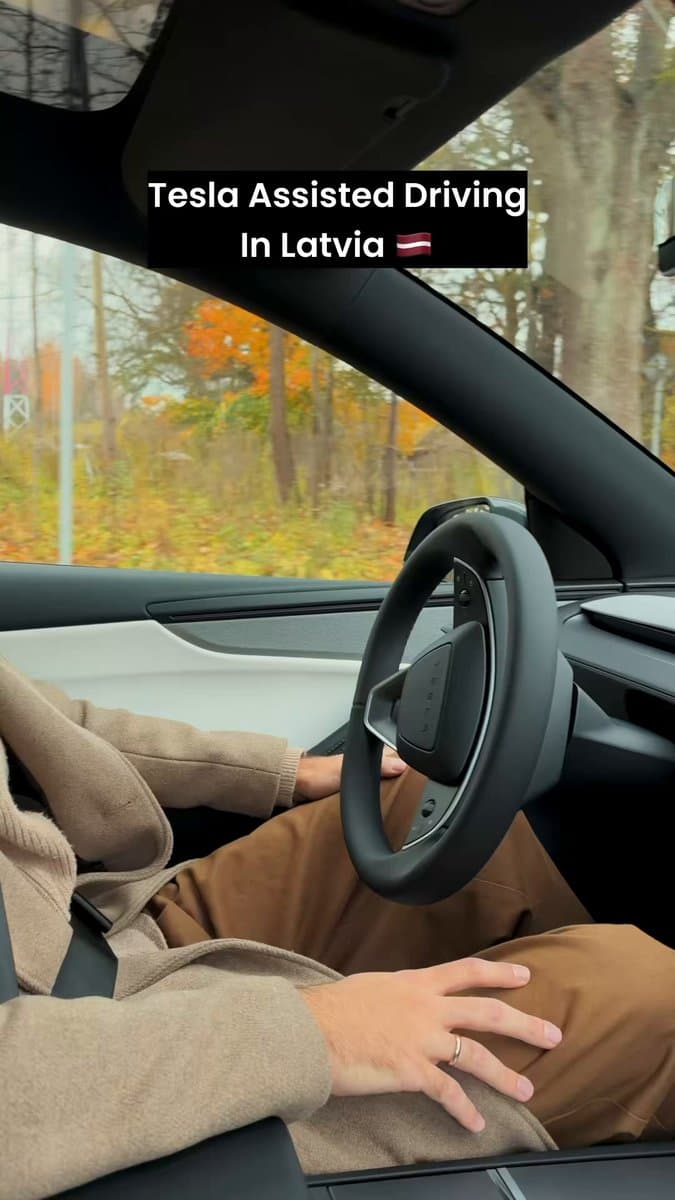
    Tesla invited me to be one of the first people in Latvia to try Tesla Assisted Driving 🇱🇻 That’s the European name for Full Self-Driving (Supervised), or FSD. It’s now approved in Latvia, with a software rollout coming soon to eligible cars. The subscription costs €99/month. I spent about an hour behind the wheel, and honestly, I wasn’t expecting to react this strongly. You just choose your destination on the screen, tap to go, and the car pulls out of its parking space and drives all the way to your destination while you supervise. Having your hands off the wheel while the car changes lanes, turns, brakes, accelerates and yields to pedestrians is such a strange, slightly nerve-racking, but incredibly cool feeling. I kept saying, “This is so cool!” Watching a car handle an entire route on familiar roads here in Latvia felt completely insane. We encountered awkwardly parked cars, a cyclist coming toward us and situations where we needed to give another car room to pass. The Tesla handled all of it. That’s just one drive, but I came away seriously impressed. I love driving. But for those repetitive everyday trips? I can absolutely see myself using this. And you really do have to supervise. You’re still responsible for driving. You need to watch the road and be ready to take over immediately. You can’t scroll through your phone or stop paying attention. Even when I looked at the center screen for too long, I got a gentle reminder to watch the road. Public Tesla Assisted Driving test drives have already started at Tesla’s store in Spice Shopping Center in Riga, so you can book one and experience it yourself. I’ve watched so many videos of FSD working elsewhere. Finally trying it here, on roads I actually know, made it feel much more real. I get the excitement now. This is awesome.

    El software de conducción autónoma supervisada de Tesla supera por fin los obstáculos normativos en Europa, abriendo un gran mercado.

    3783437.7K

Ordenado por interacción. Las publicaciones pertenecen a sus autores en X. Cifras recogidas al preparar esta selección.

The Brief

Mantén la curiosidad

IA y tecnología: qué cambia y por qué importa.
Tu selección diaria, en inglés o español.

Gratis para siempre. Cancela cuando quieras.