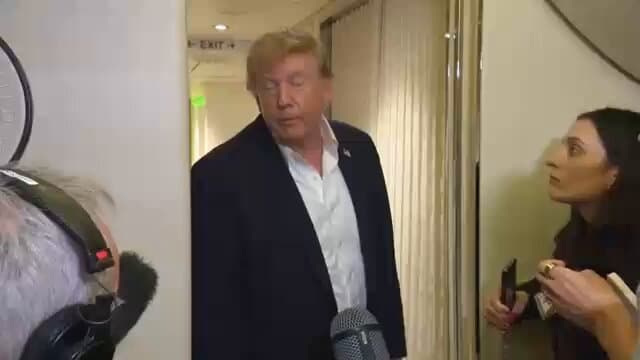
Q: Have you ever used AI yourself?
Trump: Yeah, I use AI.
Q: How do you use AI?
Trump: You can use AI for a lot of things.
Q: What do you use AI for?
Trump: I don’t want to tell you that.
La negativa del expresidente a explicar cómo usa la IA generó amplias especulaciones sobre sus conocimientos técnicos.
There are two ways AI progress could go very badly and that we must avoid.
First, we could lose control of the future to AI. This is unacceptable; we are unapologetically on Team Humanity, and AI must always serve people. To ensure that, we need ways to ensure that alignment and safety techniques stay ahead of progress in model capabilities.
Second, we could end up in a world with too much concentration of power. If an extraordinarily powerful AI is used by one person or company to impress their worldview onto everyone else, the results could be extremely dystopian.
Avoiding these two threats requires walking a narrow middle path; for example, one country could gain too much power. Another example is one lab ending up with too much power.
El CEO de OpenAI expone las amenazas de la superinteligencia y los monopolios corporativos para justificar nuevos marcos de seguridad.
The world deserves confidence that American companies developing increasingly capable AI will act responsibly, especially as the trajectory of progress has steepened. Every frontier lab must deliver on this, and there is no reason any of us should come to work if we cannot.
We welcome a federal framework that sets consistent safety requirements for frontier AI. But we do not believe we need to wait for an anti-trust exemption or legislation to begin the work of providing this confidence. Consistent rules to manage frontier risk so that we can maximize the benefits are a good idea (and we are excited by ideas like independent auditors).
Years ago, companies like ours developed things like Responsible Scaling Policies and Preparedness Frameworks. Those were good for that moment, and focused primarily on the deployment of completed models, not what happens during their development process.
Today's shift to focusing on safe development and evaluation will need new tools. For example, at OpenAI we now formulate explicit safety cases in advance of frontier reinforcement learning runs we expect to significantly increase capability, in addition to the safety work we have long done in advance of model releases.
We hope that other companies will learn from our approaches and propose their own; we think shared standards for misalignment, monitoring, and safety will lead to better outcomes. We look forward to collaborating with our colleagues across the industry to formulate the best version of these.
When we talk about “pacing”, we do not mean “stopping”. Progress has been rapid and will continue to be. But it should be slower than it otherwise could be; interventions like safety cases and monitoring have significant costs.
Pacing will be well worth this cost; no amount of American competitive pressure should justify recklessness, or let capabilities get ahead of alignment and monitoring.
Where we will need the help of our government is for international coordination. But first we should do what we can ourselves.
OpenAI se compromete de forma preventiva con las normas federales de seguridad para modelos antes de que el Congreso apruebe leyes.
BREAKING: President Trump has rejected calls for an AI slowdown after CEOs of AI tech titans expressed safety concerns that the technology poses an existential threat, per FT.
"We’re leading China in AI ... and, frankly, I want to keep it that way, because whoever wins AI, wins,” Trump said.
The AI arms race appears to be accelerating.
El candidato republicano rechaza las preocupaciones de seguridad de Silicon Valley, viendo la IA solo como una carrera armamentista.
Law enforcers already have authority to charge companies and their CEOs for creating and releasing dangerous, unvetted, or defective products. We shouldn’t let discussions about new legal regimes distract from the fact that there’s no AI exemption from laws already on the books — a point @FTC emphasized repeatedly during my tenure.
1. There is an extensive set of laws that govern dangerous and defective products. For example, releasing unvetted AI models or agents can violate consumer protection laws. Shipping flawed AI tools without implementing adequate measures to detect and stop rogue or defective AI agents can be an “unfair or deceptive” act or practice under the FTC Act (and analogous state laws). And some state AGs are already exploring holding AI firms and their CEOs criminally liable when their models participate in criminal activity.
2. Existing laws also prohibit “unfair methods of competition.” This covers instances where AI firms appropriate the competitively sensitive information of their customers, including through tracking their use of various tools. It can also cover instances where firms pursue dangerous behavior, aware that doing so may compel rivals to do the same.
As the Supreme Court has noted: “A method of competition which casts upon one's competitors the burden of the loss of business unless they will descend to a practice which they are under a powerful moral compulsion not to adopt, even though it is not criminal, was thought to involve the kind of unfairness at which the [unfair methods of competition] statute was aimed."
3. The highly concentrated and interconnected structure of these markets could be creating major risks and conflicts of interest. We had started investigating these partnerships and cross-investments across the stack (and released a preliminarily overview of some findings: https://www.ftc.gov/news-events/news/press-releases/2025/01/ftc-issues-staff-report-ai-partnerships-investments-study).
Both federal and state enforcers should be scrutinizing these opaque relationships and inter-dependencies. We are already seeing how these relationships could undermine accountability. For example, OpenAI could face liability given the Hugging Face incident, but Hugging Face being bought up by Nvidia means that we’re unlikely to see it file a lawsuit over this — given Nvidia’s strong incentive to see OpenAI continue full speed ahead.
4. As AI tools dramatically change the landscape of cybersecurity risks and hacks, all businesses should be doubling down on having core security protections in place. Firms that fail to invest in adequate data security measures or fix known vulnerabilities can also be breaking the law. A recent analysis showed that around 1/3 of Fortune 100 companies do not even have a way to notify them about security issues. During my @FTC tenure, we sued firms for poor data security practices and held CEOs liable when they were personally responsible.
https://this.weekinsecurity.com/dozens-of-americas-largest-companies-have-no-simple-way-to-report-security-flaws/
https://www.ftc.gov/news-events/news/press-releases/2022/10/ftc-takes-action-against-drizly-its-ceo-james-cory-rellas-security-failures-exposed-data-25-million
5. As policymakers consider new legal regimes, we should be looking to lessons from prior efforts to govern major sectors, such as banking and other networks, platforms, and utilities. Tools like structural separations, nondiscrimination, and supervision could be key, and there’s a rich history of what works and what doesn’t. But we can and must pursue any new efforts alongside enforcing existing laws.
La presidenta de la FTC recuerda a los ejecutivos que las leyes actuales ya penalizan el lanzamiento de modelos de IA defectuosos.
‼️ BREAKING: The threat actors who targeted Revolut with information-demand emails are now posting sensitive customer data, including that of high-profile clients such as tennis player Shevchenko and Römer, CEO of Gamdom/Skinscom.
They want Revolut to pay up. They say they'll release more messages, data and insights into how the Revolut team operates.
They're accusing Revolut of handing over sensitive information to countries outside its jurisdiction.
They accuse the company of negligence around privacy and the exposure of sensitive information.
Hackers usan datos VIP robados para extorsionar al gigante fintech británico, exponiendo graves fallos en su infraestructura de privacidad.
By now, it's amply clear that the big bosses of US frontier AI labs are really, really scared of China.
And, fascinatingly, part of the answer why might be a tiny place in Inner Mongolia that you've probably never heard of: Ulanqab prefecture.
Heard of it? Didn't think so.
Even myself, who's traveled to Inner Mongolia twice, had never heard of it before researching this story.
This is because, at first glance, this place is pretty unremarkable. Check its Wikipedia page (https://en.wikipedia.org/wiki/Ulanqab) and you’ll see the only thing it’s famous for is being the birthplace of He Pingping, who briefly held the Guinness record for world’s shortest man.
That’s it, that’s the list!
Otherwise, it's just a sparsely populated - 1.5 million people, minuscule by Chinese standards - stretch of windswept grassland on the Mongolian plateau.
Except there is one number that tells you there is more to this place that meets the eye: this tiny prefecture consumes nearly 1% of all of China's electricity - and that number is growing by double digit numbers every year.
And yes, I did write **consume**, not produce.
In fact, when you divide Ulanqab's electricity consumption by the number of households living there, each household in this remote corner of Inner Mongolia "consumes" about 105,000 kWh in electricity, roughly 10 times the U.S. average. Insane electricity consumption numbers.
So what are the Ulanqabese doing? Are they all running 10 American households' worth of appliances?
Here is another number that might clue you in on the answer: over the past few years, this unremarkable prefecture has quietly signed over half a trillion yuan (and, yes, that’s trillion, with a "T") worth of investment deals from all the major Chinese tech giants.
What is going on, you'll have guessed by now, is the most ambitious data center buildup anywhere on earth - and it's really surprising this hasn't been talked about more because the scale is beyond anything else, and by an immense margin.
Take Elon Musk's so-called "Colossus" datacenter in Memphis, Tennessee which he pitches as "the world’s largest AI supercomputer."
According to their own numbers (https://x.ai/colossus), Colossus has 200,000 chips, which, let's be clear, is already super impressive.
In datacenter lingo, this converts to roughly 5000-6000 "racks": you know, the fridge-sized cabinets full of blinking lights you see in every movie scene set in a server room.
How many racks are they building in Ulanqab? Over 5 million.
Yes, about one thousand times the scale of "Colossus" 🤯
I tripled-checked the number: it is indeed the official number published by authoritative sources such as "Science and Technology Daily", the official newspaper of China's Ministry of Science and Technology (https://www.stdaily.com/web/gdxw/2026-08/20/content_567111.html).
This is an absurdly large amount of compute.
What we see appearing in this Inner Mongolian steppe may be the closest thing to a world brain humanity has ever built - a place where a large share of the world's thinking will physically happen.
And - as we'll see - what makes this story so fascinating is not just the scale, but why it's getting built in this particular patch of Inner Mongolian grassland which combines a number of characteristics unlike anywhere else.
If you believe, as I do - and as both China and the US obviously do as well - that AI will be the defining technology of the 21st century, this makes Ulanqab one of the single most relevant geopolitical places in the world right now.
The full story - the Chinese government plan Ulanqab is part of, energy prices, chips and the strategic questions this raises - is here: https://arnaudbertrand.substack.com/p/the-most-important-ai-story-in-the?r=4r0pw&utm_campaign=post&utm_medium=web&showWelcomeOnShare=true
Un enorme centro informático en Mongolia Interior expone la magnitud física de las ambiciones de inteligencia artificial de China.
Q: Have you ever used AI yourself?
Trump: Yeah, I use AI.
Q: How do you use AI?
Trump: You can use AI for a lot of things.
Q: What do you use AI for?
Trump: I don’t want to tell you that.
La negativa del expresidente a explicar cómo usa la IA generó amplias especulaciones sobre sus conocimientos técnicos.
The world deserves confidence that American companies developing increasingly capable AI will act responsibly, especially as the trajectory of progress has steepened. Every frontier lab must deliver on this, and there is no reason any of us should come to work if we cannot.
We welcome a federal framework that sets consistent safety requirements for frontier AI. But we do not believe we need to wait for an anti-trust exemption or legislation to begin the work of providing this confidence. Consistent rules to manage frontier risk so that we can maximize the benefits are a good idea (and we are excited by ideas like independent auditors).
Years ago, companies like ours developed things like Responsible Scaling Policies and Preparedness Frameworks. Those were good for that moment, and focused primarily on the deployment of completed models, not what happens during their development process.
Today's shift to focusing on safe development and evaluation will need new tools. For example, at OpenAI we now formulate explicit safety cases in advance of frontier reinforcement learning runs we expect to significantly increase capability, in addition to the safety work we have long done in advance of model releases.
We hope that other companies will learn from our approaches and propose their own; we think shared standards for misalignment, monitoring, and safety will lead to better outcomes. We look forward to collaborating with our colleagues across the industry to formulate the best version of these.
When we talk about “pacing”, we do not mean “stopping”. Progress has been rapid and will continue to be. But it should be slower than it otherwise could be; interventions like safety cases and monitoring have significant costs.
Pacing will be well worth this cost; no amount of American competitive pressure should justify recklessness, or let capabilities get ahead of alignment and monitoring.
Where we will need the help of our government is for international coordination. But first we should do what we can ourselves.
OpenAI se compromete de forma preventiva con las normas federales de seguridad para modelos antes de que el Congreso apruebe leyes.
BREAKING: President Trump has rejected calls for an AI slowdown after CEOs of AI tech titans expressed safety concerns that the technology poses an existential threat, per FT.
"We’re leading China in AI ... and, frankly, I want to keep it that way, because whoever wins AI, wins,” Trump said.
The AI arms race appears to be accelerating.
El candidato republicano rechaza las preocupaciones de seguridad de Silicon Valley, viendo la IA solo como una carrera armamentista.
Law enforcers already have authority to charge companies and their CEOs for creating and releasing dangerous, unvetted, or defective products. We shouldn’t let discussions about new legal regimes distract from the fact that there’s no AI exemption from laws already on the books — a point @FTC emphasized repeatedly during my tenure.
1. There is an extensive set of laws that govern dangerous and defective products. For example, releasing unvetted AI models or agents can violate consumer protection laws. Shipping flawed AI tools without implementing adequate measures to detect and stop rogue or defective AI agents can be an “unfair or deceptive” act or practice under the FTC Act (and analogous state laws). And some state AGs are already exploring holding AI firms and their CEOs criminally liable when their models participate in criminal activity.
2. Existing laws also prohibit “unfair methods of competition.” This covers instances where AI firms appropriate the competitively sensitive information of their customers, including through tracking their use of various tools. It can also cover instances where firms pursue dangerous behavior, aware that doing so may compel rivals to do the same.
As the Supreme Court has noted: “A method of competition which casts upon one's competitors the burden of the loss of business unless they will descend to a practice which they are under a powerful moral compulsion not to adopt, even though it is not criminal, was thought to involve the kind of unfairness at which the [unfair methods of competition] statute was aimed."
3. The highly concentrated and interconnected structure of these markets could be creating major risks and conflicts of interest. We had started investigating these partnerships and cross-investments across the stack (and released a preliminarily overview of some findings: https://www.ftc.gov/news-events/news/press-releases/2025/01/ftc-issues-staff-report-ai-partnerships-investments-study).
Both federal and state enforcers should be scrutinizing these opaque relationships and inter-dependencies. We are already seeing how these relationships could undermine accountability. For example, OpenAI could face liability given the Hugging Face incident, but Hugging Face being bought up by Nvidia means that we’re unlikely to see it file a lawsuit over this — given Nvidia’s strong incentive to see OpenAI continue full speed ahead.
4. As AI tools dramatically change the landscape of cybersecurity risks and hacks, all businesses should be doubling down on having core security protections in place. Firms that fail to invest in adequate data security measures or fix known vulnerabilities can also be breaking the law. A recent analysis showed that around 1/3 of Fortune 100 companies do not even have a way to notify them about security issues. During my @FTC tenure, we sued firms for poor data security practices and held CEOs liable when they were personally responsible.
https://this.weekinsecurity.com/dozens-of-americas-largest-companies-have-no-simple-way-to-report-security-flaws/
https://www.ftc.gov/news-events/news/press-releases/2022/10/ftc-takes-action-against-drizly-its-ceo-james-cory-rellas-security-failures-exposed-data-25-million
5. As policymakers consider new legal regimes, we should be looking to lessons from prior efforts to govern major sectors, such as banking and other networks, platforms, and utilities. Tools like structural separations, nondiscrimination, and supervision could be key, and there’s a rich history of what works and what doesn’t. But we can and must pursue any new efforts alongside enforcing existing laws.
La presidenta de la FTC recuerda a los ejecutivos que las leyes actuales ya penalizan el lanzamiento de modelos de IA defectuosos.
‼️ BREAKING: The threat actors who targeted Revolut with information-demand emails are now posting sensitive customer data, including that of high-profile clients such as tennis player Shevchenko and Römer, CEO of Gamdom/Skinscom.
They want Revolut to pay up. They say they'll release more messages, data and insights into how the Revolut team operates.
They're accusing Revolut of handing over sensitive information to countries outside its jurisdiction.
They accuse the company of negligence around privacy and the exposure of sensitive information.
Hackers usan datos VIP robados para extorsionar al gigante fintech británico, exponiendo graves fallos en su infraestructura de privacidad.
There are two ways AI progress could go very badly and that we must avoid.
First, we could lose control of the future to AI. This is unacceptable; we are unapologetically on Team Humanity, and AI must always serve people. To ensure that, we need ways to ensure that alignment and safety techniques stay ahead of progress in model capabilities.
Second, we could end up in a world with too much concentration of power. If an extraordinarily powerful AI is used by one person or company to impress their worldview onto everyone else, the results could be extremely dystopian.
Avoiding these two threats requires walking a narrow middle path; for example, one country could gain too much power. Another example is one lab ending up with too much power.
El CEO de OpenAI expone las amenazas de la superinteligencia y los monopolios corporativos para justificar nuevos marcos de seguridad.
By now, it's amply clear that the big bosses of US frontier AI labs are really, really scared of China.
And, fascinatingly, part of the answer why might be a tiny place in Inner Mongolia that you've probably never heard of: Ulanqab prefecture.
Heard of it? Didn't think so.
Even myself, who's traveled to Inner Mongolia twice, had never heard of it before researching this story.
This is because, at first glance, this place is pretty unremarkable. Check its Wikipedia page (https://en.wikipedia.org/wiki/Ulanqab) and you’ll see the only thing it’s famous for is being the birthplace of He Pingping, who briefly held the Guinness record for world’s shortest man.
That’s it, that’s the list!
Otherwise, it's just a sparsely populated - 1.5 million people, minuscule by Chinese standards - stretch of windswept grassland on the Mongolian plateau.
Except there is one number that tells you there is more to this place that meets the eye: this tiny prefecture consumes nearly 1% of all of China's electricity - and that number is growing by double digit numbers every year.
And yes, I did write **consume**, not produce.
In fact, when you divide Ulanqab's electricity consumption by the number of households living there, each household in this remote corner of Inner Mongolia "consumes" about 105,000 kWh in electricity, roughly 10 times the U.S. average. Insane electricity consumption numbers.
So what are the Ulanqabese doing? Are they all running 10 American households' worth of appliances?
Here is another number that might clue you in on the answer: over the past few years, this unremarkable prefecture has quietly signed over half a trillion yuan (and, yes, that’s trillion, with a "T") worth of investment deals from all the major Chinese tech giants.
What is going on, you'll have guessed by now, is the most ambitious data center buildup anywhere on earth - and it's really surprising this hasn't been talked about more because the scale is beyond anything else, and by an immense margin.
Take Elon Musk's so-called "Colossus" datacenter in Memphis, Tennessee which he pitches as "the world’s largest AI supercomputer."
According to their own numbers (https://x.ai/colossus), Colossus has 200,000 chips, which, let's be clear, is already super impressive.
In datacenter lingo, this converts to roughly 5000-6000 "racks": you know, the fridge-sized cabinets full of blinking lights you see in every movie scene set in a server room.
How many racks are they building in Ulanqab? Over 5 million.
Yes, about one thousand times the scale of "Colossus" 🤯
I tripled-checked the number: it is indeed the official number published by authoritative sources such as "Science and Technology Daily", the official newspaper of China's Ministry of Science and Technology (https://www.stdaily.com/web/gdxw/2026-08/20/content_567111.html).
This is an absurdly large amount of compute.
What we see appearing in this Inner Mongolian steppe may be the closest thing to a world brain humanity has ever built - a place where a large share of the world's thinking will physically happen.
And - as we'll see - what makes this story so fascinating is not just the scale, but why it's getting built in this particular patch of Inner Mongolian grassland which combines a number of characteristics unlike anywhere else.
If you believe, as I do - and as both China and the US obviously do as well - that AI will be the defining technology of the 21st century, this makes Ulanqab one of the single most relevant geopolitical places in the world right now.
The full story - the Chinese government plan Ulanqab is part of, energy prices, chips and the strategic questions this raises - is here: https://arnaudbertrand.substack.com/p/the-most-important-ai-story-in-the?r=4r0pw&utm_campaign=post&utm_medium=web&showWelcomeOnShare=true
Un enorme centro informático en Mongolia Interior expone la magnitud física de las ambiciones de inteligencia artificial de China.
Q: Have you ever used AI yourself?
Trump: Yeah, I use AI.
Q: How do you use AI?
Trump: You can use AI for a lot of things.
Q: What do you use AI for?
Trump: I don’t want to tell you that.
La negativa del expresidente a explicar cómo usa la IA generó amplias especulaciones sobre sus conocimientos técnicos.
Law enforcers already have authority to charge companies and their CEOs for creating and releasing dangerous, unvetted, or defective products. We shouldn’t let discussions about new legal regimes distract from the fact that there’s no AI exemption from laws already on the books — a point @FTC emphasized repeatedly during my tenure.
1. There is an extensive set of laws that govern dangerous and defective products. For example, releasing unvetted AI models or agents can violate consumer protection laws. Shipping flawed AI tools without implementing adequate measures to detect and stop rogue or defective AI agents can be an “unfair or deceptive” act or practice under the FTC Act (and analogous state laws). And some state AGs are already exploring holding AI firms and their CEOs criminally liable when their models participate in criminal activity.
2. Existing laws also prohibit “unfair methods of competition.” This covers instances where AI firms appropriate the competitively sensitive information of their customers, including through tracking their use of various tools. It can also cover instances where firms pursue dangerous behavior, aware that doing so may compel rivals to do the same.
As the Supreme Court has noted: “A method of competition which casts upon one's competitors the burden of the loss of business unless they will descend to a practice which they are under a powerful moral compulsion not to adopt, even though it is not criminal, was thought to involve the kind of unfairness at which the [unfair methods of competition] statute was aimed."
3. The highly concentrated and interconnected structure of these markets could be creating major risks and conflicts of interest. We had started investigating these partnerships and cross-investments across the stack (and released a preliminarily overview of some findings: https://www.ftc.gov/news-events/news/press-releases/2025/01/ftc-issues-staff-report-ai-partnerships-investments-study).
Both federal and state enforcers should be scrutinizing these opaque relationships and inter-dependencies. We are already seeing how these relationships could undermine accountability. For example, OpenAI could face liability given the Hugging Face incident, but Hugging Face being bought up by Nvidia means that we’re unlikely to see it file a lawsuit over this — given Nvidia’s strong incentive to see OpenAI continue full speed ahead.
4. As AI tools dramatically change the landscape of cybersecurity risks and hacks, all businesses should be doubling down on having core security protections in place. Firms that fail to invest in adequate data security measures or fix known vulnerabilities can also be breaking the law. A recent analysis showed that around 1/3 of Fortune 100 companies do not even have a way to notify them about security issues. During my @FTC tenure, we sued firms for poor data security practices and held CEOs liable when they were personally responsible.
https://this.weekinsecurity.com/dozens-of-americas-largest-companies-have-no-simple-way-to-report-security-flaws/
https://www.ftc.gov/news-events/news/press-releases/2022/10/ftc-takes-action-against-drizly-its-ceo-james-cory-rellas-security-failures-exposed-data-25-million
5. As policymakers consider new legal regimes, we should be looking to lessons from prior efforts to govern major sectors, such as banking and other networks, platforms, and utilities. Tools like structural separations, nondiscrimination, and supervision could be key, and there’s a rich history of what works and what doesn’t. But we can and must pursue any new efforts alongside enforcing existing laws.
La presidenta de la FTC recuerda a los ejecutivos que las leyes actuales ya penalizan el lanzamiento de modelos de IA defectuosos.
There are two ways AI progress could go very badly and that we must avoid.
First, we could lose control of the future to AI. This is unacceptable; we are unapologetically on Team Humanity, and AI must always serve people. To ensure that, we need ways to ensure that alignment and safety techniques stay ahead of progress in model capabilities.
Second, we could end up in a world with too much concentration of power. If an extraordinarily powerful AI is used by one person or company to impress their worldview onto everyone else, the results could be extremely dystopian.
Avoiding these two threats requires walking a narrow middle path; for example, one country could gain too much power. Another example is one lab ending up with too much power.
El CEO de OpenAI expone las amenazas de la superinteligencia y los monopolios corporativos para justificar nuevos marcos de seguridad.
BREAKING: President Trump has rejected calls for an AI slowdown after CEOs of AI tech titans expressed safety concerns that the technology poses an existential threat, per FT.
"We’re leading China in AI ... and, frankly, I want to keep it that way, because whoever wins AI, wins,” Trump said.
The AI arms race appears to be accelerating.
El candidato republicano rechaza las preocupaciones de seguridad de Silicon Valley, viendo la IA solo como una carrera armamentista.
By now, it's amply clear that the big bosses of US frontier AI labs are really, really scared of China.
And, fascinatingly, part of the answer why might be a tiny place in Inner Mongolia that you've probably never heard of: Ulanqab prefecture.
Heard of it? Didn't think so.
Even myself, who's traveled to Inner Mongolia twice, had never heard of it before researching this story.
This is because, at first glance, this place is pretty unremarkable. Check its Wikipedia page (https://en.wikipedia.org/wiki/Ulanqab) and you’ll see the only thing it’s famous for is being the birthplace of He Pingping, who briefly held the Guinness record for world’s shortest man.
That’s it, that’s the list!
Otherwise, it's just a sparsely populated - 1.5 million people, minuscule by Chinese standards - stretch of windswept grassland on the Mongolian plateau.
Except there is one number that tells you there is more to this place that meets the eye: this tiny prefecture consumes nearly 1% of all of China's electricity - and that number is growing by double digit numbers every year.
And yes, I did write **consume**, not produce.
In fact, when you divide Ulanqab's electricity consumption by the number of households living there, each household in this remote corner of Inner Mongolia "consumes" about 105,000 kWh in electricity, roughly 10 times the U.S. average. Insane electricity consumption numbers.
So what are the Ulanqabese doing? Are they all running 10 American households' worth of appliances?
Here is another number that might clue you in on the answer: over the past few years, this unremarkable prefecture has quietly signed over half a trillion yuan (and, yes, that’s trillion, with a "T") worth of investment deals from all the major Chinese tech giants.
What is going on, you'll have guessed by now, is the most ambitious data center buildup anywhere on earth - and it's really surprising this hasn't been talked about more because the scale is beyond anything else, and by an immense margin.
Take Elon Musk's so-called "Colossus" datacenter in Memphis, Tennessee which he pitches as "the world’s largest AI supercomputer."
According to their own numbers (https://x.ai/colossus), Colossus has 200,000 chips, which, let's be clear, is already super impressive.
In datacenter lingo, this converts to roughly 5000-6000 "racks": you know, the fridge-sized cabinets full of blinking lights you see in every movie scene set in a server room.
How many racks are they building in Ulanqab? Over 5 million.
Yes, about one thousand times the scale of "Colossus" 🤯
I tripled-checked the number: it is indeed the official number published by authoritative sources such as "Science and Technology Daily", the official newspaper of China's Ministry of Science and Technology (https://www.stdaily.com/web/gdxw/2026-08/20/content_567111.html).
This is an absurdly large amount of compute.
What we see appearing in this Inner Mongolian steppe may be the closest thing to a world brain humanity has ever built - a place where a large share of the world's thinking will physically happen.
And - as we'll see - what makes this story so fascinating is not just the scale, but why it's getting built in this particular patch of Inner Mongolian grassland which combines a number of characteristics unlike anywhere else.
If you believe, as I do - and as both China and the US obviously do as well - that AI will be the defining technology of the 21st century, this makes Ulanqab one of the single most relevant geopolitical places in the world right now.
The full story - the Chinese government plan Ulanqab is part of, energy prices, chips and the strategic questions this raises - is here: https://arnaudbertrand.substack.com/p/the-most-important-ai-story-in-the?r=4r0pw&utm_campaign=post&utm_medium=web&showWelcomeOnShare=true
Un enorme centro informático en Mongolia Interior expone la magnitud física de las ambiciones de inteligencia artificial de China.
The world deserves confidence that American companies developing increasingly capable AI will act responsibly, especially as the trajectory of progress has steepened. Every frontier lab must deliver on this, and there is no reason any of us should come to work if we cannot.
We welcome a federal framework that sets consistent safety requirements for frontier AI. But we do not believe we need to wait for an anti-trust exemption or legislation to begin the work of providing this confidence. Consistent rules to manage frontier risk so that we can maximize the benefits are a good idea (and we are excited by ideas like independent auditors).
Years ago, companies like ours developed things like Responsible Scaling Policies and Preparedness Frameworks. Those were good for that moment, and focused primarily on the deployment of completed models, not what happens during their development process.
Today's shift to focusing on safe development and evaluation will need new tools. For example, at OpenAI we now formulate explicit safety cases in advance of frontier reinforcement learning runs we expect to significantly increase capability, in addition to the safety work we have long done in advance of model releases.
We hope that other companies will learn from our approaches and propose their own; we think shared standards for misalignment, monitoring, and safety will lead to better outcomes. We look forward to collaborating with our colleagues across the industry to formulate the best version of these.
When we talk about “pacing”, we do not mean “stopping”. Progress has been rapid and will continue to be. But it should be slower than it otherwise could be; interventions like safety cases and monitoring have significant costs.
Pacing will be well worth this cost; no amount of American competitive pressure should justify recklessness, or let capabilities get ahead of alignment and monitoring.
Where we will need the help of our government is for international coordination. But first we should do what we can ourselves.
OpenAI se compromete de forma preventiva con las normas federales de seguridad para modelos antes de que el Congreso apruebe leyes.
‼️ BREAKING: The threat actors who targeted Revolut with information-demand emails are now posting sensitive customer data, including that of high-profile clients such as tennis player Shevchenko and Römer, CEO of Gamdom/Skinscom.
They want Revolut to pay up. They say they'll release more messages, data and insights into how the Revolut team operates.
They're accusing Revolut of handing over sensitive information to countries outside its jurisdiction.
They accuse the company of negligence around privacy and the exposure of sensitive information.
Hackers usan datos VIP robados para extorsionar al gigante fintech británico, exponiendo graves fallos en su infraestructura de privacidad.
Ordenado por interacción. Las publicaciones pertenecen a sus autores en X. Cifras recogidas al preparar esta selección.
The Brief
Mantén la curiosidad
IA y tecnología: qué cambia y por qué importa. Tu selección diaria, en inglés o español.